Bible · Church · community

The Gathered People Of God

I’ve been wondering what you might call a community of followers of Jesus if you didn’t want to use the word church.

In my daily prayers, I’m reading the book that I know as Ecclesiastes – part of the wisdom literature of the First Testament.
In Hebrew, the title of book is ‘Qoheleth’, which is usually translated as The Preacher. A reasonable name for a book of wisdom you might say.

But – the root of the word Qoheleth is the verb qhl, which means ‘to gather,’ and a more accurate description of the title of the book would be ‘The One who gathers people together.’ (In the presence of God). And our name for the book – Ecclesiastes, also means a person who gathers people together.

In the New Testament, the word that is translated as church (ekklesia) should more accurately be translated as gathering. The word church is now so much about a building, when what we are talking about is a community, and I’d like to think that we could get back to the original sense of ‘church’ as the gathered people of God.

Grace and Peace

Church · Song for Today · World Affairs

Beige, Purple, Red, Blue, Orange …

First, a disclaimer … this is not mine, nor is it Rob Bell’s but comes from academic scholarship. Rob Bell has presented it for a wider audience, and it’s very interesting. Me, We, Everybody, Part 2

I tried to outline some of what this was about in an earlier post, so I’m just going to take off from there. It’s all about human development. The first episode was about the micro, or personal aspects of human development. This episode is about human development through history.

And another disclaimer. This is just a broad outline. It’s not meant to give a precise blueprint, but I can see that it is a helpful way of understanding human development.

The first three are firmly ‘Me’ – based on the individual and their needs.

So – first – a period of time when survival was the main thing. Kill or be killed. Make sure that you have the basic essential of life. Food, water, shelter, etc. This is firmly focussed on the individual. Rob Bell assigns colours to each stage and this one is Beige.
In Beige, who holds the power ? I do

Second. This is all to do with pleasing the gods. Survival depends on food, and humans notice that crops need two things – sunshine and water. So we pray to the rain and the sun gods, and if the crops fail, we look for ways to ask the gods to help us. Rituals and sacrifice become ways that we use to pray to the gods. This period is magic, and the colour is Purple.
In Purple, who holds the power ? The Priest/Shaman

Third. This is to do with following a leader. As communities form, so strong leaders emerge – people who have power, or wealth, and charisma. People who are able to influence others to obey them. This period is Red.
In Red, who holds the power ? The King.

Now we move to ‘We’ – where the tribe becomes important.

So – Fourth. Sometimes leaders pass on their mantle to others in the family – usually sons. Dynasties rule over communities, but at some point the power of the individual is replaced by traditions that have gathered force over time. This is where community comes in, and we live our lives more in accordance with values and practices that have emerged over time, rather than blind obedience to a leader. This period is Blue.
In Blue, who holds the power ? The Rules

A third move to ‘Everybody’ starts from this point

The Fifth period is about beginning to look outside your community and discover that other people follow different traditions and ways of living. Scientific discovery opens our eyes to new ways of seeing, and some of humanity’s basic assumptions are questioned. (The earth is no longer the centre of the universe). So, for example, in the 16th century and beyond, this is a period when in Western Europe, we start to see democracy as an alternative way of deciding who our leaders are. It’s also the time of the Reformation, when there is a great religious upheaval in the Western Christian Church.
This period is Orange
In Orange – who holds the power ? Science.

The Sixth period after Orange is Green. This is not so much about scientific discovery changing things (although that is a major influence), but about seeing the value of different points of view. In other words – pluralism. It’s no longer about what is the right way to live, but about accepting and valuing a range of different lifestyles. The 1960’s would probably be the time when this exploded, with for example, Human Rights, the Civil Rights Movement, Feminism, The Anti-War movement, Nuclear Disarmament, Animal Rights etc. One of the characteristics of this period is the belief that every way of seeing the world has equal value – no one way is better than the others. Every story must be listened to. There is a celebration of diversity. A feature of this Green period is difficulty in moving forward, and making a decision, because no one wants to say that their way is better. Every ‘truth’ is equal. However, claiming that there is no higher level truth is a contradiction, as that in itself is making an absolute truth claim, At its extreme, Green sees any view that is held with conviction, and which they see as unhealthy, as a form of violence.

In Green who holds the power ? No-One / Everyone

The next period is Yellow, where there is an acceptance that all of the above have their place and their value. In Yellow, there is an attempt to integrate all of the other colours. So whilst the Purple ‘Magical’ period might have been discarded by the other colours so far, Yellow is keen to hold a sense of mystery that comes with the Purple era.
In Yellow, who holds the power ? I Do, kind of …

The originators of this theory, called Spiral Dynamics, suggest that a society is ready to move from one stage to another when 10% of the population are moving, and that each society has a ‘centre of gravity colour’ that describes the dominant culture. They suggest that there are other phases yet to be realised ….

I’m now asking how this might work in a church setting. For example, what might a church that is operating largely in Red look like ?

So this is me, just wondering …

Beige – A church where it would be every one for themselves. I can’t quite picture what this would look like ..

Purple – One of the characteristics of this type of Christian/Church would be asking, in the face of adversity, ‘what have we done to deserve this ?’ Working harder and praying harder to please God. God is seen as rewarding or punishing us according to what we have done.

Red – Over reliance on the leader. Unquestioning obedience, as in cults, and over authoritarian leadership.

Blue – Following the norms and traditions of your denomination, congregation. Not being open to other ways of doing things. Believing that your way is the right way. Superiority when you compare your church to other churches.

Orange – Looking outside the tradition to explore other ways of doing things. Learning new things from other traditions, and leaving behind what has been unhelpful from your tradition – eg male only leadership.

Green – Valuing all the different expressions of church equally.

Yellow – Integrating the different colours – so seeing the value of leadership, tradition etc as well as diversity.

Question. If you are a member of any faith community, Christian or otherwise, can you see any of the above in your experience …

A final thought – individuals, communities and nations all experience aspects of most of the colours. It’s not like we move from one colour to the next. But it is a journey of discovery seeing the importance of each of the ‘colours.’ I was listening to a song earlier today, and it seemed to say something about this journey of life through sometimes troubled waters, but always inviting us to sail on …

Sail on Sailor

I sailed an ocean, unsettled ocean
Through restful waters and deep commotion
Often frightened, unenlightened
Sail on, sail on sailor

I wrest the waters, fight Neptune’s waters
Sail through the sorrows of life’s marauders
Unrepenting, often empty
Sail on, sail on sailor

Caught like a sewer rat alone but I sail
Bought like a crust of bread, but oh do I wail

Seldom stumble, never crumble
Try to tumble, life’s a rumble
Feel the stinging, I’ve been given
Never ending, unrelenting
Heartbreak searing, always fearing
Never caring, persevering
Sail on, sail on, sailor

I work the seaways, the gale-swept seaways
Past shipwrecked daughters of wicked waters
Uninspired, drenched and tired
Wail on, wail on, sailor

Always needing, even bleeding
Never feeding all my feelings
Damn the thunder, must I blunder
There’s no wonder all I’m under
Stop the crying and the lying
And the sighing and my dying

Sail on, sail on sailor

I still have to listen to the next part of ‘Me, We, Everybody,’ and I’ll maybe add another post then.

Grace and Peace

Activism · Bible · Church · faith · Following Jesus · Political

The River Runs Down Hill

Water is a prominent theme in both the First Testament, and the Second. I was listening earlier this week to a talk by Ched Myers, speaking about both the ecological and the theological significance of water.
Listen here. Roll Like A River

There’s a lot to digest there, but I’ll just refer to sonmething he said at the end. He’s made the point earlier that in his context in Southern California, the river Ventura that once flowed all year round is now seasonal. This is largely because the water is taken off by residential needs and industry futher up stream.
That has all sorts of ecological consequences to the environment, as well as affecting those who live down stream.

The situation is not unlike the Jordan Valley, where many people, (Palestinians in particular) have to contend with water shortages, as well as the land itself being impoverished.

Already, we are seeing water as a commodity being fought over, and who wins ? The rich. We are familiar with wars over other resources like oil, but we are now realising that the main building block of life – water – is getting scarcer in many areas, and a cause of conflict.

In Southern California and the Jordan Valley, it is the environment and the people downstream that are affected.

Ched Myers draws a parallel between the ecological and economic issues here, and the way that water is spoken of in scripture.

There are many passages that speak of the life giving properties of water – coupled with water as an image of our spiritual lives. In Psalm 1 water is a symbol of God’s way of living.

Happy are those whose delight is in the law of the Lord, and on his law they meditate day and night. They are like trees planted by streams of water, which yield their fruit in its season, and their leaves do not wither. In all that they do, they prosper. (Psalm 1 verses 1-3)

In John’s Gospel we hear Jesus say these words:
Those who drink of the water that I will give them will never be thirsty. The water that I will give will become in them a spring of water gushing up to eternal life.” John Chapter 4 verse 14

It’s clear that water is not only essential for our very material lives, but is also a kind of code for what we might call abundant life, where there are no winners and losers, but where everyone has their needs fully met.

The Prophet Amos says this:
I hate, I despise your festivals, and I take no delight in your solemn assemblies.
Even though you offer me your burnt offerings and grain offerings,  I will not accept them;
and the offerings of well-being of your fatted animals I will not look upon.
Take away from me the noise of your songs; I will not listen to the melody of your harps.
But let justice roll down like waters, and righteousness like an ever-flowing stream. Amos Chapter 5 verses 21-24

Water flows down hill … but by the time it reaches the communities where Ched Myers lives, or the Palestinian People in the Jordan Valley, there is not enough left for everyone.

In my last-but-one post, I said that the Christian life is about ‘Gift and Task.’ This post is definitely about ‘Task’. The task of every one of us to seek justice for those who are furthest away from the source of blessing. Those who are on the margins where the resources do not reach, as well as the land that is impoverished by lack of water.

Grace and Peace.

Church · community · Following Jesus · music · Song for Today

Song For Today #25

We had a reading in Church today from the first letter of John that included these words …
This is how we know that we love the children of God: by loving God and carrying out his commands. 3 In fact, this is love for God: to keep his commands. And his commands are not burdensome ….
1 John Chapter 5 verse 2

And the Gospel reading was from John’s Gospel and included these words of Jesus:
This is my commandment, that you love (and unselfishly seek the best for) one another, just as I have loved you.
John Chapter 15 verse 12 (Amplified Bible)

Mike, the preacher today, introduced the Gospel reading by showing us that the first section of John 15 (that we had last week), is about the believer’s relationship to God, the second section today is about the believer’s relationship to others in the faith community, and the third section will be about the believer’s relationship to the world.

The phrase in the reading from John’s letter tells us that what God requires of us as we relate to one another is not burdensome. Straightaway my mind locked on to the word burden. Caring for one another in the community of faith is not a burden, because they are my brothers and sisters in Christ. There’s a pretty straight line from there to the song for today:
He ain’t heavy, he’s my brother

The road is long, with many a winding turn
That lead us to (who knows) where, who knows where?
But I’m strong, strong enough to carry him – yeah
He ain’t heavy – he’s my brother

So on we go, his welfare is my concern
no burden is he to bear, we’ll get there
For I know he would not encumber me
He ain’t heavy – he’s my brother

If I’m leaving at all, if I’m leaving with sadness
that everyone’s heart isn’t filled with the gladness
of love for one another.

It’s a long, long road, from which there is no return
While we’re on the way to there, why not share?
And the load doesn’t weigh me down at all
He ain’t heavy – he’s my brother

Words and Music: Bobby Scott and Bob Russell.
Recorded by the Hollies in 1969. A classic!

Carry each other’s burdens, and in this way you will fulfill the law of Christ.

Grace and Peace

Church · community · faith · Jesus · Worship

He Is Risen Indeed, Alleluia!

It’s Easter Day. For me the most important day in the Christian Year. It’s a declaration that God is unwilling to take our ‘no’ for an answer. With Jesus, it is always yes. An unconditional ‘yes’ to be with us.

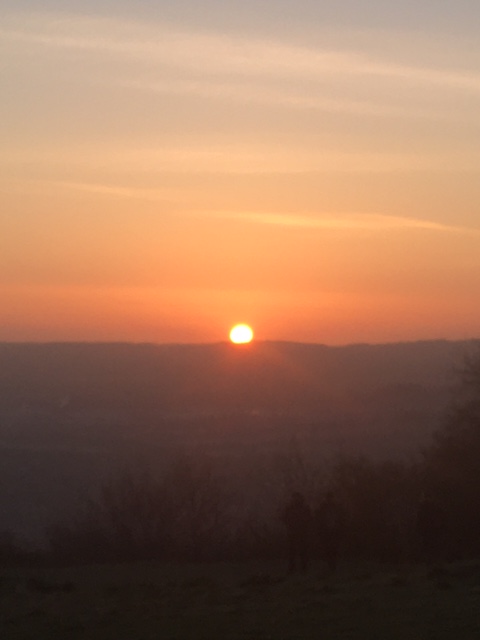
This morning we met with some friends and their two young children to walk up Robinswood Hill. The hill is just a mile or so from where we live, and from the top you gt a 360 degree view taking in the city of Gloucester and the surrounding countryside.

We had decided to get to the top in time for sunrise just after 6.30. We met in the car park, with the darkness already beginning to fade as the pre-dawn light became stronger.

It’s a 200 metre climb – quite a task for Steve with a two year old on his back, and pretty challenging for their five year old. But we made it in time for the sunrise, and got ready for a short act of worship for Easter Day. Another friend joined us at the last minute. He phoned us from the car park, 200 metres below us.
‘Where are you ?’
‘We’re at the top. We’ll see you in about 15 minutes’

So finally, we were all there, and shared a communion of croissants and hot chocolate, with a song and some prayers, and the familar Easter shout:
Alleluia, Christ is risen
He is risen indeed, Alleluia.
Praise the God and Father of our Lord Jesus Christ
He has given us new life and hope by raising Jesus from the dead
Alleluia, Christ is risen
He is risen indeed, Alleluia.

As we started to sing ‘Thine be the Glory’ at the end of our short service, a couple who had just got to the top of the hill came and joined us. I don’t know what the dog walker and the few others who were there for the sunrise thought, but we gave it our best as we sang that great Easter hymn.

Over the last 35 years or so, we’ve nearly always done something similar. From a hill in North Yorkshire, to a nature reserve in Hertfordshire, via Beverley in East Yorkshire, where one year we had snow! There’s something very special about celebrating the resurrection as the sun comes up.


When we got home, I came across this song in one of my prayer books. It seemed to echo our early morning gathering, and sums up for me a lot of what our faith is all about. Here’s a translation below and a link to the song here

“Vamos todos al banquete “

Let us go now to the banquet, to the feast of the universe —
the table’s set and a place is waiting.

I will rise in the early morning; the community’s waiting for me.
With a spring in my step I’m walking with my friends and my family.

God invites all the poor and hungry to the banquet of justice and good —
where the harvest will not be hoarded so that no one will lack for food.

May we build a place among us where all people are equal in love —
For God has called us to work together and to share everything we have.

translated version of “Vamos Todos Al Banquete” written by Guillermo Cuéllar
and commissioned by Msgr. Oscar Romero for the Misa Popular Salvadoreña


Church · community · faith · Following Jesus · Theology · Worship

Re-Imagining Eucharist

OK, so this is two words. Having five word titles is a challenge I set myself, as well as being a web address (fiveshortwords.com) that was available! I think it’s time to allow myself to break the rule if I need to. Plus, as this is a post about rule-breaking, it seems appropriate.

So to Eucharist. The central act of weekly worship in many Christian churches. Eucharist was not a word I was familiar with when I was growing up. For the Christian community of my childhood it was known as The Lord’s Supper. Also known as Breaking of Bread. In other traditions it’s known as Communion, Mass and Eucharist. I’m using Eucharist here because it seems to be the word that is most used these days in a lot of Church of England circles. It’s the act of worship where we remember Jesus’ Last Supper, and his command to remember him by eating bread and drinking wine, just as they would have done at that meal.

In another post, I have written about the ‘High Hedge’ that separates those who are ‘in’, with those who are ‘out,’ in some churches. The highest hedge would mean someone had to be baptised, and confirmed in order to receive the bread and the wine.

None of the words that are used to describe this central act of worship suggest this high hedge. The Lord’s Supper suggests a meal, as does The Breaking of Bread. Communion suggests fellowship and intimacy. The word Mass (from the Latin Mittere, to send) is to do with being sent to be the God’s People For God’s World. Eucharist is from the Greek word meaning thanksgiving.

Maybe if we were being honest we should rename this family meal as Phractis – Greek for hedge. The word phractis itself sounds like fraction, which is when something is split into parts – in the case of Eucharist, those who receive and those who don’t.

A few years ago I heard Sarah Miles tell her story of coming to faith in Jesus. She had never been to church. She had never been taken by her parents. She was from a non-religious background. But one day she was passing a church and felt compelled to go in. When it came to the time for communion, she knew instinctively that this was something she wanted, and needed. As she held her hands out in expectation, someone put the bread into her hands. This was the start of her journey of faith.

As I read the Gospels, I see Jesus sharing meals with people without any restrictions. He eats with ‘tax collectors and sinners,’ people who were on the outside of the religious community. He knew that when you eat with people, connections are made. People share, not only their food, but themselves. The best meals are where we get beyond polite conversation to reflect on the big questions that our lives are asking us. Not every time we share a meal, for sure, do we ask these questions, but if we never ask them, then we’re not really sharing our lives.
What makes your heart sing ? What’s the best thing in your life at the moment ? Did you see the sunset yesterday ? How do I bring up my kids in this crazy world ? How do I put bread on the table when I’m out of work ? How can I look after my elderly parent as well as everything else I’m supposed to do ? How do I live with myself, when I know all the bad stuff that others don’t see ? ….. (you add your own question)

There is a ‘high hedge’ in the Gospels, but it seems to be all about following Jesus. That in the end is what divided people – into those who were willing to take a risk and see where it led, and those who decided to stick with what they knew. If there is a holy act that expresses this desire to be a follower, then it’s baptism. That’s the hedge.

But certainly in the established church in this country we got it the wrong way round. We made baptism available to everyone and anyone without fully explaining that this was a serious life choice.
And at the same time we said that you weren’t supposed to share in the family meal. There was a limit to the hospitality that we could offer.

It’s like if you invited some friends round for the evening. Come at 7, you said. So they arrive at 7 just as you are sitting down to your evening meal. And you ‘welcome’ them into the same room where you are eating, but you went on and ate your meal while they waited for you to finish.

What am I saying ? Throw out hundreds of years of church practice ? Pretend I know better ?

Just think how it would be if there was another way to share bread and wine. A meal that would be just as holy, just as mystical, just as life changing. A meal that just as clearly had Jesus at the centre, but which didn’t bar anyone from joining in. A meal that could happen anywhere, anytime, for anyone.

I wonder how many preachers, church leaders, priests and pastors would say Yes to this ? It might be threatening. It might be risky. It might be difficult to square with your theology.

And then again, it might be wonderful.

Grace and peace.

Bible · Church · faith · Following Jesus · Jesus · Theology

New Light On St Paul

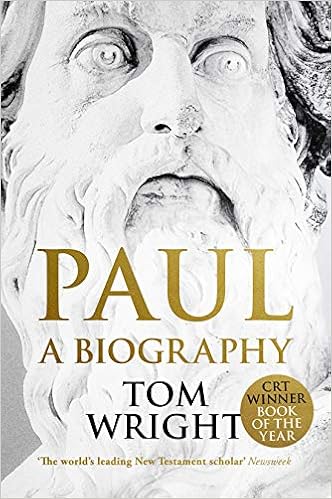
OK. It’s been a while. I’ve had so many ideas but never got round to getting it down. Here’s a few thoughts from Tom Wright, otherwise known as N.T. Wright. He was Bishop of Durham for a while, but is best known as an academic whose whole adult life has been spent studying the life and writings of St Paul.

He wrote a book about the life of St Paul that came out three years ago. I haven’t read it, but heard him talk about it on the Nomad Podacst.

To start with, his name is originally Saul. He comes from a conservative tradition in Judaism, and as the book of Acts describes, will do anything to protect Judaism from what he sees as unhealthy, misguided influences. One of those ‘way out’ movements is of course, what he would see as the cult of Jesus. Saul is basically a fundamentalist, and will track down followers of Jesus, and condone killing them for the cause of religious purity. Hence the stoning of Stephen, one of the prominent members of what we would call the early church. Saul is at this point a violent man, determined to put a stop to this abberation of the faith that he treasures.

But to call it the early church is slightly misleading – at this early point in the evolution of the Jesus movement, we’re talking about a community that is mostly made up of Jews before the word Christian has even been uttered. When we read the word ‘church’ in our English translations, the original Greek word is better translated by ‘gathering,’ ‘assembly, ‘ or ‘company.’

Tom Wright reminds us how important it is to understand the first century context of the words that we read. Another example of where we might have been reading this wrongly is to do with what we might have called the ‘conversion’ of Saul. Growing up, I had the impression that on the road to Damascus, when Saul has his experience of Jesus, it is at that point that he ‘becomes a Christian.’
(You can read the account in Acts chapter 9)

But at that point in time, there was no such thing as a Christian. There was no separate religion called Christianity. Saul was a Jew who had such a profound and mystical experience of the risen Christ, that he suddenly sees that he has been mistaken, and that Jesus is in fact, the Messiah of God. He doesn’t stop being a faithful Jew, and would in all likelihood continue in exactly the same way as he had done before regarding his religious observance, but now seeing that the promised Messiah has in fact come – in the person of Jesus Christ.

After this life changing encounter, at some point early on, Saul disappears off to Arabia for three years. It’s not clear exactly where he went or what he did during these three years, but Tom Wright has a theory … first a bit of background:

Back in the First Testament, * the prophet Elijah is at a turning point in his life. He had just defeated the 400 prophets of Baal, and was on the run from king Ahab and his wife Jezebel. At this time of great stress in his life, where does he go ? To mount Horeb. Mount Horeb is essentially the same as Mount Sinai, where Moses received the Ten Commandments. So Elijah is going back to the place where it all started. The place where God made it clear that the children of Israel were a ‘set apart people.’ They had a call to be God’s people for the nations. At Mount Horeb, God meets with Elijah and he gets the commissioning and strength that he needs for the next phase in his ministry. God tells Elijah that he is to ‘Go back the way you came, to Damascus.’ Once there, he was to anoint Jehu as the new king of Israel.

Tom Wright’s theory is that Arabia was the region that included Mount Sinai. Where would Saul go to think through the experience that he had on the road to Damascus ? Maybe back to where it all started – to Mount Sinai. Saul’s roots are in the ancient story of Israel’s deliverance from slavery; the journeying through the wilderness; the call to live as the people of God. So Saul goes to Sinai, to learn what this new call to follow Jesus will mean. And at the end of those three years, where does he go ? Back the way he came, to Damascus. And once there he will share the news that a new king has been anointed – Jesus. And that this good news of Jesus is for all people, both Jew and Greek, men and women, slave and free. And that this new community will be different from any community previously known, because it will not be according to your ethnic group, or whether you were a man or a woman, or a slave or a free person. This new community will break all the rules and be for all.

I feel like I should read the book !

And, as I was pondering on this alternative, radical new community that we see in the book of Acts, it made me think about my own experience of the church, and to what extent the churches I have been a part of have been ethnically diverse, with men and women both accepted fully, with class, background, education and social status not being an issue. Sadly, it seems that churches by default become fairly monocultural, not at all the vision that Paul had … 2000 years later it’s still a work in progress. Additionally, there are movements within the church that see the growth of the church being most effective when this mono approach is used – because like attracts like. This is in sharp contrast to the kingdom vision of a diverse community, which although it is often a more challenging environment, has within it the possibility of fully enacting the principles of love. Such a Christian community is truly a thing of great beauty.

* Christians have generally called the first part of the Bible ‘The Old Testament.’ But there are dangers in that. It might lead us to think that we can leave all of that behind. Now we have the New, we don’t need the Old. The New Testament gives us everything we need. In a sense that is true, but we are greatly impoverished in our undertanding of Jesus if we do not understand his roots, which lie in the work of God through Israel. If we only know the New Testament, we don’t know the New Testament! There is so much richness in the books of Moses, the history books, the wisdom and the prophets that we need to attend to. There has been a move to call these writings ‘The Hebrew Bible,’ but others are more inclined to use the phrase ‘First Testament,’ which gives those writings a more exalted place than ‘Old Testament,’ and unlike the phrase Hebrew Bible gives them their righful place within the whole revelation of God’s love and purposes.

Grace and Peace

Art and Design · Bible · Church · Creativity, · Theology

Business As Usual ? Or Not ?

This morning, my daily prayer included these readings:
Genesis 13:2-18; Galatains 2:1-10 31 and Mark 7:31-37

The Genesis reading was about Abram and Lot (Genesis 13). At this point in the story, they both have considerable wealth – camels, sheep, goats etc. They realise that they it’s no longer sustainable for them to stay together. Their herders are beginning to fall out over where to graze their flocks, and they need more land.

So Abram decides that to avoid trouble, they must separate. By rights, Abram should have had the choice of where to go, and you might expect him to choose the best land. But he doesn’t. He gives Lot the choice, and Lot chooses the well watered plain of the river Jordan.

Abram’s generosity is rewarded as in the following verses we hear God reaffirming his promise to Abram, that his descendents will be numerous: “Go, walk through the length and breadth of the land, for I am giving it to you.”

What you might expect to happen (Abram having the choice, and getting the best land) doesn’t.

Skip to my next reading today, from the New Testament book of Paul’s letter to the Galatians. Paul is sharing his story with church leaders in Jerusalem – how he has been working with the non Jewish believers. The idea that Gentiles could become a full part of the early (Mainly Jewish) church without being circumcised was a new thing. Yet the leaders in Jerusalem have eventually reached a point of accepting Gentiles without requiring circumcision.

What you might expect to happen (circumcision) doesn’t.

And finally, in Mark’s Gospel chapter 7, we read of the healing of a deaf and dumb man. Ordinarily, the man would have been deaf for the rest of his life.

What you might expect to happen doesn’t.

God’s way of working is often to challenge what we would normally expect, and do something different.

Link to …. Creativity

For the last three Thursdays, I have been attending a webinar – Just Imagine. Four sessions on creativity. Last night’s session was about the role of play in creativity. Questioning what things are usually designed to do, and playfully imagining something different.

All too often we live according to norms and recipes with known outcomes. Playfulness challenges this with no fixed outcomes in mind. This approach to creativity often starts with a question … ‘What if …’

Maybe God was playful in creation … ‘What if we had cows as well as galaxies ?’

One of the ideas I was especially fascinated by was from architect Steve Collins, who wondered …What if churches were like dark kitchens, which are based on a delivery only model. So unlike a take away, there’s no contact directly with the customer. Getting food out to the customer has never been easier.

The ‘What if ?’ question may not lead immediately to a workable solution, but it’s likely that many of the great ideas have sprung from such questioning.

And going back to play being part of God’s nature, we wondered how good our churches are at play ?

Part of the play process might be to start with two apparently disconnected ideas, and then play around with them and see where that leads. Candlesticks and Electric Scooters – I wonder where that would go ? Off the top of my head, I can’t think of anything ??!!

So, I’m thinking now about the first part of this post – about God doing things that are unexpected, and the idea of asking ‘What if … ‘ Mmhhhh …. think on.

Grace and peace


Church · community · Prayer · Worship

A Great Many People Praying

I was reading in Luke chapter 1 this morning. It’s about Mary’s cousin Elizabeth and her husband Zechariah, as they longed for a child. (Who would turn out to be John the Baptist).

During the time Herod ruled Judea, there was a priest named Zechariah, married to Elizabeth. Zechariah and Elizabeth truly did what God said was good. They did everything the Lord commanded and were without fault in keeping his law. But they had no children, because Elizabeth could not have a baby, and both of them were very old.

One day Zechariah was serving as a priest before God, because his group was on duty. According to the custom of the priests, he was chosen by lot to go into the Temple of the Lord and burn incense. 10 There were a great many people outside praying at the time the incense was offered. 11 Then an angel of the Lord appeared to Zechariah, standing on the right side of the incense table. 12 When he saw the angel, Zechariah was startled and frightened. 13 But the angel said to him, “Zechariah, don’t be afraid. God has heard your prayer. Your wife, Elizabeth, will give birth to a son, and you will name him John.

The phrase that struck me was this: There were a great many people outside praying

As Zechariah is doing his work of leading God’s people in prayer, “A multitude of people are faithfully gathered at the temple to back Zechariah in prayer. Prayer is the context in which God acts most creatively, the environment in which his promises are announced and his work of salvation begins.”
Eugene Peterson in Praying with the Early Christians

In these days of Covid, I am struggling to work out what being part of a congregation means. We have our small group of Christian friends, and are working at mutual encouragement and support, but the congregational aspect of church life is hard.

I have been to a few of our services in church, and experienced that socially distanced, mask wearing, non singing way of being church together, which is ok up to a point.
I have watched pre-recorded services online, some of which have been very creative, using technology to involve members of a congregation in readings, leading prayers, singing at home etc
I have watched live services online at home, which at least has the benefit of being live.

But the sense of participation in worship, and the sense of being a part of a community in worship has been largely absent. I think this has resulted in me praying much less for our worship, and those who lead, even whilst my disciplines of prayer, reading of scripture and study at home have increased.

I’m challenged today to wrestle with this, to try and see a way to make congregational worship more a part of my life in these days.

Grace and peace.

Church · faith

Which Jesus Floats Your Boat

Ann Morisy, community theologian and author, talks about imitating Jesus. She is attracted especially by Jesus’ tendency to seek out the unlikely people. Uneducated fishermen; Tax Collectors, most of whom would have collaborated with the Roman authorities; Women, lacking in status and influence. Etc.

She tells of a project to locate a doctor’s surgery in a housing estate where there was no G.P. presence. The unlikely person was the phlebotomist, the one who took blood for testing. He was a reformed drug addict. Who better to find a vein ?!

So I’m asking myself the question … as I look at the life and work of Jesus, is there something that particuarly excites me ? Which Jesus floats my boat ?

Work in progress; I’m still thinking about that.

Grace and peace.