Bible · faith · Following Jesus

The Same Territory As Before

Matthew 19:23-30

Then Jesus said to his disciples, ‘Truly I tell you, it will be hard for a rich person to enter the kingdom of heaven. Again I tell you, it is easier for a camel to go through the eye of a needle than for someone who is rich to enter the kingdom of God.’ When the disciples heard this, they were greatly astounded and said, ‘Then who can be saved?’ But Jesus looked at them and said, ‘For mortals it is impossible, but for God all things are possible.’

This was the day when the Catholic Church remembered Mary Queen. One of Mary’s gifts to us is her example of pondering. We are encouraged to ponder today.

Once more we see Jesus challenging those with wealth and privilege. Until I/we/they see what it means to truly live out solidarity with the poor, I/we/they cannot enter the kingdom of heaven.

In the next few verses, Jesus will say that the first shall be last and the last shall be first.

It is the least and the lost and the last who are first in the kingdom of heaven.

The beginning of Luke’s Gospel introduces us to a young girl called Mary who is told that she will have a son and will name him Jesus …. (Luke 1:30)

She responds with a song of praise that includes the words … ‘He has cast down the mighty from their thrones and has lifted up the lowly’

Lord – Help us who have relative wealth and privilege to see more clearly and to follow more nearly the way of Jesus.

community · faith · Poetry · Worship

What’s The Opposite Of Spiritual

This is quite a bit longer than I would usually post … a sermon preached a few weeks ago in Easter week, focussing on the bodily resurrection of Jesus, and the importance of an embodied faith, lived out by our spiritual practices.

Thursday Communion 13.4.23 St Catharine’s, Gloucester

Jesus Appears to the Disciples

On the day of resurrection, Jesus had appeared to two disciples on their way home to  Emmaus … after Jesus has left them, they hurry back to Jerusalem to share the news … Luke 24:35

35 Then the two told what had happened on the way, and how Jesus was recognized by them when he broke the bread.

36 While they were talking about this, Jesus himself stood among them and said to them, ‘Peace be with you.’ 37 They were startled and terrified, and thought that they were seeing a ghost. 38 He said to them, ‘Why are you frightened, and why do doubts arise in your hearts? 39 Look at my hands and my feet; see that it is I myself. Touch me and see; for a ghost does not have flesh and bones as you see that I have.’ 40 And when he had said this, he showed them his hands and his feet. 41 While in their joy they were disbelieving and still wondering, he said to them, ‘Have you anything here to eat?’ 42 They gave him a piece of broiled fish, 43 and he took it and ate in their presence.

44 Then he said to them, ‘These are my words that I spoke to you while I was still with you—that everything written about me in the law of Moses, the prophets, and the psalms must be fulfilled.’ 45 Then he opened their minds to understand the scriptures, 46 and he said to them, ‘Thus it is written, that the Messiah is to suffer and to rise from the dead on the third day, 47 and that repentance and forgiveness of sins is to be proclaimed in his name to all nations, beginning from Jerusalem. 48 You are witnesses of these things. 49 And see, I am sending upon you what my Father promised; so stay here in the city until you have been clothed with power from on high.’

Sermon

Jesus himself stood among them and said to them, “Peace be with you.”   … touch me and see …

The risen Lord is present with us now as we meet to share in this meal of Holy Communion – bread and wine … now able to be here present in our bodies – a privilege that we appreciate so much more in recent years.   Pause

It’s that aspect of our lives that I’ve been thinking about – we might call it the embodied life.  We had some family time over Easter, and spent hours playing board games … physically present with one another, engaged in an activity that was communal and devoid of screens. Contrast that with what we often see and experience ourselves as we spend time relating to our phones , social media etc.

I remember an occasion when I was a theological student and we were visiting the local church for a seminar.  The vicar led a discussion with us, and at one point (I can’t remember how it came up) he asked us “what is the opposite of Spiritual ?”  We kind of knew that he was laying a trap for us, and I can’t remember if anyone did fall into the trap, but he was expecting someone to say ‘physical.’  The point being – the opposite of spiritual is unspiritual.

And the reason he asked the question is because one of the heresies that have always been around for the church (Gnosticism) is one that sees the physical, material world as bad, creation is fundamentally flawed, even evil, and to be truly spiritual we need to rise above the material world, to escape from the body and become pure spirit.

This heresy was around in the early years of the church, and is still around today. although we may not recognise it easily.

I have a Christian friend who to all appearances is an orthodox Christian – but his view of the climate crisis is that we shouldn’t worry too much about it or put our energies into tackling it because Jesus will return and renew the earth anyway.  And yes, that is a part of our faith, but it’s getting dangerously near to saying that the material world doesn’t matter.

But Christian faith is founded on the material world. Everything about our faith is solid … material .. physical.

God is revealed in creation – The heavens declare the glory of God – psalm 19

God is supremely revealed in the  incarnation – Jesus, the eternal Word made flesh.

And in our Gospel reading we see that even the resurrected body of Jesus is solid, substantial, not an apparition, not a free floating spirit somewhere in the ether.

Just note some of the words in the Gospel reading – hands, feet, touch, flesh, bones, hands, feet (again) eat, fish, eat (again).  This is bodily stuff.  Now I know that there’s much that we simply don’t know about what happens when we die, and what resurrection means for us, but there are some clues here – aren’t there ?

I’ve heard people talk about the spirit leaving the body when we die and having some kind of independent existence as if the body is merely a shell, and not really important for our existence.  But the resurrection of Jesus is not like that – the resurrected Jesus is body mind and spirit … new body for sure, but a resurrection of the body, and not some free floating spirit.

Each of us is made up of body mind and spirit, working together, and the gnostic heresy that tries to elevate the spiritual as something disembodied must be resisted.

There’s a real danger at this moment in time that our spiritual life becomes less embodied, with fewer physical expressions of faith in favour of something interior, private, individualistic.

I enjoy thinking, and reading … stuff that goes on in my head, but I’m more interested in living !  I’m more interested in a faith that is embodied, lived out in material ways.  One of my retired clergy colleagues years ago talked about the way that the life of the spirit, spiritual things are experienced through the material stuff of life.

This includes acts of service to others; being present with others to share our lives; taking creation seriously – enjoying the diversity of all that God has given us, and playing our part in caring for the world.

And it includes our practices in worship – that wonderfully work to keep us true to this embodied faith.  Just think of these actions that embody our faith …

The waters of Baptism; The bread and wine of communion. The posture of our bodies … in our Christian tradition we stand when the Gospel is read, or when we say the creed. We greet one another in the peace – and I have noticed the way the peace is shared in this service – with handshakes and hugs.  

In Lent we have the service of ashing on Ash Wednesday, and the washing of feet on Maundy Thursday. Our Good Friday services are focussed on the bodily crucifixion of the Lord, with crown of thorns, and torture and vinegar.

But there are other practices that might not be so familiar to us – making the sign of the cross, bowing down or kneeling as part of our worship, or raising our hands in praise. Having hands laid on us in a service of healing.  All of these are ways to embody worship, and all touch on something profound that cannot be replicated by the inner workings of the mind.

In the eucharistic prayer there will be pouring of wine, breaking bread and lifting the cup and the bread … bodily actions that reveal something of the heart of our worship.  Do you know ? I think there’s more – you may think of more … but let’s just stop there … 

I’ll finish with a sonnet .. . inspired by this a book of sonnets by poet Malcolm Guite that go through the church year 

Disciples gathered in Jerusalem
When suddenly two friends arrived and said
The Lord had risen and appeared to them
They’d recognised him when he broke the bread
While they were puzzling on the situation
Jesus himself came with his word of Peace
“You look as if you’ve seen an apparition
Do you have anything that I may eat ?
He took the food and ate it while they watched him
“You see a Ghost does not have flesh and bones,
I’ll tell you ev’rything that has been written –
I had to die and rise to take my throne.
Now soon it will be time to say goodbye
Then you’ll be clothed with power from on high”

Later in the service we shared the peace in silence …to focus on the bodily action.
I suggested that for any who are keeping their distance (as we have had to do in the pandemic) that they find a way to make the sharing of the peace a bodily thing, maybe by using the Makaton sign for peace.

……………………………………………..

N.B. Whilst writing this I came across this article on ‘excarnation,’  Embodied Living in the Age of Excarnation” By Joel Oesch .

The article helped to inform and clarify what I was trying to say and draws on the work of Charles Taylor, who defines excarnation as “the steady disembodying of spiritual life, so that it is less and less carried in deeply meaningful bodily forms, and lies more and more in the head.”

Grace and Peace.

faith · Following Jesus

Wondering Where The Lions Are ?

So this week, we started the ‘Being With’ course at Church. I came across this on a conference on Zoom during lockdown. The course has been developed by Sam Wells, vicar at St Martin-In-The-Fields in London along with his associate vicar, Sally Hitchiner.

When I heard Sam Wells talk about the course, I knew immediately that this was huge. It’s a way of introducing people to Christianity that recognises and affirms the truth that God is always at work in our lives, and that we all bring precious experiences that can help us as we together, discover the joy of being with God.

I have wanted to offer this course for so long, and finally on Wednesday this week, we kicked off with the first session.

I’m going to give you a feel for what we did.

After a welcome, we went straight in and invited the group to respond to some ‘wondering.’
I wonder if you have ever known what it feels like to be set free ?
I wonder if you have ever known what it feels like to be in prison ?
I wonder how it would feel to know that there’s something in the past that you don’t need to worry about anymore ?
I wonder what it would feel like to know that the future cannot hurt you ?

The invitation is to share from our own experience stories that might be very everyday and mundane, or might be profound.

E.g. I remember as a child that my brother locked me in my room, but my mum came and told him off, and said that he must let me out.

We cannot live freely in the present when our lives are dominated by the twin prisons of fear of the past, and fear of the future.
The past may be blighted by things have been done to us that have hurt us, or ways in which we have hurt others.
The future is a cloud of unknowing, with fears about our own mortality, sickness, bereavement and all the other pains that we as humans are subject to. We can end up paralysed, imprisoned by our fears.

This session is about dealing with those twin ‘lions’ so that we can live in the present. Two central planks of Christianity are knowing forgiveness for things in the past, and receiving the gift of everlasting life so that we can live without fear of the future.

This is not, by the way, a quick fix. My guess is that we spend our whole lives growing in both of these aspects of faith.

But in the end, having these two – the faith that forgiveness can set us free, and the hope of everlasting life – we can be set free to live in God’s love in the here and now.

I was out on my walk today and wanted to end by listening to a song. I was browsing my collection of Bruce Cockburn’s music and came across ‘Wondering Where The Lions Are,’ with these lines:

I had another dream about lions at the door
They weren’t half as frightening as they were before
But i’m thinking about eternity
Some kind of ecstasy got a hold on me.

It seemed like a pretty good way to sum up what we had been thinking about in the group this week, and indentifying and dealing with these two ‘lions.’

So here’s the song, and lyrics.

And a link to ‘Being With.’

Wondering Where The Lions Are

Sun’s up, uuh huh, looks okay
The world survives into another day
And i’m thinking about eternity
Some kind of ecstasy got a hold on me.

I had another dream about lions at the door
They weren’t half as frightening as they were before
But i’m thinking about eternity
Some kind of ecstasy got a hold on me.

Walls windows trees, waves coming through
You be in me and i’ll be in you
Together in eternity
Some kind of ecstasy got a hold on me

Up among the firs where it smells so sweet
Or down in the valley where the river used to be
I got my mind on eternity
Some kind of ecstasy got a hold on me
And i’m wondering where the lions are…
I’m wondering where the lions are…

Huge orange flying boat rises off a lake,
Thousand-year-old petroglyphs doing a double take,
Pointing a finger at eternity
I’m sitting in the middle of this ecstasy

Young men marching, helmets shining in the sun,
Polished as precise like the brain behind the gun
(Should be!) they got me thinking about eternity
Some kind of ecstasy got a hold on me
And i’m wondering where the lions are…
I’m wondering where the lions are…

Freighters on the nod on the surface of the bay
One of these days we’re going to sail away,
Going to sail into eternity
Some kind of ecstasy got a hold on me
And i’m wondering where the lions are…
I’m wondering where the lions are…

Bible · faith · Jesus

Wise Words From Daniel Berrigan

Daniel Berrigan, Catholic Priest and peace activist one said that the major tasks of the church were to build community, foster spiritual dsiciplines and teach bible literacy.

The first task of reading the Bible is to ask why it was written. What was the experience of the authors that had moved them to write as they did ? And the second task is to ask what relevance it might have for us today.

It’s bible literacy that I’ve been thinking about as I’ve been listening to the first two chapters of Mark’s Gospel this week. Here is Mark chapter 1:40-45

40 A leper came to him begging him, and kneeling he said to him, ‘If you choose, you can make me clean.’ 41 Moved with pity, Jesus stretched out his hand and touched him, and said to him, ‘I do choose. Be made clean!’ 42 Immediately the leprosy left him, and he was made clean. 43 After sternly warning him he sent him away at once, 44 saying to him, ‘See that you say nothing to anyone; but go, show yourself to the priest, and offer for your cleansing what Moses commanded, as a testimony to them.’ 45 But he went out and began to proclaim it freely, and to spread the word, so that Jesus could no longer go into a town openly, but stayed out in the country; and people came to him from every quarter.

In verse 41, we read that Jesus was moved with pity. But in other, possibly earlier manuscripts, Jesus is moved with anger.

If that is so, then is it possible that those who were copying out the manuscripts thought that pity was more in line with who they though Jesus was ?

If the original meaning was that Jesus is somehow angry, then who is he angry with, and why. Many commentators are clear that a major theme (or maybe The Major Theme) of Mark’s Gospel is the conflict between Jesus and the authorities. The Scribes and the Pharisees. It’s easy to see this conflict building up as the Gospel account moves on.

So to suggest that Jesus is angry with the religious powers fits the narrative, and the idea that Jesus is angry here is very possible, even likely.

Why ? Because as the narrative moved on, we see that the priests enter the story. Ched Myers suggests that the man has already been to the priests to be delcared clean, and has been turned away. Jesus is effectively saying – the religious powers are not the only ones that have authority. They cling to their power for fear that anyone else might make a decision for themselves. If the priests can persuade the people that they (the priests) are the only ones that can declare someone clean, then they hold onto a great deal of influence over people’s daily lives.

Jesus will have none of that. A central part of his mission is to open up a way to God that does not rely on the power of a priest. His activity, out and about in the towns and the villages, far from the temple, is showing that God is working anywhere and everywhere, and God doesn’t need a priest to be the one who decides if someone can be accepted in the community.

Very soon after this incident in the Gospel, Jesus will send out the 12 with authority to announce the message and heal wherever they go. You can do this too!

And so can we.

Grace and Peace.

faith · Poetry · Songwriting

It’s Show Not Tell – Again

It’s Show Not Tell – Again

Today is the feast day of Saint John the evangelist.

The Gospel reading set for today is from the end of John’s Gospel:

Early on the first day of the week, while it was still dark, Mary Magdalene came to the tomb and saw that the stone had been removed from the tomb. 

So she ran and went to Simon Peter and the other disciple, the one whom Jesus loved, and said to them, ‘They have taken the Lord out of the tomb, and we do not know where they have laid him.’ 

Then Peter and the other disciple set out and went towards the tomb. The two were running together, but the other disciple outran Peter and reached the tomb first. 

He bent down to look in and saw the linen wrappings lying there, but he did not go in. 

Then Simon Peter came, following him, and went into the tomb. He saw the linen wrappings lying there, and the cloth that had been on Jesus head, not lying with the linen wrappings but rolled up in a place by itself. 

Then the other disciple who reached the tomb first, also went in, and saw and believed.

In the songs that I’ve been writing in the last few years, I have been aware of the power of ‘Show not Tell.’ It seems to me that in poetry and in songwriting, often it’s the less you say, the more you tell. 

John’s Gospel is the most poetic of the four Gospels, and in this sparse retelling of the discovery of the empty tomb, much is left to our imagination.

We understand that the ‘disciple whom Jesus loved’ is John, but he is not named here. Perhaps we can imagine that by not naming him, it leaves the possibility for us to be a part of the retelling?

Can I, in my imagination, be that unnamed disciple ? What do I see as I look into the tomb ?

All we are told is that he ‘saw and believed.’ This is the ultimate ‘Show not tell’

faith · Jesus

That’s How Close He Is

It’s Christmas Day. Bev and I are spending Christmas with her mum in Holyhead – the furthest point in North Wales off the island of Anglesey.

Midnight communion at St Cybi’s church was a special way to start Christmas. It’s the church where we were married in December 1981 – 41 years ago.

In the sermon, the preacher – the Archdeacon of Anglesey, John Harvey started by asking ‘How far would you go to see Jesus ?’ He continued by telling us about a trip he made to see Jesus many years ago. He visited Burford Priory, which was then the home of the society of the Salutation of our Lady, a community of Anglican nuns.

And he described the statue in the Priory of Mary and the Christ Child – not with Mary cradling the baby Jesus, or with the child sitting on her knee, but with Mary holding Jesus out as if to say ‘Would you like to hold him ?’

As for the offer to hold the baby … I, like many others, would accept in a heartbeat, but others, for all sorts of reasons, might be reluctant to take the baby. Holding a baby is the closest we come to innocence, but for some, there is pain and the fear of coming too close to the perfection that we may never have known.

And in the end, to go back to the question at the beginning .. it’s not a question of how far we would go to see Jesus, it’s remembering that God, in Christ has come to meet us.

At Christmas, we are invited to consider that in Jesus, God becomes flesh for us. So whatever your feelings about holding a baby, whatever your pain or fear – this is the question put to us … As the gift of Jesus is offered to us this Christmas, will we receive him ?

Would you like to hold him ? He is that close.

faith · God · Theology

The Difference A Word Makes

I’m mentioning Rowan Williams a lot recently. That’s because he’s brilliant ! I was listening to him being interviewed recently and at one point, he was talking about Pantheism and Panentheism.

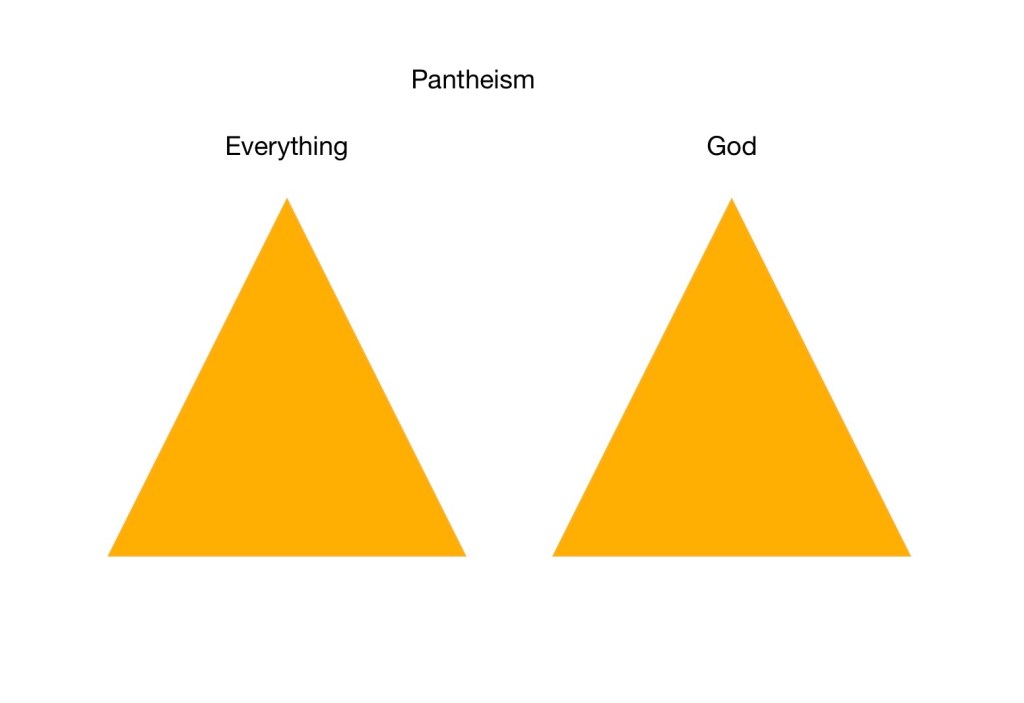
The Pantheist believes that God is the sum total of all that is. Rocks, trees, animals, people, the universe.

As he was talking I had the image of triangles in my mind. One triangle represents everything that is. The other represents God. See my little diagram below, where ‘everything’ and ‘God’ are not only exactly the same shape, but are the same size.

Pantheism = God is everything

Panentheism is a belief that God is in everything. The little word ‘in’ makes a big difference.

Everything we look at, all that exists – the green triangle in my diagram below – has at its core, the presence and activity of God.

I’ve tried to show that by making the green triangle exactly the same shape as the big blue triangle. Being the same shape means that the universe reflects the nature of God, but is not identical with God.

The totality of everything – Rocks, trees, animals, people, the universe … is soaked through with God but it certainly doesn’t exhaust God.

And to quote Roman Williams – ‘That’s pretty much where I’ve got to be’

Me too. I love the idea that you can be immersed in something much bigger than yourself.

Grace and Peace.

faith · God

There Is Nothing In God

Maybe I got you wondering … have I lost it ?

No, actually.
And what I have for you today is surprisingly simple but infinitely profound, and deep mystery – expressed by Rowan Williams in this way.

There is nothing in God that is not God.
There is nothing in God that is the result of something else.
What there is in God is absolute mutuality of gift and love.

And, amazingly, God chooses to share that gift and love with us.
That little word ‘with’ could be the most important word that we will ever know.
It points towards community –
the community that is God;
the community into which we are invited.

Being with one another is the most precious gift of being human.
That’s why, at Christmas, we see people willing to be stranded at railway stations and airports. On their way to spend time with loved ones. Friends and family.

And ‘being with’ is the most precious gift that God has given us – signified by the presence of God in Jesus.

Whatever your community, and however you experience it – in person, on video call, on the phone, through cards and texts and whatsapps, may you know the power of the presence of others in your life, and the promise of the gift of Jesus, the Christ Child, to be with you.


Bible · faith · Persecution · Political

No Room At The Inn ?

Some friends and I have some Iranian folk we have been getting to know over the last 8 months or so. They are here in the UK because they are Christians, and it’s not safe for them in Iran. Their stories are difficult to hear, as they have weighed up the cost of leaving and the cost of staying, and in the end, made the decision to come to this country.

So we had all been invited round to H and S’s for an early Christmas dinner to give our Iranian friends a taste of Roast Chicken and all the trimmings, yes, including sprouts, and with Christmas pudding to follow.

When we meet up each week we always spend some time looking at the Bible, and today we read parts of the accounts of Jesus’ birth from Luke and Matthew’s Gospel.

Luke 2 verse 7:
7 And she gave birth to her firstborn son and wrapped him in bands of cloth, and laid him in a manger, because there was no place for them in the inn.


We were asked to consider why it was that there was nowhere for them to stay ? After all, we are told earlier in verses 3 & 4 that Joseph was returning to Bethlehem for the census, because that was where his family were from. He would almost certainly have had cousins, or uncles and aunts living in Bethlehem, or at least visiting for the purpose of the census.

So why were they having trouble finding somewhere to stay ? The popular idea, arising from a mistranslation, is that they went to try and stay at an inn, but had to sleep in the stable because there were no rooms available. Remember all those nativity plays where there’s an innkeeper who send them to the stable ?

The mistranslated word is the word ‘inn.’ There is another word that would have been used if the writer had actually meant ‘inn or hostelry.’ The correct translation would be more like ‘guest room.’

This makes much more sense than Joseph and Mary traipsing around Bethlehem looking for a pub with spare rooms. It’s more likely that they have gone to the house of a relative, and been told that although the guest room is already taken, they can sleep in that part of the house where the animals are kept.

But another question arises. Why would someone from your extended family make you sleep with animals when you are clearly heavily pregnant ?

To understand that, we need to look at Matthew’s account of the birth.

Matthew 1 verses 18 and 19

18
Now the birth of Jesus the Messiah[i] took place in this way. When his mother Mary had been engaged to Joseph, but before they lived together, she was found to be with child from the Holy Spirit. 19 Her husband Joseph, being a righteous man and unwilling to expose her to public disgrace, planned to dismiss her quietly.


In Matthew’s Gospel, we read that there’s a problem with this pregnancy. Joseph and Mary are betrothed – promised to one another – but not yet married, and not yet intimate.

In a dream, Joseph is reassured that it will all be OK. He should take Mary as his wife, and bring the child up.

But even so, there was bound to be a stigma attached to the couple. here’s an unmarried couple, about to have a baby, and even worse, (if they are aware of the back story), Joseph is not the father !

So when they turn up on the cousin’s doorstep to be in Bethlehem for the census, there’s a dilemma for the cousin.

There’s the shame of giving house room to an unwed couple about to have a bastard child, but the cousin also has the strong family responsibility that will not allow him to just throw them out on to the street.

You can imagine the conversation:
1 Who is it ?
2 It’s cousin Joseph … come for the census
1 Well, invite him in then!
2 Ahh … I’m not sure we should.
1 Why’s that ?
2 He’s got someone with him – a young girl.
1 Oh. Did we know about that ?
2 I’m not sure … and there’s more …
1 Yes ?
2 She looks like she’s expecting a child.
1 So Joseph got married and didn’t tell us, or invite us to the wedding ?!
2 No, he’s not married, and he says the child is not his.
1 Hmm.
2 What shall we do ?
(Long pause and muttering that last a few minutes)
1 I suppose we’d better find a place for them to stay.
2 Yes, we should. After all, he’s family.
1 But where can they stay. The guest room wouldn’t be right.
2 No, I agree. What about with the animals ?
1 That sounds like a good idea.
2 But what about the neighbours and cousin Malachi ?
1 It’s a no win situation I’m afraid.
2 No. We can’t be seen to condone their situation …
1 But we can’t just turn them away ….

I know this is reading between the lines, but I’m guessing this is close to what was going on. Added to that – we don’t hear about family coming to visit. The first visitors were shepherds. They ranked very low on the social scale.

And the other visitors – magi (wise men) who came to visit the child probably came some time later, as it describes them coming to see a child, not a baby.

So two unlikely groups to visit the ‘new born king’ – a king who is born not in a palace, but in a humble home among animals.

So here’s the point of this blog post … better late then never.
We’re sitting there in H and S’s house, about to have our roast dinner, and we’re reading this story and thinking about it together ….

And there in front of us, in H and S’s living room, is a carved nativity set. Y, One of our Iranian friends had commented earlier, when he saw the Nativity set – Ahh, there are the Iranians …

I did a double take. Iranians ?

In Matthew’s Gospel, chapter 2, we read:
2 In the time of King Herod, after Jesus was born in Bethlehem of Judea, wise men (astrologers) from the East came to Jerusalem, 2 asking, ‘Where is the child who has been born king of the Jews?

I know this verse well. Wise men from the East.

But what I hadn’t grasped is that these were most likely Zoroastrian priests from Iran, who had been reading the stars and seeing in them a prophecy about the birth of a new king.

It felt like a precious moment, as we remembered together that Jesus came for all in society, even to those disregarded and ignored by many.
And that Jesus came for all nations, shown to us by wise men from Iran, bringing gifts for the infant Jesus.

To be there in that room felt like an enormous privilege. As we met with 21st century Iranian Christians.

What is sobering to realise is that our Iranian friends have come to find refuge in our country, and are, like Joseph and Mary in the Gospel, often not treated with dignity, and find themselves in accommodation that is not suitable, and sometimes waiting years before their case is heard.

We pray for all our friends, and the many thousands in situation like theirs. And we pray for the nation of Iran. For peace, for an end to discrimination, imprisonments and killings. And for religious freedom.

community · Creativity, · faith · Following Jesus · music · Poetry · Political · Truth · World Affairs

Apostles, Prophets, Evangelists, Pastors, Teachers,

So – we’ve had a series on church on the different aspects of service that people might be called to. See above.

I was with a group yesterday and we were talking about what an evangelist is. Essentially someone who shares their faith with others. But what struck me as we were talking was the importance of listening to each of these ways of serving.

Apostles are the people who are out in front of a new venture. I was talking to Emma and her husband Andy on Sunday – Emma runs something called the Long Table in Matson (Gloucester), and they were telling me that they spent a long time listening to the community in Matson before setting up the Long Table project.

Prophets are the ones who speak truth to power. Often but not exclusively people involved in the arts – musicians, poets, artists and so on. They are listening carefully to be attuned to what’s going on around them in the world. Movements in the political and cultural sphere; aspects of church that are in danger of, or already have gone off track.

Evangelists sometimes get it wrong by just speaking louder ! To share faith with another human being requires respect and careful listening. Talking with, not talking at.

Pastors are those who have a deep concern for the well being of others. What they offer needs to be connected to the need of the other, not the need of the one offering support. Listening is crucial.

Teachers also sometimes get it wrong – maybe they pitch what they’re trying to communicate at the wrong level, or are just out of sync with those who are learning. Perhaps we should think of this as creating a space for learning. Again, listening to the ones who are learning will help to get this right.

This all might seem glaringly obvious, but it struck me how central listening is to any kind of activity within a community, be that a family, a business, a church, or whatever …

The other thing that I’ve noticed as we’ve been working through this at church is that although some people have a particular ‘gift’ for working in a specific area, all of these ways of serving are open to any of us. So ….

Get your creative juices going and try something new
Try to be informed about what’s going on in the world – but it can be tricky to know who’s truth telling …
Think about your passions and who might be interested in sharing that passion
Think about the people in your networks, and how you can be a caring presence
We all have wisdom, knowledge and experience to share with others … how’s that going ?

But don’t burn out ! Maybe at some point you’ll notice an area where you shine, and you can give the major part of your energy to that.

Grace and peace.