I have had so many thoughts and prayers over the last nearly two years, but not been able to put into words what I’m thinking and feeling.
Many times I have been on the edge of posting, but not been able to.
Today, I was listening to a short passage from the Gospel of Luke in my daily ‘Pray as you go‘ … here it is:
And the child’s father and mother were amazed at what was being said about him. Then Simeon blessed them and said to his mother Mary, ‘This child is destined for the falling and the rising of many in Israel, and to be a sign that will be opposed so that the inner thoughts of many will be revealed—and a sword will pierce your own soul too.’ Luke 2:33-35
The child is Jesus. Simeon is a priest in the temple in Jerusalem. Mary and Joseph have brought Jesus at 40 days old to present him to the Lord. The words said to Mary are disturbing. They point to the way that Jesus will speak truth to the powers of his day, and the opposition that he will receive as a consequence.
Having listened to the reading a couple of times, I was invited to think about a character that I identified with in the passage. Or maybe I would like to imagine holding the baby in my arms ?
I’m writing this as we are surrounded by ugliness. By actions and words that spread hate and violence.
We are in the middle of the unlawful and genocidal actions of the Zionist state of Israel.
In addition we have to contend with racism directed at those seeking refuge in our land.
All around we see forces at work that are not rooted in compassion and understanding, but cruelty and ignorance.
I imagine myself in the middle of all of this, and ask myself what do I do, or say.
Do I shout out ?
“From the river to the sea …”
Yes, I have joined in those chants, and will still do so.
Do I hold up a placard ?
“Free Palestine, save Gaza”
Yes, I have done that each week in a public space this year, and will continue to do so.
But today, I have an image of myself with thousands of people simply holding babies.
No chants,
No words,
No placards.
Just holding a baby in my arms.
To hold a placard I would need to put the baby down, or give the precious bundle to someone else.
To shout a chant I might disturb this sleeping infant.
The most important thing in my mind is to protect this baby, who speaks to me of vulnerability, of non-violence, of possibility, of innocence.
Maybe this could be a worldwide Christian witness to the self giving love of that tiny babe.
Thousands, millions of people simply holding a baby in their arms.
A witness to the disrupting power of non-violence.
Join me.
N.B. this would be intended as a symbolic protest, in case you thought I was suggesting we put real babies in danger.
Category: Following Jesus
The Same Territory As Before
Matthew 19:23-30
Then Jesus said to his disciples, ‘Truly I tell you, it will be hard for a rich person to enter the kingdom of heaven. Again I tell you, it is easier for a camel to go through the eye of a needle than for someone who is rich to enter the kingdom of God.’ When the disciples heard this, they were greatly astounded and said, ‘Then who can be saved?’ But Jesus looked at them and said, ‘For mortals it is impossible, but for God all things are possible.’
This was the day when the Catholic Church remembered Mary Queen. One of Mary’s gifts to us is her example of pondering. We are encouraged to ponder today.
Once more we see Jesus challenging those with wealth and privilege. Until I/we/they see what it means to truly live out solidarity with the poor, I/we/they cannot enter the kingdom of heaven.
In the next few verses, Jesus will say that the first shall be last and the last shall be first.
It is the least and the lost and the last who are first in the kingdom of heaven.
The beginning of Luke’s Gospel introduces us to a young girl called Mary who is told that she will have a son and will name him Jesus …. (Luke 1:30)
She responds with a song of praise that includes the words … ‘He has cast down the mighty from their thrones and has lifted up the lowly’
Lord – Help us who have relative wealth and privilege to see more clearly and to follow more nearly the way of Jesus.
Just One Thing You lack
Today – 21st August, I was thinking about this Gospel passage:
Matthew 19:16-22
Then someone came to him (Jesus) and said, ‘Teacher, what good deed must I do to have eternal life?’ And he said to him, ‘Why do you ask me about what is good? There is only one who is good. If you wish to enter into life, keep the commandments.’ He said to him, ‘Which ones?’ And Jesus said, ‘You shall not murder; You shall not commit adultery; You shall not steal; You shall not bear false witness; Honour your father and mother; also, You shall love your neighbour as yourself.’ The young man said to him, ‘I have kept all these; what do I still lack?’ Jesus said to him, ‘If you wish to be perfect, go, sell your possessions, and give the money to the poor, and you will have treasure in heaven; then come, follow me.’ When the young man heard this word, he went away grieving, for he had many possessions.
I use an app – Pray As You Go … and today there was a quote from Pope Pius X, whose feast day it is today:
“To heal the breach between the rich and the poor, it is necessary to distinguish between justice and charity.” Jesus asks the young man to heal his own breach, to move from the privilege of benefactor to the discomfort of needing others.”
To see the difference between justice and charity …
My situation is one of privilege. Like the person in the Gospel reading.
Inevitably, we read scripture from our own situation and experience, and the challenge of this passage is to begin to see things from a different viewpoint – that of the poor.
How can we truly experience solidarity with the poor ? Maybe only by being poor in some sense ourselves.
The person in today’s Gospel is prevented from seeing things from the viewpoint of the poor by his possessions.
What might be stopping me from this position of solidarity with the poor ?
Let’s Catch Some Big Fish
This is a post about why Christ died. Just thought I would say that at the start. It will be followed by a post on Christ’s resurrection, as told by Mark in his gospel.
N.B. (Note carefully) What follows is not the whole story, but it is definitely an important part of the story that we have not taken seriously.
I must acknowledge the work of Ched Myers here as the inspiration for this post. I have heard him speak a few times, and most recently on the Nomad podcast just before Easter 2023, when he was asked the question – Why did Christ die ?
His answer comes at a time when I have been reading about the treatment of prisoners in Guantanamo, the Occupation of Palestinian land by Israeli settlers, and the misappropriation of water resources in the Land of The Holy One. The reason why Christ died turns out to be the same as the reason why any activist gets into trouble. They disturb the status quo.
We start by the sea of Galilee, as Mark recounts the calling of Jesus’ disciples. It’s told in typical Markan style, conveying urgency in a fast moving narrative. The disciples were fishermen. They worked in what might originally have been a self supporting economy, but an economy that had changed under Roman occupation. Fish was becoming big business, taking it away from the local to make big bucks – for example through the exporting of salted fish products. The beneficiaries of this would likely be the already rich and powerful, and not the fishing families.
So, when Jesus calls his first followers, saying ‘I will make you fish for people.’ It might not mean what I was taught as a child with the chorus – I will make you fishers of men, if you follow me, That understanding was to do with calling others to come and follow Jesus, and translated in my childhood mind to witnessing to others about Jesus. But that reading might be failing to take into account the economic and social environment of first century Galilee.
One reading of the Gospels is to see Jesus as a community organiser, kicking against a system of military, religious and economic power. Jesus consistently reaches out to the poor, and the sick, and those excluded from society for one reason or another.
So when he calls the disciples, he is saying – Come with me, and let’s catch some ‘big fish.’ Let’s take on the powers that are pressing you down and keeping you poor.
Does that resonate with you ? The idea that people with power will hold on to that power by controlling resources. In first century Galilee it was the fishing industry, while today, it’s likely to be oil or water.
How Israel uses water to control the West Bank.
The call of the disciples is just an example to remind us that Jesus is about neutralising the power of the elites for the benefit of the poor.
So, to cut a long story short (That long story is the Nomad podcast where Ched Myers outlines this much more fully), when we ask why Jesus died, the answer must be understood within the setting of the whole of the gospel account.
That account shows us a Jesus who is consistently a thorn in the side of the authorities, both religious leaders and Roman Imperial power. The conflict with the religious leaders is clear in the many encounters that Jesus has with the ‘Scribes and Pharisees.’ How Jesus relates to Roman Imperial power is less clear, but several important signs show us this thread running through the gospel.
When Jesus talk about the ‘Kingdom of God,’ or the ‘Kingdom of heaven,’ it is set against the Empire of Rome
When Jesus talks about peace, it can be seen in contrast to the ‘Pax Romana,’
The word for gospel in Greek – euangeliuon, was used by both Greece and Rome to announce history making victories.
When Jesus is called ‘Lord’ it is in contrast to saying ‘Caesar is Lord.’ All of these phrases, used in the Gospels, are like slogans on banners in a protest march.
So there’s this background in the gospel account of Jesus calling people to a new way of living that would challenge the economic, religious and military powers of the day.
No wonder then that he was crucified. This is what happens when people challenge the powers enough to make them afraid.
And who is responsible for the death of Jesus ? Is it the Jewish authorities, or Rome. There’s certainly a case for the Jewish leaders to be the prime suspects, but Rome is also in the frame.
There’s a complicated mix of power with Rome the absolute authority, and Jewish leaders essentially collaborating with Rome to keep their influence. It was convenient for the Roman powers that the Jewish leaders wanted Jesus out of the way, and in the end it was a Roman execution by crucifixion to warn other would be activists that you took on Rome at your peril.
Sadly, over the centuries, the church has ignored this political aspect of the death of Jesus, and largely understood it in the context of a personal salvation from sin.
In his little book – ‘Meeting God in Mark’ (page 62), Rowan Williams writes this – thinking about the words of Jesus to his disciples when they are talking about who is the greatest of them – ‘Jesus is saying that his execution is the price that is paid to free us all from the fantasy that God’s power is just like ours, only a hugely inflated version … it uproots the notion that whatever power we attain must be valued and clung to at all costs … … in this lethal error lies all the roots of our sin and self inflicted misery … the death of Jesus delivers us, dismantling the myth of power that hold us prisoner.’
Unfortunately, over the centuries, and particularly in the last 80 years or so, the loudest voices have told us that the death of Jesus is about God dealing with the sin of the world by sending Jesus to die on our behalf, and take the punishment that should have been ours.
There is language like that in the New Testament, but there are many other images that try to ‘explain’ the cross. It is important to grapple with those ways of understanding the cross, because it is not just about someone being martyred for opposing the powers. The New Testament is clear – something to do with the story of God and humanity is being played out here. There is a deeper message to hear, (More of that another time).
The trouble is that what we call Theories of The Atonement are not the same as simply telling the story of what happened as a human story of what happens when power is threatened by someone who shows us a different way to live.
This way of seeing the Jesus story is important for the church in the world today. This reading of the Gospel leads us to think about the call to challenge power when we see it being used to corrupt and oppress. In that way, maybe the world will see one of the ways that the message of Jesus can speak powerfully today.
Grace and Peace
Wondering Where The Lions Are ?
So this week, we started the ‘Being With’ course at Church. I came across this on a conference on Zoom during lockdown. The course has been developed by Sam Wells, vicar at St Martin-In-The-Fields in London along with his associate vicar, Sally Hitchiner.
When I heard Sam Wells talk about the course, I knew immediately that this was huge. It’s a way of introducing people to Christianity that recognises and affirms the truth that God is always at work in our lives, and that we all bring precious experiences that can help us as we together, discover the joy of being with God.
I have wanted to offer this course for so long, and finally on Wednesday this week, we kicked off with the first session.
I’m going to give you a feel for what we did.
After a welcome, we went straight in and invited the group to respond to some ‘wondering.’
I wonder if you have ever known what it feels like to be set free ?
I wonder if you have ever known what it feels like to be in prison ?
I wonder how it would feel to know that there’s something in the past that you don’t need to worry about anymore ?
I wonder what it would feel like to know that the future cannot hurt you ?
The invitation is to share from our own experience stories that might be very everyday and mundane, or might be profound.
E.g. I remember as a child that my brother locked me in my room, but my mum came and told him off, and said that he must let me out.
We cannot live freely in the present when our lives are dominated by the twin prisons of fear of the past, and fear of the future.
The past may be blighted by things have been done to us that have hurt us, or ways in which we have hurt others.
The future is a cloud of unknowing, with fears about our own mortality, sickness, bereavement and all the other pains that we as humans are subject to. We can end up paralysed, imprisoned by our fears.
This session is about dealing with those twin ‘lions’ so that we can live in the present. Two central planks of Christianity are knowing forgiveness for things in the past, and receiving the gift of everlasting life so that we can live without fear of the future.
This is not, by the way, a quick fix. My guess is that we spend our whole lives growing in both of these aspects of faith.
But in the end, having these two – the faith that forgiveness can set us free, and the hope of everlasting life – we can be set free to live in God’s love in the here and now.
I was out on my walk today and wanted to end by listening to a song. I was browsing my collection of Bruce Cockburn’s music and came across ‘Wondering Where The Lions Are,’ with these lines:
I had another dream about lions at the door
They weren’t half as frightening as they were before
But i’m thinking about eternity
Some kind of ecstasy got a hold on me.
It seemed like a pretty good way to sum up what we had been thinking about in the group this week, and indentifying and dealing with these two ‘lions.’
So here’s the song, and lyrics.
And a link to ‘Being With.’
Wondering Where The Lions Are
Sun’s up, uuh huh, looks okay
The world survives into another day
And i’m thinking about eternity
Some kind of ecstasy got a hold on me.
I had another dream about lions at the door
They weren’t half as frightening as they were before
But i’m thinking about eternity
Some kind of ecstasy got a hold on me.
Walls windows trees, waves coming through
You be in me and i’ll be in you
Together in eternity
Some kind of ecstasy got a hold on me
Up among the firs where it smells so sweet
Or down in the valley where the river used to be
I got my mind on eternity
Some kind of ecstasy got a hold on me
And i’m wondering where the lions are…
I’m wondering where the lions are…
Huge orange flying boat rises off a lake,
Thousand-year-old petroglyphs doing a double take,
Pointing a finger at eternity
I’m sitting in the middle of this ecstasy
Young men marching, helmets shining in the sun,
Polished as precise like the brain behind the gun
(Should be!) they got me thinking about eternity
Some kind of ecstasy got a hold on me
And i’m wondering where the lions are…
I’m wondering where the lions are…
Freighters on the nod on the surface of the bay
One of these days we’re going to sail away,
Going to sail into eternity
Some kind of ecstasy got a hold on me
And i’m wondering where the lions are…
I’m wondering where the lions are…
Apostles, Prophets, Evangelists, Pastors, Teachers,
So – we’ve had a series on church on the different aspects of service that people might be called to. See above.
I was with a group yesterday and we were talking about what an evangelist is. Essentially someone who shares their faith with others. But what struck me as we were talking was the importance of listening to each of these ways of serving.
Apostles are the people who are out in front of a new venture. I was talking to Emma and her husband Andy on Sunday – Emma runs something called the Long Table in Matson (Gloucester), and they were telling me that they spent a long time listening to the community in Matson before setting up the Long Table project.
Prophets are the ones who speak truth to power. Often but not exclusively people involved in the arts – musicians, poets, artists and so on. They are listening carefully to be attuned to what’s going on around them in the world. Movements in the political and cultural sphere; aspects of church that are in danger of, or already have gone off track.
Evangelists sometimes get it wrong by just speaking louder ! To share faith with another human being requires respect and careful listening. Talking with, not talking at.
Pastors are those who have a deep concern for the well being of others. What they offer needs to be connected to the need of the other, not the need of the one offering support. Listening is crucial.
Teachers also sometimes get it wrong – maybe they pitch what they’re trying to communicate at the wrong level, or are just out of sync with those who are learning. Perhaps we should think of this as creating a space for learning. Again, listening to the ones who are learning will help to get this right.
This all might seem glaringly obvious, but it struck me how central listening is to any kind of activity within a community, be that a family, a business, a church, or whatever …
The other thing that I’ve noticed as we’ve been working through this at church is that although some people have a particular ‘gift’ for working in a specific area, all of these ways of serving are open to any of us. So ….
Get your creative juices going and try something new
Try to be informed about what’s going on in the world – but it can be tricky to know who’s truth telling …
Think about your passions and who might be interested in sharing that passion
Think about the people in your networks, and how you can be a caring presence
We all have wisdom, knowledge and experience to share with others … how’s that going ?
But don’t burn out ! Maybe at some point you’ll notice an area where you shine, and you can give the major part of your energy to that.
Grace and peace.
New Wine In Old Wineskins ?
So today I wanted to try out an app I hadn’t come across before – Pray As You Go. I have been using Lection 365 for a while and wanted to see what else is out there. Pray As You Go seems to be Ignatian in style, inviting you to imagine being in the situation … today it was the Pharisees and their scribes criticising Jesus’ disciples for their eating and drinking. Before we think about the passage, just a thought about the app.
The way the app worked was very simple …
A song to listen to at the start; then the bible passage, and the invitation to imagine how you would feel if you were there, and heard what the Pharisees and their scribes said.
I felt cross with them for their attitude, but also wondered if I might agree with them ?
Then there was a short thought on the passage before another reading of the verses.
There was an invitation to imagine Jesus with you and what you might say to him.
Here’s the passage
33 Then thePharisees and their scribes said to him, ‘John’s disciples, like the disciples of the Pharisees, frequently fast and pray, but your disciples eat and drink.’ 34 Jesus said to them, ‘You cannot make wedding-guests fast while the bridegroom is with them, can you? 35 The days will come when the bridegroom will be taken away from them, and then they will fast in those days.’ 36 He also told them a parable: ‘No one tears a piece from a new garment and sews it on an old garment; otherwise the new will be torn, and the piece from the new will not match the old. 37 And no one puts new wine into old wineskins; otherwise the new wine will burst the skins and will be spilled, and the skins will be destroyed. 38 But new wine must be put into fresh wineskins. 39 And no one after drinking old wine desires new wine, but says, “The old is good.”’
Luke 5:33-39
My reflection on the passage
I was struck by the last verse … No one after drinking old wine desires new wine, but says, “The old is good.”
So what should we desire if the old wine is good ? The old wine or the new wine ?
A reasonably short rabbit hole
I thought I would look at some commentaries … You may have heard this passage preached on and heard the interpretation as follows.
The old wine is the Law, legalism, Old Covenant etc. The new wine is Jesus, grace, the Church … That is creating a clear break between Jesus and what went before.
The view that – The New Covenant Gospel of the Church Kingdom would be wasted if it was poured into the Old Covenant, Mosaic, legalistic religion of Judaism.
However, that doesn’t fit at all with verse 39 !
I fairly quickly came across this article, from Beth Immanuel Messianic Synagogue, which looked at the passage in a way I had not thought of before. Please check out the longer article there, which I will try and summarise now.
To understand this passage we need to look at it in the context of what is going on at this point in the Gospel. Jesus has just called the fishermen, and then Levi the tax collector, to follow him. Then in chapter 6, he will choose 12 apostles.
So we need to understand the incident in 5:33-39 in that light.
When the Pharisees and their scribes are critical of Jesus’ followers, they are not being critical of Jesus’ behaviour, only in his choice of followers.
In a sense, they are asking Jesus ‘Why did you pick this bunch of no-hopers, degenerates and collaborators?’
And what Jesus is saying to the Pharisees and their scribes is along the lines of:
‘If I had l called you to follow me, you wouldn’t have understood it. You are so steeped in the details of your Judaism that you would have resisted what I’m saying. The ones I have called aren’t like you. They are surely God fearing people, and many of them know the scriptures, but they’re not like you, they are open to what I’m teaching. They get it.’
It’s like this – You can’t teach an old dog new tricks.
You’re not able to hear what I’m saying because you love your traditions and your fixed way of doing things. The ones I’m calling are hungry to know God and to see God’s kingdom come, as I know many of you (Pharisees and scribes) are … but they are responding to my way of doing things and you just can’t see it … maybe one day you will.
I think we have to see these verses in the context of Jesus calling the disciples and why he chooses the ones he does. In chapter 6, when he chooses the apostles, it seems like that selection period is over and he has decided on the 12 who will take the message forward.
Old Wineskins – Those who can’t hear Jesus’ message.
Old Wine – Their ways of doing things
New Wine – Jesus’ teaching
New wineskins – Jesus’ disciples
let me know what you think …
Grace and Peace
Zacchaeus – A Very Little Man
I’m reading from the Gospel of Luke in the New Testament. The story of Zacchaeus.
1 Jesus entered Jericho and made his way through the town. 2 There was a man there named Zacchaeus. He was the chief tax collector in the region, and he had become very rich. 3 He tried to get a look at Jesus, but he was too short to see over the crowd. 4 So he ran ahead and climbed a sycamore-fig tree beside the road, for Jesus was going to pass that way.
5 When Jesus came by, he looked up at Zacchaeus and called him by name. “Zacchaeus!” he said. “Quick, come down! I must be a guest in your home today.”
6 Zacchaeus quickly climbed down and took Jesus to his house in great excitement and joy. 7 But the people were displeased. “He has gone to be the guest of a notorious sinner,” they grumbled.
8 Meanwhile, Zacchaeus stood before the Lord and said, “I will give half my wealth to the poor, Lord, and if I have cheated people on their taxes, I will give them back four times as much!”
9 Jesus responded, “Salvation has come to this home today, for this man has shown himself to be a true son of Abraham. 10 For the Son of Man came to seek and save those who are lost.”
When I was a child, we used to sing this little chorus:
Zacchaeus was a very little man,
and a very little man was he.
He climbed up into a sycamore tree,
for the Saviour he wanted to see.
And when the Saviour passed that way,
he looked up in the tree,
[Spoken] and said, ‘Now Zacchaeus, you come down,
for I’m coming to your house for tea.’
I’m coming to your house for tea.’
Zacchaeus worked for the occupying power – Rome. He was a Jew who taxed his fellow Jews on behalf of Rome. It was a system ripe for corruption, and Zachaeus had got rich on the proceeds. Zacchaeus represents the powers. Power that keeps people in poverty, as they are unfairly treated by the taxation system. The poor have had what was righfully theirs taken away from them in a system that has extorted an unfair burden of taxation.
In this situation, the Gospel – which means ‘Good news,’ – has an immediate economic outcome for the good of the poor that have been exploited by Zacchaeus. He turns the system that has built in economic inequality on its head as he promises to pay back those he has cheated.
Jesus’ comment is that not only has salvation come to the house of Zacchaeus, but that Zacchaeus must be considered once more as a true ‘Son of Abraham.’ In defrauding his fellow Jews, he had ‘forgotten who he was and given up his true identity for the sake of gain.’ * The transformation that resulted from his encounter with Jesus has not only benefitted the poor whom he had exploited, but has also given him back his true indentity.
As I read this passage today, it took me back to singing that chorus in my childhood, and a realisation that the heart of the story is missing from the chorus! Once again, we see that overturning injustice is at the heart of the Gospel.
When we become embroiled in systems that are intrinsically unjust, do we also lose some of our true self, and accept an identity that is less than our calling as children of God ? May we discover more of our true selves as those in the company of Jesus.
* Walter Brueggemann in ‘Gift and Task’ page 375.
Go In Peace And Love
We had my sister come to stay last week for a couple of days, and as we often do, we walked into the centre of Gloucester and spent some time in the cathedral.
There are some large blocks of stone as you enter the cathedral grounds, each with a different message. There are some with messages of welcome, facing you as you arrive …
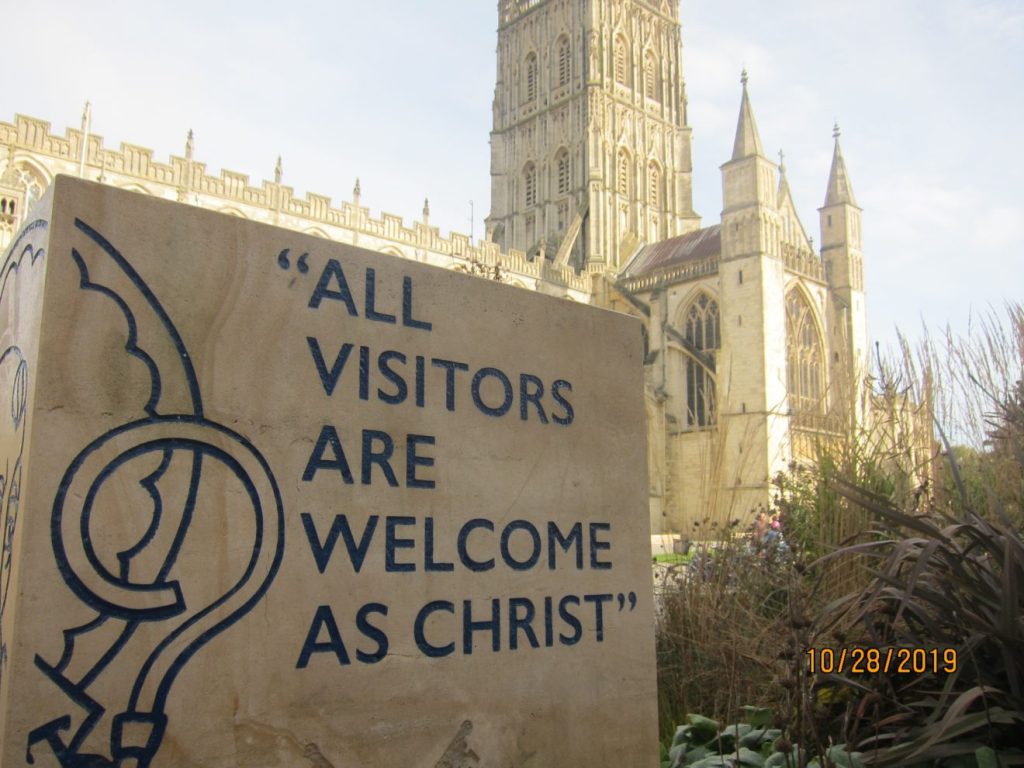
and others that you see when you’re leaving. We see different things each time we go to the cathedral, and this time my wife noticed the message on one of these large blocks of stone ‘GO IN PEACE AND LOVE.’
First thing – it’s five words.
Second thing – hang on, what does that mean exactly.
Is the word ‘love’ here meant as a noun or a verb. I’m not sure ?
I’m going to take it a a verb.
Go in peace and love.
Eating With Knives And Forks
So, I was in church this morning, and we had three readings … extracts below:
From the final words of the letter to the church in Ephesus, encouraging the community of believers to stand firm in their faith:
For our struggle is …. against the rulers, against the authorities, against the cosmic powers of this present darkness, against the spiritual forces of evil in the heavenly places.
From John’s Gospel, chapter 6, words of Jesus
It is the spirit that gives life; the flesh is useless. The words that I have spoken to you are spirit and life.
And from the book of Joshua chapter 24, Joshua addressing the Israelite nation:
“Now if you are unwilling to serve the Lord, choose this day whom you will serve, whether the gods your ancestors served in the region beyond the River or the gods of the Amorites in whose land you are living; but as for me and my household, we will serve the Lord.”
The thing that really struck me today was the way that God works through everyday living.
I was once in a class where we were asked this question by a visiting professor:
“What is the opposite of spiritual”
As we sat around waiting for one of us to be brave enough to respond, I think we were all asking ourselves – ‘Is this a trick question?’
Eventually someone piped up – ‘maybe the opposite of spiritual is physical ?’
The professor smiled, because someone had fallen into the trap he had laid.
No, no, no! He cried.
We waited. The rest of us who had been too cowardly to answer, feeling bad for the one who had stuck his head above the parapet, so to speak.
He looked at us intently. Clearly this was an important lesson that we needed to learn.
“The opposite of spiritual is unspiritual.”
Oh. Well yes, that seems logical. But what’s your point, we wondered.
Here I quote Eugene Peterson to explain the point that the professor made. “When we talk about something being spiritual, we are talking about something that God is doing.”
The mistake is to think of ‘spiritual things’ as things going on in the ether. Airy fairy. Things that don’t have any connection with life, but are more in the realm of ‘ideas about God.’
But if we take Eugene Peterson’s definition, then we’re talking about events, experiences and actions that are very much to do with real life.
In Christian Spirituality, there is an undestanding that the words and works of God are made apparent through the material stuff of our lives. In 21st century life, it’s sometimes hard to see this, since so much of our lives are lived in a bubble that removes us from the earthiness of life. We used to eat with our fingers, but now most of us use a knife and fork. There’s something about a connection with the basic essential of life – food that we have lost. I remember being invited to an Ethiopian friend for a meal, and being given no knife and fork, but quantities of ‘Injera’ – a soft sourdough type bread, slightly spongey, to gather up the food on my plate.
In his book ‘Run with the Horses.,’ Eugene Peterson describes that ‘earthy spirituality’ in this way:
“Biblical faith everywhere and always warns against siren voices that lead people away from specific and everyday engagements with weather and politics. Dogs and neighbors, shopping lists and job assignments. No true spiritual life can be distilled from or abstracted out of this world of chemicals and molecules, paying your bills and taking out the garbage. With the current interest in spirituality, we must be on guard not to revert to an other-worldly piety.”
To get back to the passages at the top of this post.
When Paul writes about contending with spiritual forces, we might picture among those forces the drive to make us want to produce more and more to satisfy our desire for aquisition and consumption. These forces are very real, and make themselves known in work places and board rooms. In lecture halls and classrooms. In shops and on T.V. and social media. In fact anywhere and everwhere you look.
When Jesus talks about the flesh being useless, he is talking about that side of our ‘fleshly’ human nature that is all about trying to be our own gods and goddesses – a seductive temptation that in the end leads nowhere.
He contrasts that kind of flesh with his own flesh – his physical body that he will give ‘for the life of the world.’
And in the third passage quoted, Joshua is challenging the people – not so much on what they believe, but how they will live. Again, moving the realm of the spiritual from ideas and beliefs to the lived life.
We had a wonderful example of that in our service this morning. Heather, our curate, was to be taking a baptism service after our morning communion service. She explained that at the moment of baptism, the minister pours the water of baptism using a scallop shell, which has long been a sign of baptism and the Christian journey. In recent months, as well as giving a baptism candle and a bible, we now give the baptised the shell that was used in their baptism.
What a powerful lesson to take away from this! Baptism is the beginning of a journey of faith, in which we are daily looking to see what God is doing in our lives and the lives of those around us – activity which is very real, whether it is made known in work places or board rooms. In lecture halls or classrooms. In shops or on T.V. and social media. In fact anywhere and everwhere you look. And in the life of the church – it is the everyday that speaks of God’s activity: water in baptism, bread and wine that we share around the table of reconciliation, and in the very beauty of creation all around us – all of life can speak to us of what God has done and is doing.
Grace and Peace.
 Five Short Words