Bible · faith · Political

Justice – Another Word For Love ?

Justice in a passage from Luke’s Gospel

I was working on a sermon earlier this week, on a text from Luke’s Gospel.

Luke 11:37-42

37 While Jesus was speaking, a Pharisee invited him to dine with him; so he went in and took his place at the table. 38 The Pharisee was amazed to see that he did not first wash before dinner. 39 Then the Lord said to him, ‘Now you Pharisees clean the outside of the cup and of the dish, but inside you are full of greed and wickedness. 40 You fools! Did not the one who made the outside make the inside also? 41 So give for alms those things that are within; and see, everything will be clean for you.

42 ‘But woe to you Pharisees! For you tithe mint and rue and herbs of all kinds, and neglect justice and the love of God; it is these you ought to have practised, without neglecting the others.

The phrase that caught my eye was this: But woe to you Pharisees! For you tithe mint and rue and herbs of all kinds, and neglect justice and the love of God.

They are just paying lip service to the command to love their neighbour. It struck me that when Jesus uses that phrase ‘Justice and the love of God,’ he is using another way of summing up the whole law – Love God and love neighbour. In other words, the idea of bringing justice to someone is what it means to love them.

Justice in Psalm 119

‘Coincidentally,’ earlier in the week, I had a part of Psalm 119 in my daily prayers and noticed that word justice again.
Psalm 119 is in 22 sections of 8 verses for each section, each section starting with one of the 22 letters of the Hebrew alphabet.
The message of the psalm is about the beauty and sufficiency of God’s law. It’s a comprehensive treatment of the importance of God’s law – demonstrated by the way that the psalm is structured using every letter of the Hebrew alphabet.

In each section there are 8 verses, and in each verse there is a word that represents the law. So the law is descibed in the following ways: Promise, Statute, Decree, Commandment, Word, Precept, Ordinance, Ways.

As far as I can see, nearly every verse in the psalm (with just a few exceptions) includes one of the words above, and interestingly I noticed the word justice crops up in two sections. (Below)

148 My eyes are awake before each watch of the night,
    that I may meditate on your promise.
149 In your steadfast love hear my voice;
    O Lord, in your justice preserve my life.
150 Those who persecute me with evil purpose draw near;
    they are far from your law.

Salvation is far from the wicked,
    for they do not seek your statutes.
156 Great is your mercy, O Lord;
    give me life according to your justice.
157 Many are my persecutors and my adversaries,
    yet I do not swerve from your decrees.

On these two occasions, I wonder if justice is intended as another word to stand in for ‘law’ etc. to remind us that justice is central to God’s law.

So, meditating on these instances of the word justice led me to the thought that justice is central to the law of love.

So what do we mean by justice ?

Walter Brueggemann has spoken about justice as “Sorting out what belongs to whom, and returning it to them.”

The word return implies that people have had things taken away from them, or do not have what rightly they should have.

The plight of the Palestinian People

A few years ago now, we became aware of the reality of life for the Palestinian people.  A key part of their story goes back to May 14th 1948, when at midnight the British mandate of Palestine ended, and the State of Israel was proclaimed. Over a short time, this resulted in over 700,000 Arabs either fleeeing or being expelled from their homes.

There are families who two generations later, still have the key of the door to the house that they lived in. Maybe grandparents have handed the key on to successive generations to keep alive the hope that one day justice may come, and they will be able to return. To mark this period of time in the history of the Palestinian people, May 15th became a annual reminder of this forced expulsion, and was named Nakba Day. (Nakba means catastrophe)

Justice is about sorting out what belongs to whom and returning it to them, but the injustice of land grabbing is still happening today in many parts of the world, including Israel, where Israelis are illegally taking land from Palestinian people that has been theirs for generations, to build Israeli settlements.

The Skyline Drive

In 2009, I had a sabbatical, and spent part of the time studying at Eastern Mennonite University doing some of their Summer School modules. I was fortunate enough to also be able to spend 10 days with my wife and son travelling around the state of Virginia in the USA.

One day, we found ourselves driving on the Skyline Drive, a 105 mile route that runs through the Shenandoah National Forest, from Front Royal in the north to Waynesboro in the south.  In order to set up the national park back in the 1930’s, the federal government had to buy the land, which involved resettling hundreds of people who were living in the area.  Many of these people did not want to move, and there were numerous court cases as they challenged the right of the government to move them off their land.  

Justice is about sorting out what belongs to whom and returning it to them. Sadly, those families lost their homes and in many cases their livelihoods. Even though they were resettled, they had been forcibly uprooted from homes they had known in some cases for generations.

The widow, the orphan and the stranger

Another take on justice runs right through the Old Testament. It’s not so much about giving people back what they have lost, but enabling them to enjoy what everyone else enjoys. The current word is ‘agency’ – justice is when the poor have agency to access the things that I take for granted – food, shelter, lack of violence, work, community, healthcare ….

In the Old Testament the people who most often need justice were widows orphans and strangers. That’s because they were the people who did not have anyone to speak on their behalf.

In that patriarchal society, a married woman would need her husband to get justice, but a widow is on her own in that world; an umarried woman would have her father to speak for her, but an orphan is on their own. They have no one to speak for them.  Similarly a stanger – that is, a foreigner living within Israel would be on their own.

It is these people, above all, who should be cared for.  The way to show that we love neighbour is how we treat the weakest in our society, those who have no one to advocate for them.

What comes to mind now, are the people in my community who are working for justice:
Gloucester City Mission, who work with those who have no home to call their own. At one time, they did have a home, but for whatever reason, they are now on the street or in temporary accommodation.  GCM are working to return a home for the homeless.
Emmaus Communities are also working for justice for the homeless – to help people in getting back what we should all have as a human right – a home.
Gloucester Food Bank. I pray for the day when all the food banks will have closed.  When there will be no one who is going without another human right – food to sustain them. But until that day, we thank God for those who are working for justice for the hungry. To give back what has been taken away
And lastly GARAS – Gloucestershire Action for Refugees and Asylum Seekers. They are working with those who have had so much taken away from them.  Country, Community, Home, Job, Family, Dignity … Justice is about giving back to them what every human being should enjoy by right.

For Jesus, justice and love are part of the same law. The command to uphold justice for the weakest is central to the DNA of the church. Without justice we are empty, we have nothing. Without justice we are just making a noise

But when we work for justice, we are serving those who have no protection, no one to speak for them, the ones without a voice – working to include them and embrace them so that they, like us can share in the bounty that God has given us all to enjoy.

Grace, Peace and Justice.

Activism · Climate Change · community · Ecology

A Movement On The March

I’ve been trying to set aside time to write about this for a week now. Finally had to get on and do it.
Last Tuesday we walked with a group of about 15 others the 12 or so miles from Gloucester to Tewkesbury – as part of a pilgrimage from Bristol to Glasgow, timed to arrive in Glasgow for COP26.

We joined just for a day, whereas most of the group were walking for the whole two weeks. In fact there were a handful of people who were aiming to make it all the way to Glasgow!

The passion and commitment of all those making this pilgrimage is amazing to see, and we felt humbled and privileged to be a part of it.

A couple of conversations with other pilgrims have stayed with me. One conversation early on in the day was to do with wondering how effective this type of action is ? Can a relatively small group of activists really bring about change ? I imagine that those who are doing the whole walk will ask themselves this question at some point.

We had two periods of about an hour’s silence either side of our lunch stop, and I used the time to think about that conversation. One thought that came to me was to do with the teaching of Jesus about what the New Testament calls ‘The Kingdom of Heaven.’ Jesus uses images of tiny things – like a very small seed, or a small amount of yeast – and teaches that this is how God typically works. Through small things. That’s actually just as well, because most of us can only do the small things.

But it’s more than that. It’s more than knowing that God works through the small things that we offer. It’s also about how those small things can have an effect far greater than you might imagine. Those small things can be agents of change to bring about transformations that are way, way bigger than the small thing that we did.

There’s also something about the power of doing the small thing with others. The power of community to bring about change.

The other conversation that I had, later on in the day, was with H, who shared with me her passion for the good of the earth, that has resulted in her getting involved in addressing the Climate Emergency. I mostly listened. I think we have to talk now about the Climate Emergency, rather than Climate Change. While we try in small ways to make a difference in our own lives, we are in awe of those who are making big sacrifices to get this message out there.

In the week since we joined the pilgrimage, they have travelled from Tewkesbury to Malvern, Worcester, Stourport, Coventry and into Birmingham.

In the last week, I cam across this article in the Guardian, where an analysis has been done of the number of terms a variety of terms appeared on UK Television in 2020.

For example, Dog has 286,626 mentions, 22 times more than Climate Change at 12,715, and ‘Banana Bread’ is heard more times than Wind Power and Solar Power combined. See the article here.

There’s something wrong there, isn’t there.

Grace and Peace.

faith · Following Jesus

Go In Peace And Love

We had my sister come to stay last week for a couple of days, and as we often do, we walked into the centre of Gloucester and spent some time in the cathedral.

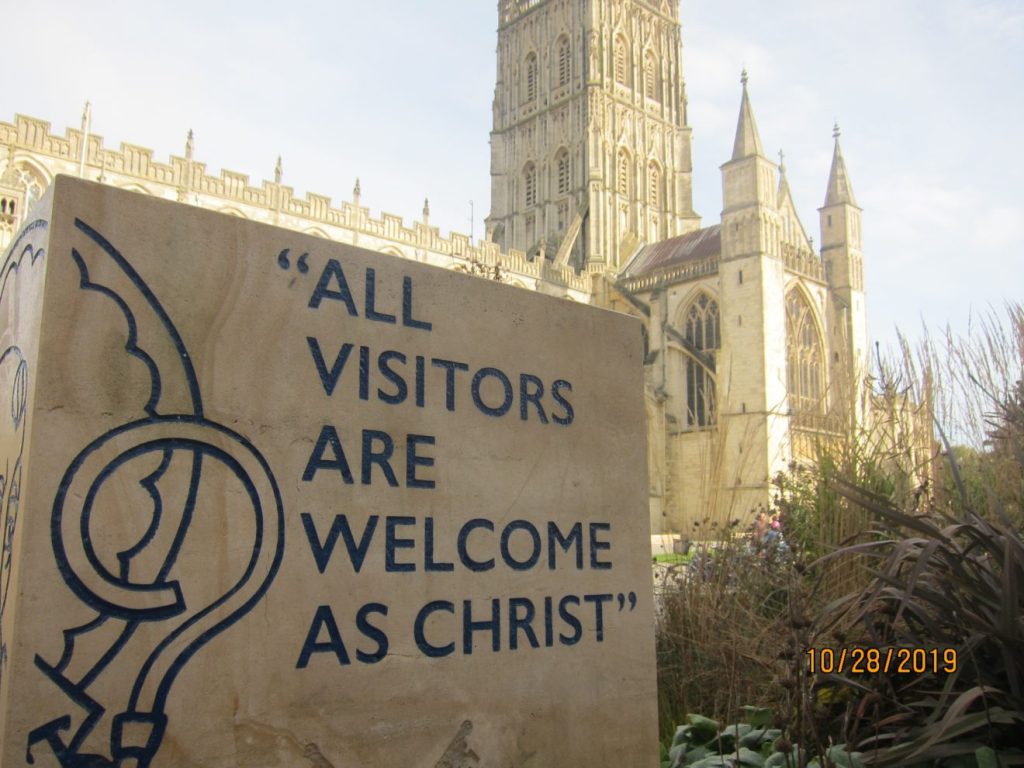
There are some large blocks of stone as you enter the cathedral grounds, each with a different message. There are some with messages of welcome, facing you as you arrive …

and others that you see when you’re leaving. We see different things each time we go to the cathedral, and this time my wife noticed the message on one of these large blocks of stone ‘GO IN PEACE AND LOVE.’

First thing – it’s five words.
Second thing – hang on, what does that mean exactly.

Is the word ‘love’ here meant as a noun or a verb. I’m not sure ?

I’m going to take it a a verb.

Go in peace and love.

Bible · Church · faith · Following Jesus

Eating With Knives And Forks

So, I was in church this morning, and we had three readings … extracts below:

From the final words of the letter to the church in Ephesus, encouraging the community of believers to stand firm in their faith:
For our struggle is …. against the rulers, against the authorities, against the cosmic powers of this present darkness, against the spiritual forces of evil in the heavenly places.

From John’s Gospel, chapter 6, words of Jesus
It is the spirit that gives life; the flesh is useless. The words that I have spoken to you are spirit and life.

And from the book of Joshua chapter 24, Joshua addressing the Israelite nation:
Now if you are unwilling to serve the Lord, choose this day whom you will serve, whether the gods your ancestors served in the region beyond the River or the gods of the Amorites in whose land you are living; but as for me and my household, we will serve the Lord.”

The thing that really struck me today was the way that God works through everyday living.

I was once in a class where we were asked this question by a visiting professor:
“What is the opposite of spiritual”

As we sat around waiting for one of us to be brave enough to respond, I think we were all asking ourselves – ‘Is this a trick question?’
Eventually someone piped up – ‘maybe the opposite of spiritual is physical ?’
The professor smiled, because someone had fallen into the trap he had laid.
No, no, no! He cried.
We waited. The rest of us who had been too cowardly to answer, feeling bad for the one who had stuck his head above the parapet, so to speak.

He looked at us intently. Clearly this was an important lesson that we needed to learn.
“The opposite of spiritual is unspiritual.”

Oh. Well yes, that seems logical. But what’s your point, we wondered.

Here I quote Eugene Peterson to explain the point that the professor made. “When we talk about something being spiritual, we are talking about something that God is doing.”

The mistake is to think of ‘spiritual things’ as things going on in the ether. Airy fairy. Things that don’t have any connection with life, but are more in the realm of ‘ideas about God.’

But if we take Eugene Peterson’s definition, then we’re talking about events, experiences and actions that are very much to do with real life.

In Christian Spirituality, there is an undestanding that the words and works of God are made apparent through the material stuff of our lives. In 21st century life, it’s sometimes hard to see this, since so much of our lives are lived in a bubble that removes us from the earthiness of life. We used to eat with our fingers, but now most of us use a knife and fork. There’s something about a connection with the basic essential of life – food that we have lost. I remember being invited to an Ethiopian friend for a meal, and being given no knife and fork, but quantities of ‘Injera’ – a soft sourdough type bread, slightly spongey, to gather up the food on my plate.

In his book ‘Run with the Horses.,’ Eugene Peterson describes that ‘earthy spirituality’ in this way:
“Biblical faith everywhere and always warns against siren voices that lead people away from specific and everyday engagements with weather and politics. Dogs and neighbors, shopping lists and job assignments. No true spiritual life can be distilled from or abstracted out of this world of chemicals and molecules, paying your bills and taking out the garbage. With the current interest in spirituality, we must be on guard not to revert to an other-worldly piety.”

To get back to the passages at the top of this post.
When Paul writes about contending with spiritual forces, we might picture among those forces the drive to make us want to produce more and more to satisfy our desire for aquisition and consumption. These forces are very real, and make themselves known in work places and board rooms. In lecture halls and classrooms. In shops and on T.V. and social media. In fact anywhere and everwhere you look.

When Jesus talks about the flesh being useless, he is talking about that side of our ‘fleshly’ human nature that is all about trying to be our own gods and goddesses – a seductive temptation that in the end leads nowhere.
He contrasts that kind of flesh with his own flesh – his physical body that he will give ‘for the life of the world.’

And in the third passage quoted, Joshua is challenging the people – not so much on what they believe, but how they will live. Again, moving the realm of the spiritual from ideas and beliefs to the lived life.

We had a wonderful example of that in our service this morning. Heather, our curate, was to be taking a baptism service after our morning communion service. She explained that at the moment of baptism, the minister pours the water of baptism using a scallop shell, which has long been a sign of baptism and the Christian journey. In recent months, as well as giving a baptism candle and a bible, we now give the baptised the shell that was used in their baptism.

What a powerful lesson to take away from this! Baptism is the beginning of a journey of faith, in which we are daily looking to see what God is doing in our lives and the lives of those around us – activity which is very real, whether it is made known in work places or board rooms. In lecture halls or classrooms. In shops or on T.V. and social media. In fact anywhere and everwhere you look. And in the life of the church – it is the everyday that speaks of God’s activity: water in baptism, bread and wine that we share around the table of reconciliation, and in the very beauty of creation all around us – all of life can speak to us of what God has done and is doing.

Grace and Peace.


Activism · Bible · Ecology · Political · Prayer · World Affairs

Spirit-Led Movements Always Perplex

This is a part of chapter 5 of the book of Acts in the New Testament.

12 The apostles performed many signs and wonders among the people. And all the believers used to meet together in Solomon’s Colonnade. 13 No one else dared join them, even though they were highly regarded by the people. 14 Nevertheless, more and more men and women believed in the Lord and were added to their number. 15 As a result, people brought the sick into the streets and laid them on beds and mats so that at least Peter’s shadow might fall on some of them as he passed by. 16 Crowds gathered also from the towns around Jerusalem, bringing their sick and those tormented by impure spirits, and all of them were healed. 17 Then the high priest and all his associates, who were members of the party of the Sadducees, were filled with jealousy. 18 They arrested the apostles and put them in the public jail. 19 But during the night an angel of the Lord opened the doors of the jail and brought them out. 20 “Go, stand in the temple courts,” he said, “and tell the people all about this new life.”

This is the account of the beginnings of the church. However, at this stage, it’s a movement within Judaism, but claiming something new that is driving a wedge between the powers that be and this new phenomenon.
(The new thing being a proclamation of the resurrection of Jesus).

I’ve written before about categories that characterise the work of the Spirit …
Inclusion … (contrasted with exclusion)
Abundance v Scarcity
Economic Justice v Coercive Power
Connectedness v Individualism
Cooperation v Competition
Solidarity v Looking After #1

In the account in Acts, the tension is between:
Voices that are determined to speak, and the forces that want to silence them
New possibilities that are emerging and present arrangements
Emancipation and Intimidation

When I was thinking about how this might play out today, there are numerous examples, but one that comes to mind is Extinction Rebellion.
How might we all play a part in the fight to put the climate emergency at the top of the political agenda ?

My thoughts are also turning to Afghanistan today. Western powers have much to regret and reflect on over past mistakes, but it’s clear that an immediate concern is the way that ‘present arragements’ in the form of fundamentalism are at play:
Silencing the voices that have begun to speak, quashing the new possibilities that have been possible (education of girls for example), and using intimidation to restrict the freedoms that are a human right.

Grace and Peace, and prayers especially for the Afghan people.


Film · Storytelling

The Power Of A Story

Spoiler Alert

We’ve just watched the film ‘The Mule,’ starring Clint Eastwood. The premise of the film is that Earl, the character played by Clint Eastwood has put his work as a horticulturist before his family. We see important family occasions – christenings, confirmations, graduations etc where he is absent – on one occasion at a flower show getting an award for his prize winning day lilies.

The film moves forward 12 years – his horticultural business has failed because of competition from firms using the internet more and more, and he is about to lose his whole livelihood.

It’s at this point that an unusual opportunity comes along – to simply drive hundreds of miles across the country and deliver some packages – we soon learn that he is working for a drug cartel transporting large quantities of cocaine.

He agrees to do one trip and buys a new truck with the money he gets. Although he only intended one trip, he does more trips, using the proceeds to save his home, pay for the refurbishment of a veteran’s club and finance his granddaughter’s college education.

The framework of the story is his activity as a drug mule and the attempts of law enforcement who are investigating the drug cartel.

You might ask questions about all the people whose lives are being ruined by taking cocaine, and the violent lives of the cartel members, but that’s not what the story is about. The background of cartel and drug running enables the full power of the family story to come through.

The heart of the story is about Earl’s relationship, or rather lack of relationship with his ex wife and daughter. This is the story of the film, but it is told using the drug running as a way of telling that story.

The film raises questions about story-telling and how legitimate it is to use such an immoral, criminal framework without any comment on the immorality of that surrounding story.

It made me think about some biblical stories, especially in the Old Testament, where we might miss the whole point of the story by focussing on our unease with the way the story is being told.

Ecology · Song for Today

Song For Today # 27

This song came to mind yesterday. It seems more and more relevant as the days go by. It’s written by Spirit’s lead guitarist, Randy California. Other songs of his indicate a sensitivity to a world beyond the materialistic and a desire to be guided by a higher power. The song appears on Spirit’s 1970 album, ‘The Twelve Dreams of Doctor Sardonicus.’ If you’re into rock music, give the album a listen. They are a band from the late 60’s and early 70’s who didn’t achieve the superstar status of some other bands, but their music has stood the test of time.

Here’s a live version with Randy California on guitar and vocal, Ed Cassidy on drums and Mike Nile on bass. It’s a beatiful version with an exquisite harmony vocal and a brief example of Randy California’s understated lead guitar playing.

Nature’s Way

It’s nature’s way of telling you something’s wrong
It’s nature’s way of telling you in a song
It’s nature’s way of receiving you
It’s nature’s way of retrieving you
It’s nature’s way of telling you something’s wrong

It’s nature’s way of telling you, it’s in the breeze
It’s nature’s way of telling you, dying trees
It’s nature’s way of receiving you
It’s nature’s way of retrieving you
It’s nature’s way of telling you something’s wrong

It’s nature’s way, it’s nature’s way

It’s nature’s way of telling you something’s wrong
It’s nature’s way of telling you in a song, oh
It’s nature’s way of receiving you (it’s nature’s way)
It’s nature’s way of retrieving you (it’s nature’s way)
It’s nature’s way of telling you something’s wrong
Something’s wrong
Something’s wrong

Grace and Peace.

Prayer

The Sacred Duty Of Prayer

In the Hebrew Bible, pretty much the first commandment that the Israelites receive from God after being liberated from Egypt is the commandment to keep the Sabbath. Maybe their recent history of seven-day-a-week slavery meant that they had developed a compulsion to work without stopping ?

It’s certainly a weakness of our society. In an environment driven by consumption and control, we need to hear the command to stop and take that regular break from economic activity. It might just be the most important commandment, because by paying attention to it, we open ourselves up to hearing God – and, in the course of stopping and being attentive, we stand a chance of following the commandment to put God first.

There is however, a down side to the commandment to keep Sabbath – we run the risk of making our life of faith a one day a week affair when it is meant to be a whole of life endeavour. If we can keep the balance – make space for sabbath whilst at the same time living our faith every day – then that’s fine.

But is it possible that some societies have not succumbed to that desire for continous ‘work without ceasing’, but have been able to balance the various aspects of life in a wholesome and life enhancing way ?
Here’s a quote from ‘A book of Native American Wisdom.’ ‘In a Sacred Manner I Live.’

In the life of an indian there was only one inevitable duty – the duty of prayer – the daily recognition of the Unseen and Eternal. His daily devotions were more necessary to him than daily food. He wakes at daybreak, puts on his mocassins, and steps down to the water’s edge. Here he throws handfuls of clear, cold water into his face, or plunges in bodily. After the bath, he stands erect before the advancing dawn, facing the sun as it dances on the horizon, and offers his unspoken orison. His mate may precede or follow him in his devotiopns, but never accompanies him. Each soul must meet the morning sun, the new sweet earth, and the Great Silence alone.

Whenever, in the course of the daily hunt, the red hunter comes across a scene that is strikingly beautiful or sublime – a black thundercloud with the rainbow’s glowing arch above the mountain, a white waterfall in the heart of a green gorge; a vast prairie tinged with the blood-red of sunset – he pauses for an instant in the attitude of worship. He sees no need for setting apart one day in seven as a holy day, since to him all days are God’s.

Charles A. Eastman. Ohiyesa.
WAHPETON SIOUX Lakota

Charles A. Eastman (1858 – 1939) was one of the first Native American authors to achieve widespread fame.

May you find that place of spacious living that allows you live fully in God, for God to live in you.

Church · community · Worship

The Work Of A Leader

This post is a quote from a book by Richard Giles – At Heaven’s Gate.

So with yourselves; since you are eager for spiritual gifts, strive to excel in them for building up the church.
1 Corinthians 14 verse 12

The chief work of a good leader is to build community. The true pastor is one who works with devoted skill, tender loving care, and infinite patience to nurture a community of faith into fullness of being; surrendering to the work of the Spirit of God ‘until all of us come to the unity of the faith and of knowledge of the Son of God, to maturity of the full stature of Christ.’ (Ephesians 4 verse 15)

Good worship springs from an authentic and palpable sense of community. Once we learn to ‘cook on gas’ as a genuinely interactive community of faith, we shall draw forth from one another a whole range of talents and ministries to create extraordinary worship …. good worship, at the local level, week in week out, depends very much on the quality of common life enjoyed by that local community. Good worship begins with a whole and happy community.

It cannot be done the other way round – for worship to be used as a sticking plaster for a dysfunctional community will not last very long. It is not much use devising creative acts of worship that we hope will somehow put the community back together again. The human heart is stubborn and contrary, and conflict will need to be addressed and wounds healed. We cannot look the other way when a community is hurting inside, for good worship continue to be beyond us if we are not right with each other, not at ease with who we are as a body.

At Heaven’s Gate pages 16 & 17

Bible · community · Following Jesus

Then Moses Climbed Mount Nebo

We were round at some friends yesterday evening catching up not having seem them for a while. They were telling us about their recent short trip in South Wales. One day they went to the top of Pen-Y-Fan, hoping to enjoy the spectacular view from the top. The weather was clear when they started out, but by the time they had reached the top, it was covered in cloud !

They told us about their trip around Europe some years ago – that as they arrived at each new area, town, city, etc, they would look for a high place to be able to see the landscape around them, and to get a feel for where they were in that landscape. It might be a hill, or a tower, and anything that gave them some kind of overview. Maybe they’ll get to go back to Pen-Y-Fan one day and take in that glorious view.

There’s a hill near where we live called Robinswood Hill which rises to just under 200m metres. From the top, you can see all around – the city of Gloucester below us; the Malvern Hills to the North West; the Severn Valley to the South; Cheltenham and the Cotswolds to the East. It’s a wonderful spot.

Although we were thinking about literal high places, I wondered about another question to do with our neighbourhood, which is just under a mile from Gloucester City centre – If we imagined ourselves high above the streets where we live, what would we see, and how do we understand our place within it ?

In my reading just this morning, I read this passage from the Hebrew scriptures. It’s a part that describes the end of the life of Moses. Just before he dies, he is given the chance to look down from a high place (Mount Nebo), over the land that God has promised to Israel.

Then Moses climbed Mount Nebo from the plains of Moab to the top of Pisgah, across from Jericho. There the Lord showed him the whole land—from Gilead to Dan, all of Naphtali, the territory of Ephraim and Manasseh, all the land of Judah as far as the Mediterranean Sea, the Negev and the whole region from the Valley of Jericho, the City of Palms, as far as Zoar. Then the Lord said to him, “This is the land I promised on oath to Abraham, Isaac and Jacob when I said, ‘I will give it to your descendants.’ I have let you see it with your eyes, but you will not cross over into it.”
Deuteronomy Chapter 34.

It’s one of those coincidences that seem to happen from time to time – when you’ve been thinking about something, and then it pops up soon afterwards from a completely different place. It seems like God is telling you to keep thinking and asking what this is all about. I’m pondering what this might mean for us …

In the early church, one of the ways that leadership was described was to do with being able to see the ‘Big Picture.’ The Greek word is Episcope.
It’s not a word we’re particularly familiar with, but we do know other related words – microscope, telescope, periscope … all intruments designed to see something – something small, something far away, something above you …

If there were such an instrument as an episcope, it would be something that would help you to see the lie of the land around you. An overview. An important aspect of leadership is to be able to so this. It might mean that you’re less likely to get caught up in distractions. You have an idea of what the task is. You have a grasp of what’s needed.

Strangely, it’s about getting a broad view, but one that helps you stay focussed.

Part of the call to follow Jesus involves ‘getting to a high place’ to see the lie of the land. The essential tool for this work is listening. Listening to others tell their stories. Finding out what is important to our friends and neighbours. Learning how to serve those around us.

One of the other passages I read this morning was from St Paul’s letter to the church in Rome – these words seem ver relevant to the call to ‘Know Jesus, and to Make Jesus Known.’
How can people call for help if they don’t know who to trust? And how can they know who to trust if they haven’t heard of the One who can be trusted? And how can they hear if nobody tells them? And how is anyone going to tell them, unless someone is sent to do it? Romans Chaprter 10.

<><