Creativity,

I’m Not Able To Visualise

I’ve been a bit frustrated recently. I’ve had so many ideas buzzing round in my head, but just not able to get my thoughts into a coherent shape. I think I’m trying too hard. I need to focus more on my own experience, rather than regurgitating titbits from other people. At least, that’s how it feels today. So here’s something I’ve discovered about myself this week …

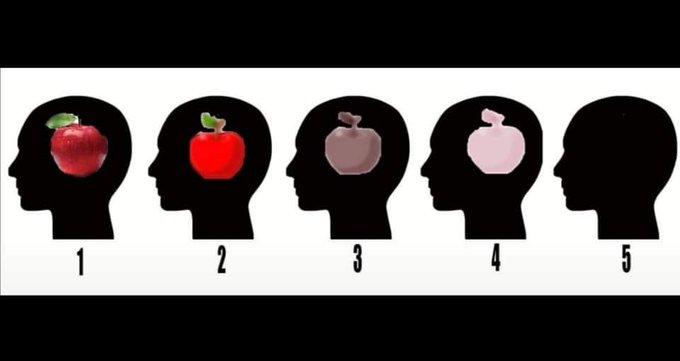
Our daughter sent us a thing from twitter

The question was … if you were to visualise an apple, would you see it clearly like number 1 above, or not at all like number 5, or somewhere in between ?

My wife immediately said she could see it clearly with detail. I said – ‘What, like a photo ?’ – ‘Yes’ she said
Me: But I don’t ‘see’ anything. I can imagine what an apple looks like, but I can’t see it! So can you see other things as well ?
Her: Yes.
Me: Wow! That’s amazing.

I suppose I might be a 4, but definitely not a 1, a 2, or a 3.

Weirdly, in the 40 years we have been together, this has never come up.

So I then asked her about hearing things.
Me: Can you hear people’s voices in your head ?
Her: Oh yes.
Me: What, like hearing them speak in their own voice ?
Her: Yes.
Me: Wow ! That’s also amazing.

I think I’m a bit more able to do that, but it seems not as clearly as my wife.

b   .What I can hear – (it’s there all the time, but sometimes I’m not aware of it) – is tinitus, more in my left ear than my right.
But that’s different, and annoying rather than cool.

Now my memory is shocking. Some of it may be age related, but I’ve never been good at remembering details from my past. My childhood is an empty page, mostly. If I want to know something about my childhood, I have to ask my sisters.

Is that related ? The condition of not being able to visualise is called Aphantasia. Is it related to the ability to hold memories ?

It’s so interesting how we’re all different …

Church · community · faith · Following Jesus · Theology · Worship

Re-Imagining Eucharist

OK, so this is two words. Having five word titles is a challenge I set myself, as well as being a web address (fiveshortwords.com) that was available! I think it’s time to allow myself to break the rule if I need to. Plus, as this is a post about rule-breaking, it seems appropriate.

So to Eucharist. The central act of weekly worship in many Christian churches. Eucharist was not a word I was familiar with when I was growing up. For the Christian community of my childhood it was known as The Lord’s Supper. Also known as Breaking of Bread. In other traditions it’s known as Communion, Mass and Eucharist. I’m using Eucharist here because it seems to be the word that is most used these days in a lot of Church of England circles. It’s the act of worship where we remember Jesus’ Last Supper, and his command to remember him by eating bread and drinking wine, just as they would have done at that meal.

In another post, I have written about the ‘High Hedge’ that separates those who are ‘in’, with those who are ‘out,’ in some churches. The highest hedge would mean someone had to be baptised, and confirmed in order to receive the bread and the wine.

None of the words that are used to describe this central act of worship suggest this high hedge. The Lord’s Supper suggests a meal, as does The Breaking of Bread. Communion suggests fellowship and intimacy. The word Mass (from the Latin Mittere, to send) is to do with being sent to be the God’s People For God’s World. Eucharist is from the Greek word meaning thanksgiving.

Maybe if we were being honest we should rename this family meal as Phractis – Greek for hedge. The word phractis itself sounds like fraction, which is when something is split into parts – in the case of Eucharist, those who receive and those who don’t.

A few years ago I heard Sarah Miles tell her story of coming to faith in Jesus. She had never been to church. She had never been taken by her parents. She was from a non-religious background. But one day she was passing a church and felt compelled to go in. When it came to the time for communion, she knew instinctively that this was something she wanted, and needed. As she held her hands out in expectation, someone put the bread into her hands. This was the start of her journey of faith.

As I read the Gospels, I see Jesus sharing meals with people without any restrictions. He eats with ‘tax collectors and sinners,’ people who were on the outside of the religious community. He knew that when you eat with people, connections are made. People share, not only their food, but themselves. The best meals are where we get beyond polite conversation to reflect on the big questions that our lives are asking us. Not every time we share a meal, for sure, do we ask these questions, but if we never ask them, then we’re not really sharing our lives.
What makes your heart sing ? What’s the best thing in your life at the moment ? Did you see the sunset yesterday ? How do I bring up my kids in this crazy world ? How do I put bread on the table when I’m out of work ? How can I look after my elderly parent as well as everything else I’m supposed to do ? How do I live with myself, when I know all the bad stuff that others don’t see ? ….. (you add your own question)

There is a ‘high hedge’ in the Gospels, but it seems to be all about following Jesus. That in the end is what divided people – into those who were willing to take a risk and see where it led, and those who decided to stick with what they knew. If there is a holy act that expresses this desire to be a follower, then it’s baptism. That’s the hedge.

But certainly in the established church in this country we got it the wrong way round. We made baptism available to everyone and anyone without fully explaining that this was a serious life choice.
And at the same time we said that you weren’t supposed to share in the family meal. There was a limit to the hospitality that we could offer.

It’s like if you invited some friends round for the evening. Come at 7, you said. So they arrive at 7 just as you are sitting down to your evening meal. And you ‘welcome’ them into the same room where you are eating, but you went on and ate your meal while they waited for you to finish.

What am I saying ? Throw out hundreds of years of church practice ? Pretend I know better ?

Just think how it would be if there was another way to share bread and wine. A meal that would be just as holy, just as mystical, just as life changing. A meal that just as clearly had Jesus at the centre, but which didn’t bar anyone from joining in. A meal that could happen anywhere, anytime, for anyone.

I wonder how many preachers, church leaders, priests and pastors would say Yes to this ? It might be threatening. It might be risky. It might be difficult to square with your theology.

And then again, it might be wonderful.

Grace and peace.

Bible · Church · faith · Following Jesus · Jesus · Theology

New Light On St Paul

OK. It’s been a while. I’ve had so many ideas but never got round to getting it down. Here’s a few thoughts from Tom Wright, otherwise known as N.T. Wright. He was Bishop of Durham for a while, but is best known as an academic whose whole adult life has been spent studying the life and writings of St Paul.

He wrote a book about the life of St Paul that came out three years ago. I haven’t read it, but heard him talk about it on the Nomad Podacst.

To start with, his name is originally Saul. He comes from a conservative tradition in Judaism, and as the book of Acts describes, will do anything to protect Judaism from what he sees as unhealthy, misguided influences. One of those ‘way out’ movements is of course, what he would see as the cult of Jesus. Saul is basically a fundamentalist, and will track down followers of Jesus, and condone killing them for the cause of religious purity. Hence the stoning of Stephen, one of the prominent members of what we would call the early church. Saul is at this point a violent man, determined to put a stop to this abberation of the faith that he treasures.

But to call it the early church is slightly misleading – at this early point in the evolution of the Jesus movement, we’re talking about a community that is mostly made up of Jews before the word Christian has even been uttered. When we read the word ‘church’ in our English translations, the original Greek word is better translated by ‘gathering,’ ‘assembly, ‘ or ‘company.’

Tom Wright reminds us how important it is to understand the first century context of the words that we read. Another example of where we might have been reading this wrongly is to do with what we might have called the ‘conversion’ of Saul. Growing up, I had the impression that on the road to Damascus, when Saul has his experience of Jesus, it is at that point that he ‘becomes a Christian.’
(You can read the account in Acts chapter 9)

But at that point in time, there was no such thing as a Christian. There was no separate religion called Christianity. Saul was a Jew who had such a profound and mystical experience of the risen Christ, that he suddenly sees that he has been mistaken, and that Jesus is in fact, the Messiah of God. He doesn’t stop being a faithful Jew, and would in all likelihood continue in exactly the same way as he had done before regarding his religious observance, but now seeing that the promised Messiah has in fact come – in the person of Jesus Christ.

After this life changing encounter, at some point early on, Saul disappears off to Arabia for three years. It’s not clear exactly where he went or what he did during these three years, but Tom Wright has a theory … first a bit of background:

Back in the First Testament, * the prophet Elijah is at a turning point in his life. He had just defeated the 400 prophets of Baal, and was on the run from king Ahab and his wife Jezebel. At this time of great stress in his life, where does he go ? To mount Horeb. Mount Horeb is essentially the same as Mount Sinai, where Moses received the Ten Commandments. So Elijah is going back to the place where it all started. The place where God made it clear that the children of Israel were a ‘set apart people.’ They had a call to be God’s people for the nations. At Mount Horeb, God meets with Elijah and he gets the commissioning and strength that he needs for the next phase in his ministry. God tells Elijah that he is to ‘Go back the way you came, to Damascus.’ Once there, he was to anoint Jehu as the new king of Israel.

Tom Wright’s theory is that Arabia was the region that included Mount Sinai. Where would Saul go to think through the experience that he had on the road to Damascus ? Maybe back to where it all started – to Mount Sinai. Saul’s roots are in the ancient story of Israel’s deliverance from slavery; the journeying through the wilderness; the call to live as the people of God. So Saul goes to Sinai, to learn what this new call to follow Jesus will mean. And at the end of those three years, where does he go ? Back the way he came, to Damascus. And once there he will share the news that a new king has been anointed – Jesus. And that this good news of Jesus is for all people, both Jew and Greek, men and women, slave and free. And that this new community will be different from any community previously known, because it will not be according to your ethnic group, or whether you were a man or a woman, or a slave or a free person. This new community will break all the rules and be for all.

I feel like I should read the book !

And, as I was pondering on this alternative, radical new community that we see in the book of Acts, it made me think about my own experience of the church, and to what extent the churches I have been a part of have been ethnically diverse, with men and women both accepted fully, with class, background, education and social status not being an issue. Sadly, it seems that churches by default become fairly monocultural, not at all the vision that Paul had … 2000 years later it’s still a work in progress. Additionally, there are movements within the church that see the growth of the church being most effective when this mono approach is used – because like attracts like. This is in sharp contrast to the kingdom vision of a diverse community, which although it is often a more challenging environment, has within it the possibility of fully enacting the principles of love. Such a Christian community is truly a thing of great beauty.

* Christians have generally called the first part of the Bible ‘The Old Testament.’ But there are dangers in that. It might lead us to think that we can leave all of that behind. Now we have the New, we don’t need the Old. The New Testament gives us everything we need. In a sense that is true, but we are greatly impoverished in our undertanding of Jesus if we do not understand his roots, which lie in the work of God through Israel. If we only know the New Testament, we don’t know the New Testament! There is so much richness in the books of Moses, the history books, the wisdom and the prophets that we need to attend to. There has been a move to call these writings ‘The Hebrew Bible,’ but others are more inclined to use the phrase ‘First Testament,’ which gives those writings a more exalted place than ‘Old Testament,’ and unlike the phrase Hebrew Bible gives them their righful place within the whole revelation of God’s love and purposes.

Grace and Peace

Bible · Following Jesus · Political · World Affairs

There Is None So Blind

A lyric from an old song “Everything is Beautiful” by Ray Stevens goes like this “there is none so blind, as those who will not see.”
In this form of a proverb, it might date back to 1546, but it probably has its roots in the Bible.

I was reading in John Gospel chapter 9 this morning. It’s the account of the healing of a man born blind. Now, because it happened on the Sabbath, when it was against the Jewish Law to work, an argument follows the healing – if Jesus was really from God, would he have done such an outrageous thing ?

As well as the physical healing, which enabled the man to see for the first time, there’s also the question of a different kind of seeing, which is to do with seeing the truth about how things really are, and making an appropriate response.

One of Jesus’ claims is to be ‘The Light of the World,’ which is about revealing how things really are. Enabling people to ‘see.’
The religious leaders take exception to this claim, and ask Jesus …. ‘Are you saying that we’re blind ?’

Some of the Pharisees near him heard this and said to him, ‘Surely we are not blind, are we?’ (John 9:40)

Jesus’ response is perhaps surprising:

41 Jesus said to them, ‘If you were blind, you would not have sin. But now that you say, “We see”, your sin remains. (John 9:41)

What he is saying in essence is this: they are not blind – they can see perfectly well. ‘If they were blind, they would have an excuse for not seeing the evidence of Jesus’ power. They are guilty because they have seen, and should have known better than to refuse the power of God.’ *
* Walter Brueggemann in ‘Gift and Task’ a year of daily readings and reflections.

In the Gospel, the religious leaders are more interested in preserving the status quo, and their position of influence. Jesus is a big threat to that power.

It made me think of current situations where people in power might see quite clearly where there is a need for change, but that change would threaten to take away their influence, so they hold on to their power. They should know better.

As always, the challenge is there for me too. Where should I know better ?

music · Songwriting

Thoughts On Constructing A Building

Well, not a building actually, more a song. I was listening to apodcast the other day that features songwriters being interviewed. So far I have listened to Dan Penn and more recently Jimmy Webb. They were both fascinating in their different ways.

One of the stories Dan Penn tells goes back to when he was around 16, and out with a group of friends. Someone would ask a question like – Do you like fried chicken, and his friend would answer ‘Is a blue bird blue ?’
(It’s like ‘Is the Pope a catholic ?’). As the evening went on, this became a running joke, and somewhere in his brain, Dan stored up that line, and it emerged in one of his first lyrics, which became a hit for Conway Twitty in 1960.

Well, me and my girl went out the other night,
Down lovers lane we were walkin
She said, Honey child, do you love me?
Right away I started talkin.

Is a bluebird blue?
Has a cat got a tail?
Hmm, is a blue bird blue?
Well honey, I love you.

So to Jimmy Webb. In 1998 or so, Jimmy Webb wrote a book – Tunesmith – about the art of songwriting, which of course, as an amateur songwriter I had to have. I’ve just started reading it, and it’s reassuring to see that some of the things I have been doing instinctively are part of the songwriters craft.
I want to quote a section from the book where he likens writing a song to building a structure of some sort – a house, a barn, a block of flats or whatever.

Firstly you have to have an idea of what it is you’re building. In other words, to start with, you need to know what the song is about. You need the big idea. And, in the same way that a building uses a variety of materials, you song will use a variety of words.

Here’s the quote: ‘In the dictionary, he finds oaken words, words of stone and paper, plywood words and words like steel beams, words of ironwood and ash, rich resonant words of mahogany and cherry, rococo words that swirl like burled walnut, simple pungent pine words, heavy words of dark ebony, ephemeral, silly words of balsa, everlasting words of marble and granite, and translucent words like coloured glass, along with blunt, pragmatic words, made of lead and cement.’

Jimmy Webb talks about the importance of having a good dictionary and thesaurus to hand – which almost felt to me like cheating, but actually isn’t. Although his book is called Tunesmith, a songwriter must also be a wordsmith, which means having a love for words themselves, for the way they sound, for the innate rhythm that a word has, for rhyme and texture, for the way one word can sit comfortably next to another, or not, depending on how you need to use it. For a sense of whether a word is soft or hard, and the skill to make a hard word do something soft, or a soft word do something hard.

So I’ve just finished a novel called ‘Nothing but grass’ by Will Cohu. I think I’ve got an idea sparked off by the book, and some words and phrases … but, heeding Jimmy Webb’s advice, I’m not going to think aloud any more about the process … it feels like this is essentially a very private enterprise until the work is finished – that is, if it ever is.

Songwriting

A Journey To White Mountain

The White Mountain is the name given to the Taurus mountains two hours drive inland from the village of Patara on the Turquoise coast of southern Turkey. We met Muzzafer Otlu in September 2018, and again when we returned in 2019. Muzzafer is the same age as me, born in 1953, and he recalls his early childhood, when his family were still living a nomadic life. They would leave their permanent home in Patara during the summer, and travel to the countryside around Elmlali where the climate in the mountains was cooler and more hospitable. The journey of about 100 km took three days – with camels and donkeys, and sheep and goats heading to the pastures for summer grazing. We visited the valley where they spent the summers. An idyllic place a few km from a small village called Islamar. (it would have had a greek name then). The song tries to capture something of that journey and that nomadic life.

The journey is long, the way is hard
From our house on the coast to a tent neath the stars
Together we dream as the White Mountain calls

The time has now come, the hot air is so still
From the rays of the sun, to the cool of the hills
Together we go as the White Mountain calls

Step by step, hour by hour
Day by day, until we reach our home

The smell of the pine, the clear water streams
From fields that are brown to pastures of green
Together we go as the White Mountain calls

The tents are pitched, the food is blest
We watch as the sun dies in the west
Together we dance as the White Mountain calls

Step by step, hour by hour
Day by day, until we reach our home

The fires are lit, the dogs keep watch
All through the night taking care of the flocks
Together we sit as the White Mountain calls

Step by step, hour by hour
Day by day, until we reach our home

The people we love, the place we belong
Shadows remembered, the Singer of Songs
Surrounding our steps, as we journey on
Together we leave, as the White Mountain calls

White Mountain: words & music: Jonathan Evans

Art and Design · Bible · Church · Creativity, · Theology

Business As Usual ? Or Not ?

This morning, my daily prayer included these readings:
Genesis 13:2-18; Galatains 2:1-10 31 and Mark 7:31-37

The Genesis reading was about Abram and Lot (Genesis 13). At this point in the story, they both have considerable wealth – camels, sheep, goats etc. They realise that they it’s no longer sustainable for them to stay together. Their herders are beginning to fall out over where to graze their flocks, and they need more land.

So Abram decides that to avoid trouble, they must separate. By rights, Abram should have had the choice of where to go, and you might expect him to choose the best land. But he doesn’t. He gives Lot the choice, and Lot chooses the well watered plain of the river Jordan.

Abram’s generosity is rewarded as in the following verses we hear God reaffirming his promise to Abram, that his descendents will be numerous: “Go, walk through the length and breadth of the land, for I am giving it to you.”

What you might expect to happen (Abram having the choice, and getting the best land) doesn’t.

Skip to my next reading today, from the New Testament book of Paul’s letter to the Galatians. Paul is sharing his story with church leaders in Jerusalem – how he has been working with the non Jewish believers. The idea that Gentiles could become a full part of the early (Mainly Jewish) church without being circumcised was a new thing. Yet the leaders in Jerusalem have eventually reached a point of accepting Gentiles without requiring circumcision.

What you might expect to happen (circumcision) doesn’t.

And finally, in Mark’s Gospel chapter 7, we read of the healing of a deaf and dumb man. Ordinarily, the man would have been deaf for the rest of his life.

What you might expect to happen doesn’t.

God’s way of working is often to challenge what we would normally expect, and do something different.

Link to …. Creativity

For the last three Thursdays, I have been attending a webinar – Just Imagine. Four sessions on creativity. Last night’s session was about the role of play in creativity. Questioning what things are usually designed to do, and playfully imagining something different.

All too often we live according to norms and recipes with known outcomes. Playfulness challenges this with no fixed outcomes in mind. This approach to creativity often starts with a question … ‘What if …’

Maybe God was playful in creation … ‘What if we had cows as well as galaxies ?’

One of the ideas I was especially fascinated by was from architect Steve Collins, who wondered …What if churches were like dark kitchens, which are based on a delivery only model. So unlike a take away, there’s no contact directly with the customer. Getting food out to the customer has never been easier.

The ‘What if ?’ question may not lead immediately to a workable solution, but it’s likely that many of the great ideas have sprung from such questioning.

And going back to play being part of God’s nature, we wondered how good our churches are at play ?

Part of the play process might be to start with two apparently disconnected ideas, and then play around with them and see where that leads. Candlesticks and Electric Scooters – I wonder where that would go ? Off the top of my head, I can’t think of anything ??!!

So, I’m thinking now about the first part of this post – about God doing things that are unexpected, and the idea of asking ‘What if … ‘ Mmhhhh …. think on.

Grace and peace


Bible · faith · God · Political · Theology · World Affairs

The Pernicious Influence of Globalisation

The Old Testament story of the Tower of Babel is pretty well known. It’s a curious tale that appears after the flood story. Here’s the text from Genesis 11.

Now the whole earth had one language and the same words.
And as they migrated from the east, they came upon a plain in the land of Shinar and settled there.
And they said to one another, ‘Come, let us make bricks, and burn them thoroughly.’ And they had brick for stone, and bitumen for mortar.
Then they said, ‘Come, let us build ourselves a city, and a tower with its top in the heavens, and let us make a name for ourselves; otherwise we shall be scattered abroad upon the face of the whole earth.’
The Lord came down to see the city and the tower, which mortals had built.
And the Lord said, ‘Look, they are one people, and they have all one language; and this is only the beginning of what they will do; nothing that they propose to do will now be impossible for them.
Come, let us go down, and confuse their language there, so that they will not understand one another’s speech.’
So the Lord scattered them abroad from there over the face of all the earth, and they left off building the city.
Therefore it was called Babel, because there the Lord confused the language of all the earth; and from there the Lord scattered them abroad over the face of all the earth.

The motivation for building the tower seems to be twofold:
a desire to be known as the best, and to do the impossible.
coupled with a fear that without power and fame, the people (whoever they were, we don’t know), would be dispersed, and thus lose their influence.

Walter Brueggemann puts it like this: ‘the story … is an early account of globalisation, a strategy of universal control by powerful people who aim to control all the money and to impose uniformity on all parts of the world population.’

The force behind such attempts for domination is so powerful that it is all consuming, stopping at nothing to be at the top. The consequence of this kind of behaviour, althought not explicitly stated in the Genesis account, is that the poor and the powerless are overlooked.

Walter Brueggemann again … ‘The scattering and confusion wrought by God is to assure that no assertive power can gain ultimate control and emerge as a single superpower.’

Fast forward to the 21st century. Where are the parallels today for empire building to achieve complete control.
The super companies – Microsoft, Google, Apple, Facebook etc (and probably some others that have the same degree of power but work behind the scenes).
The super powers – at this time notably China, while the USA decreases in its influence.

And where would we look to see God’s hand in all of this ? Is there a move of God today that will assure that no assertive power can gain ultimate control ?

Grace and Peace.


music · Political · Song for Today

A Song For Today #24

It’s been a while since I posted a song. This one came to mind today as we were listening to Canned Heat – I thought about Woodstock, and then this Richie Havens song popped in. (Richie was the opening act at Woodstock) … I went looking for a live recording and found one here. There’s a fuller production (of course) on his 1968 double album enititled ‘1983’

I can remember hearing the song on the radio back in the late 60’s or early 70’s and I must have missed the D.J. announcing the song, because it took me years to track it down – before the age of the internet. When I did discover who it was, I went out and bought the album. It’s a bit patchy, with too many Beatles covers for my taste, but for some reason this song has remained one of my personal favourites from that era. The words are challening for any age, and the melody really does it for me, added to Richie’s percussive guitar style with open tuning. The addition of something like sitars on the album recording give an eastern vibe, that is very much of the time.

Just Above My Hobby Horse’s Head

Oh, day is near,
darkness gone
and the word is clear
Children see the light,
we close their eyes
and we call it night.

And as they dream their dreams,
we talk the hours away
And as we plan and scheme,
we change tomorrow to yesterday

Borrowed for the time,
the life we share
is a sacred right
Choosing,
we may find
we’re on the road
and there are no signs

And we say we love and we say we care
And we say we know and we say we’re there
If we live our hates and we fight our wars
And we burn our towns, what is going down?

Children raise their voice,
questioning all
has been their choice
Answers
from within
point the way
to where we’ve been

And as the music plays
and we become all the days
That become the years
of our lives,
of our lives

Richie Havens / Mark Roth

Prayer

Morning Prayer For A Saturday

Saturday Theme – The Communion Of Saints

Before Prayer

The night has passed and the day lies open before us;
let us pray with one heart and mind. 

As we rejoice in the gift of this new day,
so may the light of your presence, O God,
set our hearts on fire with love for you.
Amen

Opening Prayer.

In the morning,
when I rise –
may my first thought
be of you, Lord.
To lift my voice in thanks –
for this new day,
for your love,
for the gifts
of family and friends
and fellow travellers
on the road.
Amen

The psalm of the day
suggested – 46, 87, 126, 127, 133

‘Kyrie’ prayer

Lord, you open our hearts to receive your word,
Lord, have mercy

You take pleasure in your people,
Christ, have mercy

You send the along-side-one to be with us
Lord, have mercy

Collect / Affirmation of Faith

Triune God,
Creator, Redeemer, Sustainer.
The Three-in-One
and One-in-Three.
Love exchanged in perfect harmony.
May we step out into
the deeper waters of community,
and, as we share our lives with one another,
grow in sacrificial love.
Amen.

Scripture reading(s) for the day

Prayer of thanksgiving or prayer of concern.

It’s another day, Lord.
Another 24 hours,
just like every other day in the sense of time.

But it’s today, Lord.
Different to any other day,
with new possibilities
and new challenges;
to create goodness,
to mend brokenness,
to share in the joys and sorrows of others.

May this day be a day when I am attentive;
to you,
to those around me,
and to myself.

To become more,
to heal more,
and to love more.
In your name,
Amen.

Blessing **

On our hearts, and on our houses –
the presence of God.

In our coming, and in our going –
the peace of God.

In our life, and in our believing –
the love of God.

In our church and in our community –
the blessing of God.

At our end and new beginning –
the arms of God
to welcome us
and bring us home.
Amen

Acknowledgment. ** Adapted from the closing responses
in ‘An Evening Service Of Communion,’
in the Iona Community Worship Book,
page 47 in my edition.