We’ve been watching ‘The Sinner’ in the last week. Series 4. It’s a crime drama set in Maine, USA, and stars Bill Pullman.
The main character, Percy Muldoon, is a woman in her 20’s and is very troubled by something in her past. Her uncle Colin is trying to help her recover her catholic faith and one scene shows them repeating these words together.
“I placed the sand as a boundary for the sea,
a perpetual barrier that it cannot pass …”
I didn’t recognise the words, but thought they were probably from the psalms.
Weirdly, I came across the exact same words the following day, as I came to the next section of Jeremiah in my daily prayers. (I’m reading through Jeremiah a few verses a day).
When I experience an extraordinary coincidence like this (serendipity), I try to be alert to what God might be saying. The conclusion I came to was to write a post about it in the hope that it might speak to someone.
In “Praying with the Prophets,” Eugene Peterson comments on this verse – “Oceans and lakes know and respect the boundaries set for them by God. Why will not human beings do the same ? But everywhere there are people who scorn and flout guidelines of justice and gratitude, compassion and generosity.”
The consequences of living outside the boundaries that God has given us are that our lives go out of alignment, and on a macro level, we see injustice spreading and the earth itself groaning.
Eugene Peterson’s prayer following his comment in this verse:
Dear God, I want to live in harmony with what you have created in and around me, not at odds with it. I want to increase in wisdom and stature, in favour with God and humanity. (Luke 2:52)”
Category: faith
You Show Me Your Truth
This morning, I read these words from Jeremiah chapter 5: (The speaker is Yahweh, Israel’s God).
”An appalling and horrible thing has happened in the land:
the prophets prophesy falsely, and the priests rule by their own authority; my people love to have it so, but what will you do when the end comes?”
Truth has been front and centre in the news for a while now. The Trump era brought us face to face with the damage that lies cause in the public sphere. We’re surrounded by conspiracy theorists, and one in particular in the last week.
Musician Neil Young decided to take his music down from Spotify in response to vaccine misinformation on the Joe Rogan podcast. “It’s either me or Joe Rogan.” In the end Spotify seem to be sticking with Joe Rogan, and Neil Young kept his promise and his music is being taken down. (He’s just been followed by Joni Mitchell)
I’m disappointed that Spotify are allowing, and implicitly encouraging this kind of content, and we’ve just cancelled our Spotify account in solidarity.
I know that these are not simply black and white issues, but it seemed like the right thing to do.
Once more, it is the importance of truth that is under discussion, with not only podcasters but politicians very much under the microscope.
It seems that many people love a conspiracy theory. Maybe it’s something to do with the way that the usual authority figures have often let us down and are viewed as no longer trustworthy. I wonder where it will end ?
Maybe the words of the prophet Jeremiah, (slightly amended) from 2500 years ago ring true:
An appalling and horrible thing has happened in the land: politicians, podcasters and others have spoken falsely with their misinformation and outright lies; one consequence of this is that even some of our leaders think they can do what they like, and lie to cover up their mistakes as they rule by their own authority. Sadly, many people are attracted by lies and love to have it so. I wonder what will happen next ?
I Have A Better Idea
First, a disclaimer – the ‘I’ in the title of this post is not me, in case you were thinking – what an arrogant … !
I love the way that things sometimes come together. This week a whole load of stuff has been converging for me.
Let me start with a list:
Pioneer Practice – a series of webinars hosted by the Church Mission Society and HeartEdge
Article from around 1995 in SEEN newspaper. (Newspaper of the Anglican Diocese of York)
Ched Myers on Mark chapter 6 – The feeding of the 5,000
John chapter 2 – Water into Wine
An article in the Church Times by Canon David Power
‘Total Ministry’ in the Episcopal Diocese of Michigan
Pioneer Practice
The series of webinars mentioned is about gathering the experience of ‘Pioneers’ across various Christian denominations in the UK. Jonny Baker, who works for the Church Mission Society training pioneers is the host of the webinar, which is paired with the book Pioneer Practice. Yesterday’s session was all about seeing differently.
Attendees were asked to think about these three aspects of working – Imagination, Knowledge and Skills.
What would be the order of importance of these for you ?
Most of those present had Imagination as the first. That’s why they are on a pioneer webinar, because pioneers tend to have the imagination to see things differently.
When we are confronted with a situation that we can’t understand or see a way to make progress, we often have to employ our imagination to get started. Try to see in a different way.
One of the ways that we might be challenged to see things differently is in situations where we see a need and want to do something about it. Often we might only see what is lacking, and look for ways to help by problem solving or acts of compassion.
But what if, instead of seeing what is lacking, we were to look for what is already there, and celebrate it.
This is the heart of the work of Chris and Anna Hembury who are Pioneers with the Church Mission Society in Hull.
Look for the Light that is here
Back in the 90’s, we were living and working in East Hull. At the time, as I remember it, one of the churches in another part of Hull was starting a new congregation on the Longhill Estate in East Hull. Their expressed aim was to ‘Bring the Christian Gospel to Longhill.’ An article in SEEN newspaper, written by a Christian who lived in Longhill, said something like this: ‘Don’t come to bring The Light to Longhill, come and see what is already here.’
(A well known way of working that uses this principle is ABCD – Asset Based Community Development.’)
Ched Myers
I’ve been listening to Ched Myers talking about Mark’s Gospel. Today was the story of the feeding of the 5,000.
If you know that story, I wonder how you have understood it ?
I see three ways to read this –
1. Jesus miraculously multiplies 5 loaves and two fish.
2. The disciples use their common purse to rush off to a local village and buy enough food for the crowd.
3. The crowd share the food that they have with them.
And for each of these three ways of seeing the miracle, I see a way of understanding our life together as Christian communities.
1. The charismatic church leader who seems to be able to do everything really well, and is a total inspiration
2. The leadership team that work together to serve a largely passive congregation.
3. The congregation that is active in loving and serving one another, and are a sign of God’s kingdom.
In Ched Myers’ reading of Mark chapter 6, it goes something like this:
Disciples: Why not send the people away to buy food. (But actually it’s late in the day … and this is a crowd with likely many poor people who might not have the resources to buy food).
Jesus: Why don’t you give them something to eat.
Disciples. Where would we get enough food to feed this crowd ? It would take half a year’s wages !( The disciples see the lack, not what is already there).
Jesus: I have a better idea ….
What follows is a superb example of community organising, where Jesus uses the lunch that the young boy has to teach the crowd to see what they already have, and use their resources for the benefit of everyone.
This way of seeing the Gospel will not go down well with everyone ! In our churches, we have usually understood this story as an example of miraculous multiplication. Maybe like me, you have often wondered about that intepretation, been aware of the other possibility of the crowd sharing what they had, but reluctant to abandon the ‘miraculous’ way of reading it. But perhaps Ched Myers’ way of reading it is more consonant with a Gospel that liberates people to a life of mutual care. Ched Myers would also go further and say that this interpretation subverts a whole economy that is based on self interest, and moves towards a community of solidarity.
Water into Wine
Just a brief thought about this passage. (In which wine runs out at a wedding and Jesus performs a miracle turning water into wine … a lot of wine !)
There are a range of characters here: Jesus; his mother; the disciples; the servants; the guests; the master of ceremonies. Jesus directs the action, telling the servants to fill 6 large jars with water, which, when it is tasted by the master of ceremonies, has become wine.
Notice that it is the servants who fill the water jars. The word in Greek that is used here – diakonoi – is the word that means ‘one who serves’, and is used in a variety of ways in the New Testament, but often to do with those who are committed to following Jesus, part of the Christian community and and serving God with their gifts and their time.
The servants who fill the water jars are towards the bottom of the social ladder, but are remembered here for being intrumental in the miracle that saves the day. Note again, that although the story starts with an apparent lack of resources, as it turns out, the resources are there.
Church Times article
This appeared just last week, and comes at a time when the church seems to be defined in our minds by what is lacking. Lack of money, lack of clergy, lack of people, lack of everything. And, however much we try to tell ourselves that we have the gift of the Holy Spirit, which should trump all that we’re lacking, that doesn’t seem to help.
The article, which you can read here (hopefully, as long as the link works) is suggesting that it’s high time the Church of England ditched the centrality of stipendiary (paid) ministry and moved to a different way of seeing.
(A radical move of this kind will look for imagination from our bishops, and by the way, the word for bishop in Greek is episkope – which essentially means someone with imagination, someone who is able to see the big picture, and able to see things in a different way).
The force of the article by David Power is that market forces are driving the church to ever increasing desperate measures. Lack of money forces parishes to combine, giving clergy multiple churches to lead, while congregations diminish year on year. This vicious spiral demands a new way of seeing, which probably should have been the norm all along.
The Episcopal Diocese of Michigan
A church that is going down this new route is the Episcopal Diocese of Michigan in the USA. It’s an evolving pattern that allows churches, when they are ready, to call leaders from among their own congregations. Each congregation will prayerfully choose those from among them to serve in a number of ways – as Preachers; Those who will preside at Holy Communion; Teaching the faith; Giving pastoral care; Engaging in mission to their local community … and so on. Each congregation would have a degree of autonomy (as they do now), but still be part of the wider network of a diocese, and financial resources would be directed to giving support and training to congregations. I found it inspiring to read the srticle by David Power and the way this is being lived out in the diocese of Michigan
To conclude, what I have seen here in this variety of ways is all about seeing in a different way. And particularly looking – not at what is lacking, but at the treasure that is already there.
It’s about the potential of every situation to be a place of growth and learning if we can look beyond the obvious to see what is right in front of us.
And almost certainly, this will come to pass as we tell stories of what we see happening around us when we have encountered a situation that we can’t understand, but begun to trust that there is the possibility of transformation. And in the telling of those stories, we will see signs of healing and grace, and be encouraged to continue looking for the treasure that is among us.
Grace and peace.
So Much To Tell You
I’m told that to increase your readership, you need to blog often. Ah well.
There is so much to say, but sadly I’ve forgotten a lot of it. However, here’s one snippet, and it’s all about water.
But first, the plan. I have a plan for the year. A plan that is slimmed down from last year’s marathon of 4 scripture readings every day. So this year, I’m spending the first six months reading through the prophet Jeremiah at a very leisurely pace, just a few verses each day.
Alongside that, I’m reading just a few verses from Mark’s Gospel each week. The same few verses every day of the week. I’m also trying to build in 20 minutes of silence each day. It’s a simple diet.
I’ve got a couple of other books that I’m reading alongside the scripture readings – Running Over Rocks, by Ian Adams. 52 short chapters – one for each week of the year, each one focussing on a simple spiritual practice.
And finally, Sounding the Seasons, a book of sonnets by the poet Malcolm Guite, one sonnet each week.
It feels good so far.
Oh, and I forgot – of course a psalm each day.
So, last Monday, I had three readings that included these words:
From Psalm 93:
More majestic than the thunders of mighty waters,
more majestic than the waves of the sea,
majestic on high is the Lord!
and from Jeremiah 2:
My people have … forsaken me, the fountain of living water,
and dug out cisterns for themselves,
cracked cisterns that can hold no water.
and from Mark 1:
In those days Jesus came from Nazareth of Galilee
and was baptized by John in the Jordan.
And just as he was coming up out of the water,
saw the heavens torn apart and the Spirit descending like a dove on him.
And a voice came from heaven,
‘You are my Son, the Beloved;
with you I am well pleased.’
It’s interesting that all three readings are in some way about water.
Mighty waters
The fountain of living water
The waters of baptism
And as I thought more about the Gospel reading and the water of baptism, my mind went back to the very first words of the Bible, noticing three parallels between the beginning of Genesis and the beginning of Mark’s Gospel
Parallel 1 – Descending and Hovering
At the baptism of Jesus, is it the dove that is important, or the description of the dove descending ?
Maybe what’s happening here is answering the prayer of the prophet Isaiah – “O that you (God) would tear open the heavens and come down.” (Isaiah 64:1)
This descent of the Holy Spirit in the form of a dove in Mark chapter 1 reminded me of something very similar in Genesis chapter 1:
In the beginning God created the heavens and the earth. Now the earth was formless and empty, darkness was over the surface of the deep, and the Spirit of God was hovering over the waters.
Parallel 2 – Good and Pleasing
And, in Genesis chapter 1 we have the repeated refrain – and God saw that it was good, while in Mark chapter 1, we have God saying “You are my Son, the beloved; with you I am well pleased”
In Genesis 1 God sees what he has made, and it is good.
In Mark 1 God speaks a word of affirmation over the new thing that is coming in Jesus.
Parallel 3 – Thrown out and Tempted
Following the description of God’s work of creation in Genesis 1 and 2, the plot moves to the temptation of Adam and Eve, which results in them being thrown out of the Garden of Eden.
Following Jesus’ baptism, Mark tells us that the Holy Spirit drives (or throws, banishes) Jesus out into the wilderness where he is tempted.
It’s as if the wilderness place is where humanity is, and it’s where Jesus goes to begin his work of winning humanity back. He goes to the place where we have to deal with the compulsions that drive us apart from one another. The hungers that have gone from the natural healthy desires to something twisted and broken.
And it’s here, where we dwell, that Jesus confronts and overcomes those desires – and is able to hold on to the knowledge of being a beloved son of God.
And Finally
I’m sure I’m not the first person to notice these parallels. (Indeed, maybe I read it somewhere and forgot it, but it stayed in my subconscious?) But I do find it amazing, wonderful, inspiring etc that the start of the Hebrew Bible begins with God’s work of creation, and the start of the Christian Gospel begins with God’s work of New Creation, in which, at last, God comes to be present with us to lead us … not back to the garden, but ultimately onwards …
(But that’s another story)
So may you know, deep within you, that (as one wise person has said)
There is nothing you can do to make God love you more,
and there’s nothing you could do that would make God love you less.
And Finally, Finally
Here’s the sonnet by Malcolm Guite on the Baptism of Christ:
Beginning here we glimpse the Three-in-one;
The river runs, the clouds are torn apart,
The Father speaks, the Sprit and the Son
Reveal to us the single loving heart
That beats behind the being of all things
And calls and keeps and kindles us to light.
The dove descends, the spirit soars and sings
‘You are belovèd, you are my delight!’
In that quick light and life, as water spills
And streams around the Man like quickening rain,
The voice that made the universe reveals
The God in Man who makes it new again.
He calls us too, to step into that river
To die and rise and live and love forever.
Grace and Peace.
Set Piece And Open Play
We’ve been watching some of the Football World Cup qualifiers in the last few days, as well as the Autumn Nations series of Rugby Union. On Sunday we were with friends at the Principality Stadium in Cardiff watching an unconvincing Wales team beat Fiji, largely because Fiji were reduced to 14 for much of the game as a result of a red card, and down to 13 for 20 minutes because of two yellow cards.
Having said that, it’s always great fun watching them play, the crowd are amazing, and there were some standout moments. We felt drawn in to the occasion, cheering, singing and shouting until we were hoarse; smiling at the Fijian family behind us as they cheered for a Fiji try; standing up to see the action at the far end of the pitch, just out of our eyeline.
It got me thinking about Rugby, Football (Soccer) and Church, and a possible analogy between what kind of play is going on in sport (Set piece / Open play) and what kind of expression of worship is going on in a church service.
For example – a set piece could be a free kick, or a corner in soccer (or a minor set piece would be a goal kick or throw in). A set piece in Rugby is a scrum or a line out or a penalty. How you work with the set piece depends on where it is on the pitch, what stage of the game you’re at etc. Goals and Tries often come from set pieces. You admire the skill of the free kick taker as they propel the ball so that it loops into the penalty area, just out of reach of the goalie, for an attacker to launch themselves into the air and head the ball into the top corner of the goal.
But then there’s open play – the moment in a game of rugby when your heart is in your mouth as the ball spins from the scrum halve’s hands along the line to the centres, one of whom places a kick that will fly with pin point accuracy and be caught by the winger who dodges the defending players and touches down another try. There will be mistakes and loose balls; crunching tackles and sidesteps; rucks and mauls; (don’t ask me to explain) …. It can be exciting or it can be tedious, but always with the possibility of something surprising that will turn a game around.
In Church, a set piece could be a sermon or the communion prayer, with shorter set pieces being a reading or someone leading some prayers. You admire the way that the preacher takes a passage from scripture and draws from the text something beautiful, something that sums up in a few words what you recognise as exactly what you would say if you could. You watch the person presiding at the Holy Table, and see the way their words and actions go through the drama of salvation and include us in the story.
But I sense in the worship the possibility also of open play. Contributions that come from the interaction in the moment and from the participation and involvement of the congregation. The smile between two friends who haven’t seen one another for a few weeks; the exuberance of the child running around the outer ring of chairs, as if it’s a racetrack; The voice behind me as we sing the opening hymn, lifting the praise to a new level; the moment at the end of the service when someone tells us about their life between Sundays – we’ll be praying for them this week especially; the invitation from the preacher to respond to the reading from the Gospel with our own experiences, that earth everything into daily life. The tears of someone recently bereaved who in their vulnerability allow us also to open our lives to one another.
On a bad day, we leave disconnected, uninvolved, feeling that we were just spectators when we wanted to be more a part of things. But on a good day, the interplay between set piece and open play can seem almost magical and we leave inspired, uplifted, amazed; buzzing with the mysterious feeling that we have somehow been involved in the action ourselves, and been touched by a presence that defies logic and planning, and brings us back next week for more.
Your Blessing On Our Lips
I’ve been reading a passage from Ecclesiasticus for the last few weeks. Here is today’s passage, from chapter 50. It describes the worship in the newly restored Temple in Jerusalem. As the worship came to an end ….
Then the singers praised Him with their voices in sweet and full-toned melody.
And the people of the Lord Most High offered their prayers before the Merciful One,
until the order of worship of the Lord was ended, and they completed his ritual.
Then Simon came down and raised his hands over the whole congregation of Israelites,
to pronounce the blessing of the Lord with his lips, and to glory in his name;
and they bowed down in worship a second time, to receive the blessing from the Most High.
A Benediction
And now bless the God of all, who everywhere works great wonders,
who fosters our growth from birth, and deals with us according to his mercy.
May he give us gladness of heart, and may there be peace in our days in Israel, as in the days of old.
May he entrust to us his mercy, and may he deliver us in our days!
The words that struck me today were these:
Then Simon came down and raised his hands over the whole congregation to pronounce the blessing.
It reminded me most powerfully of the times when I have done exactly that. At the end of our worship – in the places where I have served as curate and as vicar – in Hull, Beverley, and Hoddesdon … and wherever I have had the privilege of leading God’s people in worship, I have raised my hands to pronounce the Benediction, the Blessing, using words like this:
May the peace of God which passes all understanding, keep your hearts and minds in the knowledge and love of God and of His son Jesus Christ. And the blessing of God Almighty, the Father, the Son and the Holy Spirit, remain with you, this day and always. Amen.
Or it might be those moments at the communion rail, as someone bows their head to indicate that they are here to receive a blessing – maybe not yet ready to take the bread and the wine. And I place my hands lightly on their head and pray a prayer of blessing over them. Some times I will use the ancient prayer of Aaron, the High Priest of Israel –
The Lord bless you and keep you;
the Lord make his face shine on you and be gracious to you;
the Lord turn his face toward you and give you peace.
Sometimes, I might say word of blessing that I know will speak to their immediate situation – maybe for healing, for guidance, for a particular need.
But as I reflect on this part of my experience as a minister God’s church, I know that this privilege is not one that is set aside for a special group – for the ordained minister or those with some special power. Why should God’s blessing be contained within the confines of gathered worship ? Is a church building the only place to receive the peace, mercy and deliverance that come from God ? It might be reassuring to be in such a setting, receiving God’s blessing, but we must never restrict God’s blessing to such ‘Liturgical niceties.’ * The gift to bless another is a gift for us all to give and to receive.
We may simply say ‘God bless’ as we say goodbye to a friend, or ‘bless you,’ as we are aware of a need of another.
Sometimes we may use the words too easily, without much thought, but the faith of Israel teaches us that these words of blessing have power. So we use them prayerfully.
I have a prayer that I use most Fridays:
God of earth, sea, and sky;
God of bread, wine, and story;
God of wind, fire, and water;
God who shaped us,
God who remade us,
God who fills us.
Take our lives, body, heart and soul –
make us one with you and with each other.
Give us your word on our lips,
and your blessing in our hands,
that the world may see and know,
and give you glory.
Amen.
May God bless you, and those whom you love and pray for; and may you be given words of blessing to give to someone this day.
* A phrase from Walter Brueggemann that I must acknowledge !
Coercive Silence and Generative Silence
Some years ago now, I discovered the value of silence, especially in the context of prayer.
My practice of silence as a regular discipline has varied over the years – I’ve been thinking recently that I could do with making more of an effort to build it in to my daily routines.
Generative Silence
Early Experience
I was brought up in the Open Brethren. For all their faults, there was so much that gave me a healthy foundation for my own spiritual life. One of those was the importance of silence in worship. We had no pastor, no paid leaders, and there was a degree of openness that encouraged every member to play their part. (Like many churches – as long as they were male, in those days)
Our morning meeting on a Sunday had no written liturgy, and what happened would be different each week. We would be guided, we prayed, by the Holy Spirit. There would be hymns sung, scripture read, and prayers prayed. No long sermons – maybe a brief thought, usually related to one of the scriptures that had been read. And quite a lot of silence.
The value of silence
I remember particularly a book by M.Basil Pennington – Call to the Centre that helped me establish a way of praying with silence.
The other key moment was watching a series on BBC – The Big Silence – sadly no longer available on BBC iPlayer, but no doubt available on DVD.
Quaker Silence
When on Sabbatical in 2009, and during the time that I was discovering again the value of silence, I attended a Quaker meeting and wrote a bit about it here. The meeting reminded me of my own early experience of church with extended periods of silence. This kind of silence can be generative – lead to new thoughts and actions that work for the good of all. You know the phrase – ‘a pregnant pause?’ I suppose a pause is a kind of silence, and the pregnant pause is one that’s full of meaning, waiting to come out. It reminds me that silence can be generative, and that out of this silence, something new can be born.
Coercive Silence
Those with social privilege have the option to remain silent.
However, not all silence is helpful. The silence experienced by many people will not be chosen but coerced. I remember being a part of conversations where the subjects of religion and politics were outlawed – and yes, they can get boring and unproductive. But part of the reason why these discussions are out of bounds is because the privileged and the comfortably secure don’t want to have their position challenged, and because of their privilege they can choose not to have the debate anyway.
I was listening to a programme on the radio yesterday – ‘Green Inc’. Unpacking the multi-billion-dollar industry that’s rebranding the oil and gas industry as green. Whilst investing huge amounts into prolonging the oil and gas industry, there’s an attempt to persuade us that it’s not so bad after all. One way of silencing others is to shout louder and longer using the best of modern media in an attempt to drown out alternative voices.
Many of us have experienced this in our church life. We’ve heard the dominant voices and wanted to speak, but somehow there hasn’t been a forum for that conversation, or we have lacked the courage. In churches that are led by strong willed clergy, it may be hard for other voices to be heard. Even in more egalitarian faith communities, it’s often the most confident who speak the most, and they may not be the best voices to listen to.
Women, the Gay community, Black voices, the Poor generally – all have struggled to resist the forces that have threatened to silence them. There’s a verse in Exodus chapter 2 that I have mentioned recently in another post, where over many years, the Hebrew voice has been silenced by oppression.
“The Israelites groaned in their slavery and cried out, and their cry for help because of their slavery went up to God.”
The period of slavery in Egypt left them voiceless. In desperation they cry out in the hope that someone will hear them. The road to freedom started with that cry, but they would need determination to follow through on that path.
So what about those who do not have a voice – those who are forced in one way or another to stay silent. We may not even realise that it’s happening, but in any situation where one voice, or one set of voices are dominant, it’s likely that other voices are not able to speak.
You may recognise in your own experience times when you have wanted to speak, but not felt able to.
You may remember times when you have tried to speak, but found that your voice is drowned out by others.
Conversely, you may recognise in your own words and actions times when you have prevented others from speaking.
May we move to a place where all voices can be heard and listened to, and that we pay attention especially to the voices that are coming from a different place to our own.
Grace and Peace, and good listening.
Justice – Another Word For Love ?
Justice in a passage from Luke’s Gospel
I was working on a sermon earlier this week, on a text from Luke’s Gospel.
Luke 11:37-42
37 While Jesus was speaking, a Pharisee invited him to dine with him; so he went in and took his place at the table. 38 The Pharisee was amazed to see that he did not first wash before dinner. 39 Then the Lord said to him, ‘Now you Pharisees clean the outside of the cup and of the dish, but inside you are full of greed and wickedness. 40 You fools! Did not the one who made the outside make the inside also? 41 So give for alms those things that are within; and see, everything will be clean for you.
42 ‘But woe to you Pharisees! For you tithe mint and rue and herbs of all kinds, and neglect justice and the love of God; it is these you ought to have practised, without neglecting the others.
The phrase that caught my eye was this: But woe to you Pharisees! For you tithe mint and rue and herbs of all kinds, and neglect justice and the love of God.
They are just paying lip service to the command to love their neighbour. It struck me that when Jesus uses that phrase ‘Justice and the love of God,’ he is using another way of summing up the whole law – Love God and love neighbour. In other words, the idea of bringing justice to someone is what it means to love them.
Justice in Psalm 119
‘Coincidentally,’ earlier in the week, I had a part of Psalm 119 in my daily prayers and noticed that word justice again.
Psalm 119 is in 22 sections of 8 verses for each section, each section starting with one of the 22 letters of the Hebrew alphabet.
The message of the psalm is about the beauty and sufficiency of God’s law. It’s a comprehensive treatment of the importance of God’s law – demonstrated by the way that the psalm is structured using every letter of the Hebrew alphabet.
In each section there are 8 verses, and in each verse there is a word that represents the law. So the law is descibed in the following ways: Promise, Statute, Decree, Commandment, Word, Precept, Ordinance, Ways.
As far as I can see, nearly every verse in the psalm (with just a few exceptions) includes one of the words above, and interestingly I noticed the word justice crops up in two sections. (Below)
148 My eyes are awake before each watch of the night,
that I may meditate on your promise.
149 In your steadfast love hear my voice;
O Lord, in your justice preserve my life.
150 Those who persecute me with evil purpose draw near;
they are far from your law.
Salvation is far from the wicked,
for they do not seek your statutes.
156 Great is your mercy, O Lord;
give me life according to your justice.
157 Many are my persecutors and my adversaries,
yet I do not swerve from your decrees.
On these two occasions, I wonder if justice is intended as another word to stand in for ‘law’ etc. to remind us that justice is central to God’s law.
So, meditating on these instances of the word justice led me to the thought that justice is central to the law of love.
So what do we mean by justice ?
Walter Brueggemann has spoken about justice as “Sorting out what belongs to whom, and returning it to them.”
The word return implies that people have had things taken away from them, or do not have what rightly they should have.
The plight of the Palestinian People
A few years ago now, we became aware of the reality of life for the Palestinian people. A key part of their story goes back to May 14th 1948, when at midnight the British mandate of Palestine ended, and the State of Israel was proclaimed. Over a short time, this resulted in over 700,000 Arabs either fleeeing or being expelled from their homes.
There are families who two generations later, still have the key of the door to the house that they lived in. Maybe grandparents have handed the key on to successive generations to keep alive the hope that one day justice may come, and they will be able to return. To mark this period of time in the history of the Palestinian people, May 15th became a annual reminder of this forced expulsion, and was named Nakba Day. (Nakba means catastrophe)
Justice is about sorting out what belongs to whom and returning it to them, but the injustice of land grabbing is still happening today in many parts of the world, including Israel, where Israelis are illegally taking land from Palestinian people that has been theirs for generations, to build Israeli settlements.
The Skyline Drive
In 2009, I had a sabbatical, and spent part of the time studying at Eastern Mennonite University doing some of their Summer School modules. I was fortunate enough to also be able to spend 10 days with my wife and son travelling around the state of Virginia in the USA.
One day, we found ourselves driving on the Skyline Drive, a 105 mile route that runs through the Shenandoah National Forest, from Front Royal in the north to Waynesboro in the south. In order to set up the national park back in the 1930’s, the federal government had to buy the land, which involved resettling hundreds of people who were living in the area. Many of these people did not want to move, and there were numerous court cases as they challenged the right of the government to move them off their land.
Justice is about sorting out what belongs to whom and returning it to them. Sadly, those families lost their homes and in many cases their livelihoods. Even though they were resettled, they had been forcibly uprooted from homes they had known in some cases for generations.
The widow, the orphan and the stranger
Another take on justice runs right through the Old Testament. It’s not so much about giving people back what they have lost, but enabling them to enjoy what everyone else enjoys. The current word is ‘agency’ – justice is when the poor have agency to access the things that I take for granted – food, shelter, lack of violence, work, community, healthcare ….
In the Old Testament the people who most often need justice were widows orphans and strangers. That’s because they were the people who did not have anyone to speak on their behalf.
In that patriarchal society, a married woman would need her husband to get justice, but a widow is on her own in that world; an umarried woman would have her father to speak for her, but an orphan is on their own. They have no one to speak for them. Similarly a stanger – that is, a foreigner living within Israel would be on their own.
It is these people, above all, who should be cared for. The way to show that we love neighbour is how we treat the weakest in our society, those who have no one to advocate for them.
What comes to mind now, are the people in my community who are working for justice:
Gloucester City Mission, who work with those who have no home to call their own. At one time, they did have a home, but for whatever reason, they are now on the street or in temporary accommodation. GCM are working to return a home for the homeless.
Emmaus Communities are also working for justice for the homeless – to help people in getting back what we should all have as a human right – a home.
Gloucester Food Bank. I pray for the day when all the food banks will have closed. When there will be no one who is going without another human right – food to sustain them. But until that day, we thank God for those who are working for justice for the hungry. To give back what has been taken away
And lastly GARAS – Gloucestershire Action for Refugees and Asylum Seekers. They are working with those who have had so much taken away from them. Country, Community, Home, Job, Family, Dignity … Justice is about giving back to them what every human being should enjoy by right.
For Jesus, justice and love are part of the same law. The command to uphold justice for the weakest is central to the DNA of the church. Without justice we are empty, we have nothing. Without justice we are just making a noise
But when we work for justice, we are serving those who have no protection, no one to speak for them, the ones without a voice – working to include them and embrace them so that they, like us can share in the bounty that God has given us all to enjoy.
Grace, Peace and Justice.
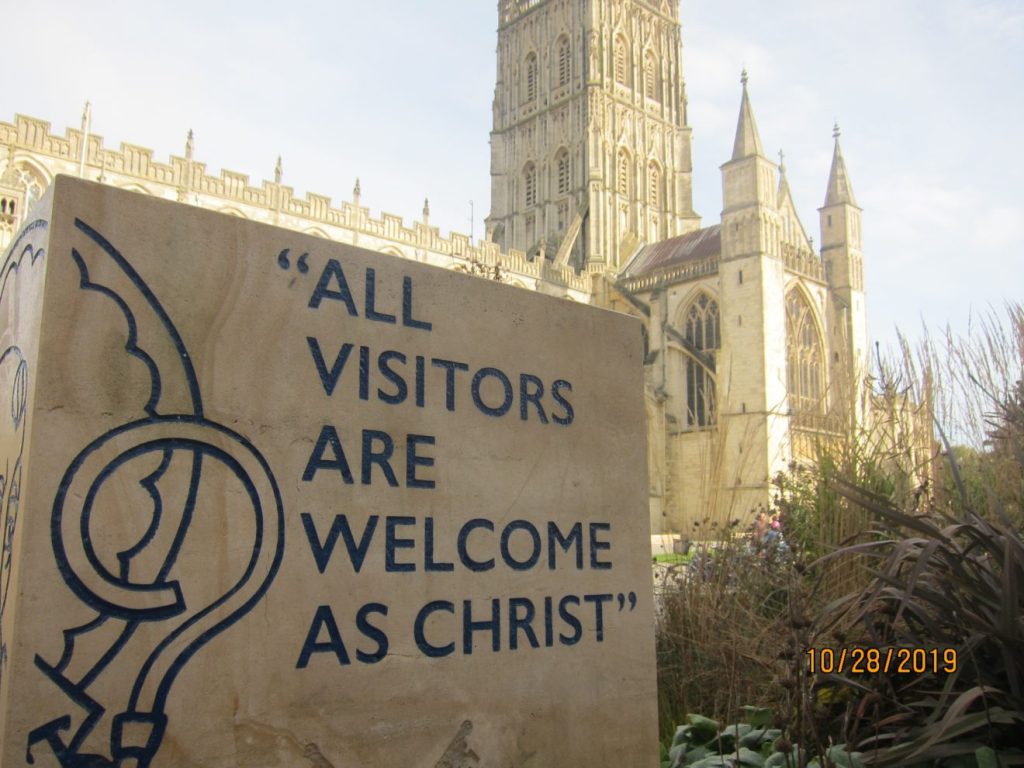
Go In Peace And Love
We had my sister come to stay last week for a couple of days, and as we often do, we walked into the centre of Gloucester and spent some time in the cathedral.
There are some large blocks of stone as you enter the cathedral grounds, each with a different message. There are some with messages of welcome, facing you as you arrive …

and others that you see when you’re leaving. We see different things each time we go to the cathedral, and this time my wife noticed the message on one of these large blocks of stone ‘GO IN PEACE AND LOVE.’
First thing – it’s five words.
Second thing – hang on, what does that mean exactly.
Is the word ‘love’ here meant as a noun or a verb. I’m not sure ?
I’m going to take it a a verb.
Go in peace and love.
Eating With Knives And Forks
So, I was in church this morning, and we had three readings … extracts below:
From the final words of the letter to the church in Ephesus, encouraging the community of believers to stand firm in their faith:
For our struggle is …. against the rulers, against the authorities, against the cosmic powers of this present darkness, against the spiritual forces of evil in the heavenly places.
From John’s Gospel, chapter 6, words of Jesus
It is the spirit that gives life; the flesh is useless. The words that I have spoken to you are spirit and life.
And from the book of Joshua chapter 24, Joshua addressing the Israelite nation:
“Now if you are unwilling to serve the Lord, choose this day whom you will serve, whether the gods your ancestors served in the region beyond the River or the gods of the Amorites in whose land you are living; but as for me and my household, we will serve the Lord.”
The thing that really struck me today was the way that God works through everyday living.
I was once in a class where we were asked this question by a visiting professor:
“What is the opposite of spiritual”
As we sat around waiting for one of us to be brave enough to respond, I think we were all asking ourselves – ‘Is this a trick question?’
Eventually someone piped up – ‘maybe the opposite of spiritual is physical ?’
The professor smiled, because someone had fallen into the trap he had laid.
No, no, no! He cried.
We waited. The rest of us who had been too cowardly to answer, feeling bad for the one who had stuck his head above the parapet, so to speak.
He looked at us intently. Clearly this was an important lesson that we needed to learn.
“The opposite of spiritual is unspiritual.”
Oh. Well yes, that seems logical. But what’s your point, we wondered.
Here I quote Eugene Peterson to explain the point that the professor made. “When we talk about something being spiritual, we are talking about something that God is doing.”
The mistake is to think of ‘spiritual things’ as things going on in the ether. Airy fairy. Things that don’t have any connection with life, but are more in the realm of ‘ideas about God.’
But if we take Eugene Peterson’s definition, then we’re talking about events, experiences and actions that are very much to do with real life.
In Christian Spirituality, there is an undestanding that the words and works of God are made apparent through the material stuff of our lives. In 21st century life, it’s sometimes hard to see this, since so much of our lives are lived in a bubble that removes us from the earthiness of life. We used to eat with our fingers, but now most of us use a knife and fork. There’s something about a connection with the basic essential of life – food that we have lost. I remember being invited to an Ethiopian friend for a meal, and being given no knife and fork, but quantities of ‘Injera’ – a soft sourdough type bread, slightly spongey, to gather up the food on my plate.
In his book ‘Run with the Horses.,’ Eugene Peterson describes that ‘earthy spirituality’ in this way:
“Biblical faith everywhere and always warns against siren voices that lead people away from specific and everyday engagements with weather and politics. Dogs and neighbors, shopping lists and job assignments. No true spiritual life can be distilled from or abstracted out of this world of chemicals and molecules, paying your bills and taking out the garbage. With the current interest in spirituality, we must be on guard not to revert to an other-worldly piety.”
To get back to the passages at the top of this post.
When Paul writes about contending with spiritual forces, we might picture among those forces the drive to make us want to produce more and more to satisfy our desire for aquisition and consumption. These forces are very real, and make themselves known in work places and board rooms. In lecture halls and classrooms. In shops and on T.V. and social media. In fact anywhere and everwhere you look.
When Jesus talks about the flesh being useless, he is talking about that side of our ‘fleshly’ human nature that is all about trying to be our own gods and goddesses – a seductive temptation that in the end leads nowhere.
He contrasts that kind of flesh with his own flesh – his physical body that he will give ‘for the life of the world.’
And in the third passage quoted, Joshua is challenging the people – not so much on what they believe, but how they will live. Again, moving the realm of the spiritual from ideas and beliefs to the lived life.
We had a wonderful example of that in our service this morning. Heather, our curate, was to be taking a baptism service after our morning communion service. She explained that at the moment of baptism, the minister pours the water of baptism using a scallop shell, which has long been a sign of baptism and the Christian journey. In recent months, as well as giving a baptism candle and a bible, we now give the baptised the shell that was used in their baptism.
What a powerful lesson to take away from this! Baptism is the beginning of a journey of faith, in which we are daily looking to see what God is doing in our lives and the lives of those around us – activity which is very real, whether it is made known in work places or board rooms. In lecture halls or classrooms. In shops or on T.V. and social media. In fact anywhere and everwhere you look. And in the life of the church – it is the everyday that speaks of God’s activity: water in baptism, bread and wine that we share around the table of reconciliation, and in the very beauty of creation all around us – all of life can speak to us of what God has done and is doing.
Grace and Peace.