A Prayer For This Day · Bible · faith · Prayer · Worship

Your Blessing On Our Lips

I’ve been reading a passage from Ecclesiasticus for the last few weeks. Here is today’s passage, from chapter 50. It describes the worship in the newly restored Temple in Jerusalem. As the worship came to an end ….

Then the singers praised Him with their voices in sweet and full-toned melody.

And the people of the Lord Most High offered their prayers before the Merciful One,
until the order of worship of the Lord was ended, and they completed his ritual.

Then Simon came down and raised his hands over the whole congregation of Israelites,
to pronounce the blessing of the Lord with his lips, and to glory in his name;
and they bowed down in worship a second time, to receive the blessing from the Most High.

A Benediction

And now bless the God of all, who everywhere works great wonders,
who fosters our growth from birth, and deals with us according to his mercy.
May he give us gladness of heart, and may there be peace in our days in Israel, as in the days of old.
May he entrust to us his mercy, and may he deliver us in our days!

The words that struck me today were these:
Then Simon came down and raised his hands over the whole congregation to pronounce the blessing.

It reminded me most powerfully of the times when I have done exactly that. At the end of our worship – in the places where I have served as curate and as vicar – in Hull, Beverley, and Hoddesdon … and wherever I have had the privilege of leading God’s people in worship, I have raised my hands to pronounce the Benediction, the Blessing, using words like this:
May the peace of God which passes all understanding, keep your hearts and minds in the knowledge and love of God and of His son Jesus Christ. And the blessing of God Almighty, the Father, the Son and the Holy Spirit, remain with you, this day and always. Amen.

Or it might be those moments at the communion rail, as someone bows their head to indicate that they are here to receive a blessing – maybe not yet ready to take the bread and the wine. And I place my hands lightly on their head and pray a prayer of blessing over them. Some times I will use the ancient prayer of Aaron, the High Priest of Israel –
The Lord bless you and keep you;
the Lord make his face shine on you and be gracious to you;
the Lord turn his face toward you and give you peace.

Sometimes, I might say word of blessing that I know will speak to their immediate situation – maybe for healing, for guidance, for a particular need.

But as I reflect on this part of my experience as a minister God’s church, I know that this privilege is not one that is set aside for a special group – for the ordained minister or those with some special power. Why should God’s blessing be contained within the confines of gathered worship ? Is a church building the only place to receive the peace, mercy and deliverance that come from God ? It might be reassuring to be in such a setting, receiving God’s blessing, but we must never restrict God’s blessing to such ‘Liturgical niceties.’ * The gift to bless another is a gift for us all to give and to receive.

We may simply say ‘God bless’ as we say goodbye to a friend, or ‘bless you,’ as we are aware of a need of another.
Sometimes we may use the words too easily, without much thought, but the faith of Israel teaches us that these words of blessing have power. So we use them prayerfully.

I have a prayer that I use most Fridays:

God of earth, sea, and sky;
God of bread, wine, and story;
God of wind, fire, and water;
God who shaped us,
God who remade us,
God who fills us.
Take our lives, body, heart and soul –
make us one with you and with each other.
Give us your word on our lips,
and your blessing in our hands,
that the world may see and know,
and give you glory.
Amen.

May God bless you, and those whom you love and pray for; and may you be given words of blessing to give to someone this day.

* A phrase from Walter Brueggemann that I must acknowledge !

Bible · faith · Political · Prayer · suffering

Coercive Silence and Generative Silence

Some years ago now, I discovered the value of silence, especially in the context of prayer.
My practice of silence as a regular discipline has varied over the years – I’ve been thinking recently that I could do with making more of an effort to build it in to my daily routines.

Generative Silence

Early Experience
I was brought up in the Open Brethren. For all their faults, there was so much that gave me a healthy foundation for my own spiritual life. One of those was the importance of silence in worship. We had no pastor, no paid leaders, and there was a degree of openness that encouraged every member to play their part. (Like many churches – as long as they were male, in those days)
Our morning meeting on a Sunday had no written liturgy, and what happened would be different each week. We would be guided, we prayed, by the Holy Spirit. There would be hymns sung, scripture read, and prayers prayed. No long sermons – maybe a brief thought, usually related to one of the scriptures that had been read. And quite a lot of silence.


The value of silence
I remember particularly a book by M.Basil Pennington – Call to the Centre that helped me establish a way of praying with silence.

The other key moment was watching a series on BBC – The Big Silence – sadly no longer available on BBC iPlayer, but no doubt available on DVD.

Quaker Silence
When on Sabbatical in 2009, and during the time that I was discovering again the value of silence, I attended a Quaker meeting and wrote a bit about it here. The meeting reminded me of my own early experience of church with extended periods of silence. This kind of silence can be generative – lead to new thoughts and actions that work for the good of all. You know the phrase – ‘a pregnant pause?’ I suppose a pause is a kind of silence, and the pregnant pause is one that’s full of meaning, waiting to come out. It reminds me that silence can be generative, and that out of this silence, something new can be born.

Coercive Silence

Those with social privilege have the option to remain silent.
However, not all silence is helpful. The silence experienced by many people will not be chosen but coerced. I remember being a part of conversations where the subjects of religion and politics were outlawed – and yes, they can get boring and unproductive. But part of the reason why these discussions are out of bounds is because the privileged and the comfortably secure don’t want to have their position challenged, and because of their privilege they can choose not to have the debate anyway.

I was listening to a programme on the radio yesterday – ‘Green Inc’. Unpacking the multi-billion-dollar industry that’s rebranding the oil and gas industry as green. Whilst investing huge amounts into prolonging the oil and gas industry, there’s an attempt to persuade us that it’s not so bad after all. One way of silencing others is to shout louder and longer using the best of modern media in an attempt to drown out alternative voices.

Many of us have experienced this in our church life. We’ve heard the dominant voices and wanted to speak, but somehow there hasn’t been a forum for that conversation, or we have lacked the courage. In churches that are led by strong willed clergy, it may be hard for other voices to be heard. Even in more egalitarian faith communities, it’s often the most confident who speak the most, and they may not be the best voices to listen to.

Women, the Gay community, Black voices, the Poor generally – all have struggled to resist the forces that have threatened to silence them. There’s a verse in Exodus chapter 2 that I have mentioned recently in another post, where over many years, the Hebrew voice has been silenced by oppression.
“The Israelites groaned in their slavery and cried out, and their cry for help because of their slavery went up to God.”
The period of slavery in Egypt left them voiceless. In desperation they cry out in the hope that someone will hear them. The road to freedom started with that cry, but they would need determination to follow through on that path.

So what about those who do not have a voice – those who are forced in one way or another to stay silent. We may not even realise that it’s happening, but in any situation where one voice, or one set of voices are dominant, it’s likely that other voices are not able to speak.
You may recognise in your own experience times when you have wanted to speak, but not felt able to.
You may remember times when you have tried to speak, but found that your voice is drowned out by others.
Conversely, you may recognise in your own words and actions times when you have prevented others from speaking.

May we move to a place where all voices can be heard and listened to, and that we pay attention especially to the voices that are coming from a different place to our own.

Grace and Peace, and good listening.


Bible · faith · Political

Justice – Another Word For Love ?

Justice in a passage from Luke’s Gospel

I was working on a sermon earlier this week, on a text from Luke’s Gospel.

Luke 11:37-42

37 While Jesus was speaking, a Pharisee invited him to dine with him; so he went in and took his place at the table. 38 The Pharisee was amazed to see that he did not first wash before dinner. 39 Then the Lord said to him, ‘Now you Pharisees clean the outside of the cup and of the dish, but inside you are full of greed and wickedness. 40 You fools! Did not the one who made the outside make the inside also? 41 So give for alms those things that are within; and see, everything will be clean for you.

42 ‘But woe to you Pharisees! For you tithe mint and rue and herbs of all kinds, and neglect justice and the love of God; it is these you ought to have practised, without neglecting the others.

The phrase that caught my eye was this: But woe to you Pharisees! For you tithe mint and rue and herbs of all kinds, and neglect justice and the love of God.

They are just paying lip service to the command to love their neighbour. It struck me that when Jesus uses that phrase ‘Justice and the love of God,’ he is using another way of summing up the whole law – Love God and love neighbour. In other words, the idea of bringing justice to someone is what it means to love them.

Justice in Psalm 119

‘Coincidentally,’ earlier in the week, I had a part of Psalm 119 in my daily prayers and noticed that word justice again.
Psalm 119 is in 22 sections of 8 verses for each section, each section starting with one of the 22 letters of the Hebrew alphabet.
The message of the psalm is about the beauty and sufficiency of God’s law. It’s a comprehensive treatment of the importance of God’s law – demonstrated by the way that the psalm is structured using every letter of the Hebrew alphabet.

In each section there are 8 verses, and in each verse there is a word that represents the law. So the law is descibed in the following ways: Promise, Statute, Decree, Commandment, Word, Precept, Ordinance, Ways.

As far as I can see, nearly every verse in the psalm (with just a few exceptions) includes one of the words above, and interestingly I noticed the word justice crops up in two sections. (Below)

148 My eyes are awake before each watch of the night,
    that I may meditate on your promise.
149 In your steadfast love hear my voice;
    O Lord, in your justice preserve my life.
150 Those who persecute me with evil purpose draw near;
    they are far from your law.

Salvation is far from the wicked,
    for they do not seek your statutes.
156 Great is your mercy, O Lord;
    give me life according to your justice.
157 Many are my persecutors and my adversaries,
    yet I do not swerve from your decrees.

On these two occasions, I wonder if justice is intended as another word to stand in for ‘law’ etc. to remind us that justice is central to God’s law.

So, meditating on these instances of the word justice led me to the thought that justice is central to the law of love.

So what do we mean by justice ?

Walter Brueggemann has spoken about justice as “Sorting out what belongs to whom, and returning it to them.”

The word return implies that people have had things taken away from them, or do not have what rightly they should have.

The plight of the Palestinian People

A few years ago now, we became aware of the reality of life for the Palestinian people.  A key part of their story goes back to May 14th 1948, when at midnight the British mandate of Palestine ended, and the State of Israel was proclaimed. Over a short time, this resulted in over 700,000 Arabs either fleeeing or being expelled from their homes.

There are families who two generations later, still have the key of the door to the house that they lived in. Maybe grandparents have handed the key on to successive generations to keep alive the hope that one day justice may come, and they will be able to return. To mark this period of time in the history of the Palestinian people, May 15th became a annual reminder of this forced expulsion, and was named Nakba Day. (Nakba means catastrophe)

Justice is about sorting out what belongs to whom and returning it to them, but the injustice of land grabbing is still happening today in many parts of the world, including Israel, where Israelis are illegally taking land from Palestinian people that has been theirs for generations, to build Israeli settlements.

The Skyline Drive

In 2009, I had a sabbatical, and spent part of the time studying at Eastern Mennonite University doing some of their Summer School modules. I was fortunate enough to also be able to spend 10 days with my wife and son travelling around the state of Virginia in the USA.

One day, we found ourselves driving on the Skyline Drive, a 105 mile route that runs through the Shenandoah National Forest, from Front Royal in the north to Waynesboro in the south.  In order to set up the national park back in the 1930’s, the federal government had to buy the land, which involved resettling hundreds of people who were living in the area.  Many of these people did not want to move, and there were numerous court cases as they challenged the right of the government to move them off their land.  

Justice is about sorting out what belongs to whom and returning it to them. Sadly, those families lost their homes and in many cases their livelihoods. Even though they were resettled, they had been forcibly uprooted from homes they had known in some cases for generations.

The widow, the orphan and the stranger

Another take on justice runs right through the Old Testament. It’s not so much about giving people back what they have lost, but enabling them to enjoy what everyone else enjoys. The current word is ‘agency’ – justice is when the poor have agency to access the things that I take for granted – food, shelter, lack of violence, work, community, healthcare ….

In the Old Testament the people who most often need justice were widows orphans and strangers. That’s because they were the people who did not have anyone to speak on their behalf.

In that patriarchal society, a married woman would need her husband to get justice, but a widow is on her own in that world; an umarried woman would have her father to speak for her, but an orphan is on their own. They have no one to speak for them.  Similarly a stanger – that is, a foreigner living within Israel would be on their own.

It is these people, above all, who should be cared for.  The way to show that we love neighbour is how we treat the weakest in our society, those who have no one to advocate for them.

What comes to mind now, are the people in my community who are working for justice:
Gloucester City Mission, who work with those who have no home to call their own. At one time, they did have a home, but for whatever reason, they are now on the street or in temporary accommodation.  GCM are working to return a home for the homeless.
Emmaus Communities are also working for justice for the homeless – to help people in getting back what we should all have as a human right – a home.
Gloucester Food Bank. I pray for the day when all the food banks will have closed.  When there will be no one who is going without another human right – food to sustain them. But until that day, we thank God for those who are working for justice for the hungry. To give back what has been taken away
And lastly GARAS – Gloucestershire Action for Refugees and Asylum Seekers. They are working with those who have had so much taken away from them.  Country, Community, Home, Job, Family, Dignity … Justice is about giving back to them what every human being should enjoy by right.

For Jesus, justice and love are part of the same law. The command to uphold justice for the weakest is central to the DNA of the church. Without justice we are empty, we have nothing. Without justice we are just making a noise

But when we work for justice, we are serving those who have no protection, no one to speak for them, the ones without a voice – working to include them and embrace them so that they, like us can share in the bounty that God has given us all to enjoy.

Grace, Peace and Justice.

faith · Following Jesus

Go In Peace And Love

We had my sister come to stay last week for a couple of days, and as we often do, we walked into the centre of Gloucester and spent some time in the cathedral.

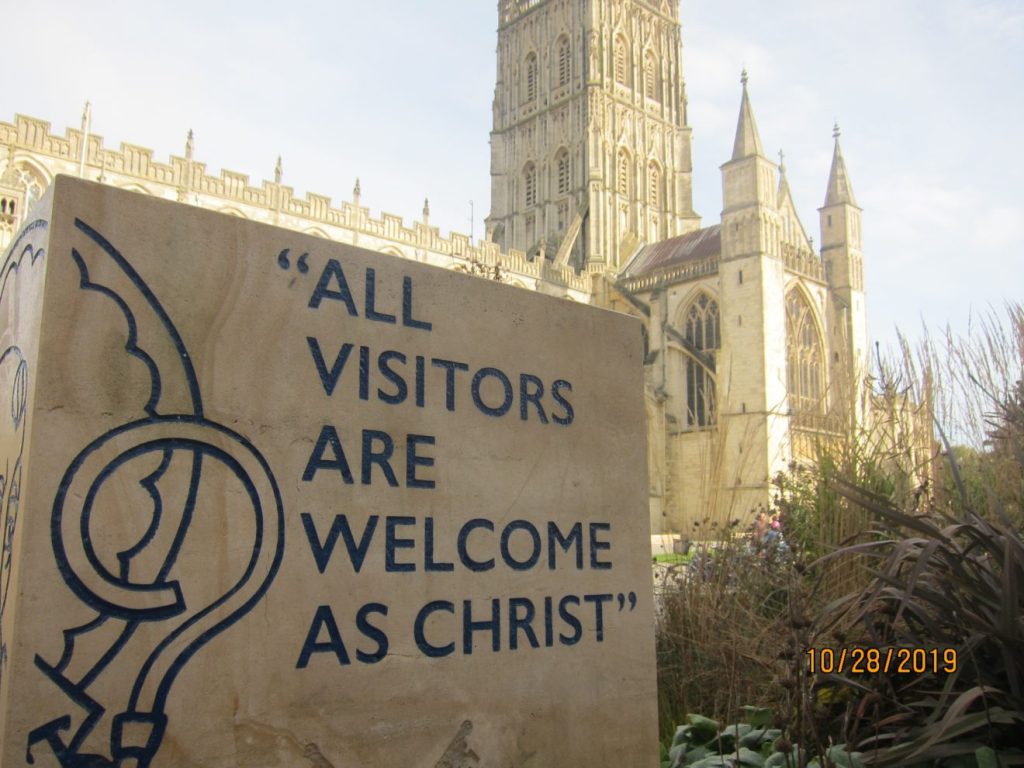
There are some large blocks of stone as you enter the cathedral grounds, each with a different message. There are some with messages of welcome, facing you as you arrive …

and others that you see when you’re leaving. We see different things each time we go to the cathedral, and this time my wife noticed the message on one of these large blocks of stone ‘GO IN PEACE AND LOVE.’

First thing – it’s five words.
Second thing – hang on, what does that mean exactly.

Is the word ‘love’ here meant as a noun or a verb. I’m not sure ?

I’m going to take it a a verb.

Go in peace and love.

Bible · Church · faith · Following Jesus

Eating With Knives And Forks

So, I was in church this morning, and we had three readings … extracts below:

From the final words of the letter to the church in Ephesus, encouraging the community of believers to stand firm in their faith:
For our struggle is …. against the rulers, against the authorities, against the cosmic powers of this present darkness, against the spiritual forces of evil in the heavenly places.

From John’s Gospel, chapter 6, words of Jesus
It is the spirit that gives life; the flesh is useless. The words that I have spoken to you are spirit and life.

And from the book of Joshua chapter 24, Joshua addressing the Israelite nation:
Now if you are unwilling to serve the Lord, choose this day whom you will serve, whether the gods your ancestors served in the region beyond the River or the gods of the Amorites in whose land you are living; but as for me and my household, we will serve the Lord.”

The thing that really struck me today was the way that God works through everyday living.

I was once in a class where we were asked this question by a visiting professor:
“What is the opposite of spiritual”

As we sat around waiting for one of us to be brave enough to respond, I think we were all asking ourselves – ‘Is this a trick question?’
Eventually someone piped up – ‘maybe the opposite of spiritual is physical ?’
The professor smiled, because someone had fallen into the trap he had laid.
No, no, no! He cried.
We waited. The rest of us who had been too cowardly to answer, feeling bad for the one who had stuck his head above the parapet, so to speak.

He looked at us intently. Clearly this was an important lesson that we needed to learn.
“The opposite of spiritual is unspiritual.”

Oh. Well yes, that seems logical. But what’s your point, we wondered.

Here I quote Eugene Peterson to explain the point that the professor made. “When we talk about something being spiritual, we are talking about something that God is doing.”

The mistake is to think of ‘spiritual things’ as things going on in the ether. Airy fairy. Things that don’t have any connection with life, but are more in the realm of ‘ideas about God.’

But if we take Eugene Peterson’s definition, then we’re talking about events, experiences and actions that are very much to do with real life.

In Christian Spirituality, there is an undestanding that the words and works of God are made apparent through the material stuff of our lives. In 21st century life, it’s sometimes hard to see this, since so much of our lives are lived in a bubble that removes us from the earthiness of life. We used to eat with our fingers, but now most of us use a knife and fork. There’s something about a connection with the basic essential of life – food that we have lost. I remember being invited to an Ethiopian friend for a meal, and being given no knife and fork, but quantities of ‘Injera’ – a soft sourdough type bread, slightly spongey, to gather up the food on my plate.

In his book ‘Run with the Horses.,’ Eugene Peterson describes that ‘earthy spirituality’ in this way:
“Biblical faith everywhere and always warns against siren voices that lead people away from specific and everyday engagements with weather and politics. Dogs and neighbors, shopping lists and job assignments. No true spiritual life can be distilled from or abstracted out of this world of chemicals and molecules, paying your bills and taking out the garbage. With the current interest in spirituality, we must be on guard not to revert to an other-worldly piety.”

To get back to the passages at the top of this post.
When Paul writes about contending with spiritual forces, we might picture among those forces the drive to make us want to produce more and more to satisfy our desire for aquisition and consumption. These forces are very real, and make themselves known in work places and board rooms. In lecture halls and classrooms. In shops and on T.V. and social media. In fact anywhere and everwhere you look.

When Jesus talks about the flesh being useless, he is talking about that side of our ‘fleshly’ human nature that is all about trying to be our own gods and goddesses – a seductive temptation that in the end leads nowhere.
He contrasts that kind of flesh with his own flesh – his physical body that he will give ‘for the life of the world.’

And in the third passage quoted, Joshua is challenging the people – not so much on what they believe, but how they will live. Again, moving the realm of the spiritual from ideas and beliefs to the lived life.

We had a wonderful example of that in our service this morning. Heather, our curate, was to be taking a baptism service after our morning communion service. She explained that at the moment of baptism, the minister pours the water of baptism using a scallop shell, which has long been a sign of baptism and the Christian journey. In recent months, as well as giving a baptism candle and a bible, we now give the baptised the shell that was used in their baptism.

What a powerful lesson to take away from this! Baptism is the beginning of a journey of faith, in which we are daily looking to see what God is doing in our lives and the lives of those around us – activity which is very real, whether it is made known in work places or board rooms. In lecture halls or classrooms. In shops or on T.V. and social media. In fact anywhere and everwhere you look. And in the life of the church – it is the everyday that speaks of God’s activity: water in baptism, bread and wine that we share around the table of reconciliation, and in the very beauty of creation all around us – all of life can speak to us of what God has done and is doing.

Grace and Peace.


Bible · Church · faith · Grace · Theology

Which Side Are You On ?

Or – alternative readings of Numbers Chapter 16.

I’m reading the Old Testament book of Numbers at the moment.

It’s a book worth spending time on, because of parallels with the situation of the Christian church. The narrative of the book of Numbers is set in the time after Israel’s deliverance from slavery in Egypt, but before they enter the land of promise. The Christian story is also set between a time of deliverance through the cross and resurrection of Jesus, and the future time when God will fulfil the promise of a ‘New Heaven and a New Earth.’

It’s a story of a community that at times is divided because of the challenges that they face in their wilderness wanderings. it’s a time of formation, with Israel trying to work out what is their identity and mission, as competing voices clamour to be heard.

In Numbers chapter 16, we read of a rebellion headed by Korah, one of the Levite tribe.
The Levites as a tribe were given the responsibility and privilege of serving in the Tabernacle, the ‘Tent of Meeting,’ which was the focus of Israel’s worship. However, their duties were limited, and overseen by Aaron and the other priests. Korah’s issue is that some Levites were seen to be better than others. His point is that the whole of Israel have been called and have an equal status – all are holy.

16  1 Now Korah, along with Dathan and Abiram took two hundred and fifty Israelite men, leaders of the congregation, chosen from the assembly, well-known men, and they confronted Moses. They assembled against Moses and against Aaron, and said to them, ‘You have gone too far! All the congregation are holy, every one of them, and the Lord is among them. So why then do you exalt yourselves above the assembly of the Lord?’

When Moses heard it, he fell on his face. Then he said to Korah and all his company, ‘In the morning the Lord will make known who is his, and who is holy, and who will be allowed to approach him; the one whom he will choose he will allow to approach him. Do this: take censers, Korah and all your company, and tomorrow put fire in them, and lay incense on them before the Lord; and the man whom the Lord chooses shall be the holy one. You Levites have gone too far!’

Then Moses said to Korah, ‘Hear now, you Levites! Is it too little for you that the God of Israel has separated you from the congregation of Israel, to allow you to approach him in order to perform the duties of the Lord’s tabernacle, and to stand before the congregation and serve them? 10 He has allowed you to approach him, and all your brother Levites with you; yet you seek the priesthood as well! 11 Therefore you and all your company have gathered together against the Lord. What is Aaron that you rail against him?’

As the story progresses, Korah and his large number of followers are portrayed as faithless, wishing they were back in what they see as the relative comfort of Egypt, and angry that Moses’ leadership style is too authoritarian.
Moses and Aaron are portrayed as men full of integrity, not making any profit out of their leadership position.
Then God comes into the story, and is clearly on the side of Moses and Aaron, the result being that Korah and all his followers die.

As I reflect on this passage, I’m asking two question:
1: Who wrote the account ? Usually it’s the winners who write history. In this case it was likely the priestly class who are the authors.
2: Is it possible to read it from different standpoints ?

So, reading it from the point of view of the leaders, we’ve got a revolt that threatens what God is doing and the leaders of the uprising must be punished. Leaders are ordained by God and should be obeyed, or else !

Or, could you read this from ‘below,’ from the point of view of the rebels, and say to the priestly class / leaders about their reading of events – well that’s what you would say! The truth of it is that when people without power and influence try to have their say to bring about change, they usually end up worse off, as on this occasion. The leaders use their position, and invoke God or some other power as being on their side.

The way the priests wrote it, they come down on the side of Moses, but my sympathies are with Korah. More importantly, we need to read this through a New Testament lens. For St Paul, there is no distinction between Greek and Jew, Slave and Free, Male and Female – the biggest distinctions in the world of 1st century Judaism. All are equal in Christ.

The impulse to make distinctions between people is a powerful one. It’s embedded in our culture of achievement. Some are seen to be intrinsically worth more than others. To varying degrees, this separation can still occur on the basis of race, gender, sexuality, wealth, education, class, etc, and in the church, ordination. In opposition to this divisive approach, the Gospel declares that in Christ we are of equal value, with no distinction and no requirement to meet a certain standard.

There are applications for leadership here. A reading of the incident that is sympathetic to Moses, but also trying to be a ‘critical friend,’ might say that Moses has become too remote from the people with the result that they complain without understanding what Moses is doing. We see that all the time in the church and in secular environments. Leaders need to keep in close touch with those in their care.
A more critical judgment of Moses (and Aaron) might say that they have become proud of their status, and see themselves as beyond reproach. If leaders in a church become too separate, the danger is that they see themsleves, or are seen by others as more holy than the rest. This quickly leads to a culture either of dependence or rebellion, rather than a healthy interdependence that recognises the holiness of all.

Grace and Peace, especially to all in leadership.


Activism · Bible · Church · faith · Following Jesus · Political

The River Runs Down Hill

Water is a prominent theme in both the First Testament, and the Second. I was listening earlier this week to a talk by Ched Myers, speaking about both the ecological and the theological significance of water.
Listen here. Roll Like A River

There’s a lot to digest there, but I’ll just refer to sonmething he said at the end. He’s made the point earlier that in his context in Southern California, the river Ventura that once flowed all year round is now seasonal. This is largely because the water is taken off by residential needs and industry futher up stream.
That has all sorts of ecological consequences to the environment, as well as affecting those who live down stream.

The situation is not unlike the Jordan Valley, where many people, (Palestinians in particular) have to contend with water shortages, as well as the land itself being impoverished.

Already, we are seeing water as a commodity being fought over, and who wins ? The rich. We are familiar with wars over other resources like oil, but we are now realising that the main building block of life – water – is getting scarcer in many areas, and a cause of conflict.

In Southern California and the Jordan Valley, it is the environment and the people downstream that are affected.

Ched Myers draws a parallel between the ecological and economic issues here, and the way that water is spoken of in scripture.

There are many passages that speak of the life giving properties of water – coupled with water as an image of our spiritual lives. In Psalm 1 water is a symbol of God’s way of living.

Happy are those whose delight is in the law of the Lord, and on his law they meditate day and night. They are like trees planted by streams of water, which yield their fruit in its season, and their leaves do not wither. In all that they do, they prosper. (Psalm 1 verses 1-3)

In John’s Gospel we hear Jesus say these words:
Those who drink of the water that I will give them will never be thirsty. The water that I will give will become in them a spring of water gushing up to eternal life.” John Chapter 4 verse 14

It’s clear that water is not only essential for our very material lives, but is also a kind of code for what we might call abundant life, where there are no winners and losers, but where everyone has their needs fully met.

The Prophet Amos says this:
I hate, I despise your festivals, and I take no delight in your solemn assemblies.
Even though you offer me your burnt offerings and grain offerings,  I will not accept them;
and the offerings of well-being of your fatted animals I will not look upon.
Take away from me the noise of your songs; I will not listen to the melody of your harps.
But let justice roll down like waters, and righteousness like an ever-flowing stream. Amos Chapter 5 verses 21-24

Water flows down hill … but by the time it reaches the communities where Ched Myers lives, or the Palestinian People in the Jordan Valley, there is not enough left for everyone.

In my last-but-one post, I said that the Christian life is about ‘Gift and Task.’ This post is definitely about ‘Task’. The task of every one of us to seek justice for those who are furthest away from the source of blessing. Those who are on the margins where the resources do not reach, as well as the land that is impoverished by lack of water.

Grace and Peace.

Church · community · faith · Jesus · Worship

He Is Risen Indeed, Alleluia!

It’s Easter Day. For me the most important day in the Christian Year. It’s a declaration that God is unwilling to take our ‘no’ for an answer. With Jesus, it is always yes. An unconditional ‘yes’ to be with us.

This morning we met with some friends and their two young children to walk up Robinswood Hill. The hill is just a mile or so from where we live, and from the top you gt a 360 degree view taking in the city of Gloucester and the surrounding countryside.

We had decided to get to the top in time for sunrise just after 6.30. We met in the car park, with the darkness already beginning to fade as the pre-dawn light became stronger.

It’s a 200 metre climb – quite a task for Steve with a two year old on his back, and pretty challenging for their five year old. But we made it in time for the sunrise, and got ready for a short act of worship for Easter Day. Another friend joined us at the last minute. He phoned us from the car park, 200 metres below us.
‘Where are you ?’
‘We’re at the top. We’ll see you in about 15 minutes’

So finally, we were all there, and shared a communion of croissants and hot chocolate, with a song and some prayers, and the familar Easter shout:
Alleluia, Christ is risen
He is risen indeed, Alleluia.
Praise the God and Father of our Lord Jesus Christ
He has given us new life and hope by raising Jesus from the dead
Alleluia, Christ is risen
He is risen indeed, Alleluia.

As we started to sing ‘Thine be the Glory’ at the end of our short service, a couple who had just got to the top of the hill came and joined us. I don’t know what the dog walker and the few others who were there for the sunrise thought, but we gave it our best as we sang that great Easter hymn.

Over the last 35 years or so, we’ve nearly always done something similar. From a hill in North Yorkshire, to a nature reserve in Hertfordshire, via Beverley in East Yorkshire, where one year we had snow! There’s something very special about celebrating the resurrection as the sun comes up.


When we got home, I came across this song in one of my prayer books. It seemed to echo our early morning gathering, and sums up for me a lot of what our faith is all about. Here’s a translation below and a link to the song here

“Vamos todos al banquete “

Let us go now to the banquet, to the feast of the universe —
the table’s set and a place is waiting.

I will rise in the early morning; the community’s waiting for me.
With a spring in my step I’m walking with my friends and my family.

God invites all the poor and hungry to the banquet of justice and good —
where the harvest will not be hoarded so that no one will lack for food.

May we build a place among us where all people are equal in love —
For God has called us to work together and to share everything we have.

translated version of “Vamos Todos Al Banquete” written by Guillermo Cuéllar
and commissioned by Msgr. Oscar Romero for the Misa Popular Salvadoreña


Bible · faith · suffering

When The Work Is Done

Holy Saturday and Prayer

Today is Holy Saturday. An important day in the Christian calendar. The day between Good Friday and Easter Day. That holy space between death and resurrection. The space between desolation and life.

My reading in the book of Lamentations, still despairing over the destruction of the Holy City, Jerusalem, has these words, addressed to God:
You have wrapped yourself with a cloud so that no prayer can pass through. Lamentations 3 verse 44

But even in the midst of this despair, we read just a few verses later:
I called on your name, O Lord, from the depths of the pit;
You heard my plea …
You came near when I called on you; you said, ‘Do not fear!
You have taken up my cause, O Lord, you have redeemed my life. (Lamentations 3 verses 55-58)

Somehow in the life of faith of the Old Testament saints is a recognition that even in a time of loss and grief, when God seems to be absent, the only thing to do is to pray. Prayer is all that is left. It’s a paradox. We see no hope, and yet, in spite of that, we hope. These passages are a deep well of resources for the person of faith.

Walter Brueggemann puts it like this:
“Faith is the capacity to hold both honest reality and open possibility”

I wonder if Jesus’ disciples were able to draw on those resources after the crucifixion. I wonder what hope, if any, they were able to find ?

Holy Saturday and Rest

In the Jewish faith Saturday is the seventh day of the week. The Jewish Sabbath. A day of rest. It starts on Friday night and lasts until Saturday night. This recalls God’s work of creation, where each of the acts of creation ends with these words:
And there was evening and there was morning, the first (second etc) day. Genesis Chapter 1

The Sabbath day of rest mirrors God’s own rest at the end of the work of creation:
On the seventh day God finished the work that he had done, and he rested on the seventh day from all the work that he had done. So God blessed the seventh day and hallowed it, because on it God rested from all the work that he had done in creation.
(Genesis 2 verses 2 & 3)

This Sabbath day, Holy Saturday, is also the culmination of God’s work. As God rests at the end of the work of creation, so now another work is finished. Jesus’ dying words on the cross are ‘It is finished’
When Jesus had received the wine, he said, ‘It is finished.’ Then he bowed his head and gave up his spirit.
(John 19 verse 30)
It is at the cross where Jesus finishes his work to be with us in solidarity until the very end.

So this day is a day when we wait. Nothing happens on Holy Saturday. It’s a day for quiet contemplation. Until the celebrations that begin to signal the resurrection, there are no services. Everything stops.

It’s a day when we might recall those aspects of our lives where, like the writer of lamentations, we hold those two ancient prayers together. The prayer of absolute despair and the prayer of hope in the face of no hope.

You have wrapped yourself with a cloud so that no prayer can pass through.
And
I called on your name, O Lord, from the depths of the pit; you heard my plea … you came near when I called on you;

In some mysterious way, the hope doesn’t deny the state that we are in, and yet the reality of that despair cannot stop us from praying.

Grace and Peace.


Bible · faith · God · Theology

We Know Only In Part …

… but we’re getting there.

Rob Bell “I’m going to try and create a space where hope is the most rational response to the world …
I love that thought, and basically I’m with it, but it didn’t seem like that on the first Good Friday.

Today is Good Friday – Friday April 2nd 2021

One of my readings for today was from lamentations:
I am one who has seen affliction
    under the rod of God’s wrath;
he has driven and brought me
    into darkness without any light;
against me alone he turns his hand,
    again and again, all day long.

This is the cry of desolation at the laying waste of Jerusalem and the destruction of the temple. It’s a place of no hope. It is echoed in the cry of Jesus on the cross – ‘My God, why have you forsaken me ?’

No hope.

Also in my readings for today was psalm 95. A strange psalm it seemed to me.
But in the middle of the psalm, these words are addressed to God’s people:

O that today you would listen to his voice!
    Do not harden your hearts, as at Meribah,
    as on the day at Massah in the wilderness,
when your ancestors tested me,
    and put me to the proof, though they had seen my work.

In verse 9, I saw something that resonated with me to do with what happened on that first Good Friday.

The Old Testament is full of God’s faithfulness, in the face of Israel’s unfaithfulness.
It’s as though all the way through, Israel are pushing God to see how far God will go. In spite of the work of God in liberating Israel from slavery, they forget, and abandon the love they have had for God. Is there a point at which God will say – ‘That’s it! I’ve had enough of you people.’

In fact, it does appear at times as though God does say exactly that. But then something happens, and God’s faithfulness reappears, just as the sun reappears from behind clouds.

And today, Good Friday, is a day when it seems like the human race is testing God again. ‘They put me to the proof, though they had seen my work.’
In spite of all that Jesus has said and done, he is now rejected. In Jesus, the world has witnessed the works and character of God revealed in Jesus in a new way, and yet still people put God to the test. Jesus is pushed to see how far his love will go. The soldiers around the cross shout – ‘If you are the King of the Jews, save yourself!’ This is a challenge to see how far God’s love will go.

Sam Wells talks about the cross in this way:
The cross is the moment when Jesus had to choose being with the Father, or with us, and he chooses us.  And at the same time, the Father has to choose between letting the Son be with us, or keeping the Son to himself. Such is God’s commitment to us that chooses to let the Son be with us. 

This is the faithfulness of God in the face of human unfaithfulness.

Sam Wells again (paraphrased) talking about Easter day:
This day. this Easter day, this wondrous, glorious, blessed, fabulous day is the greatest day in the history of the universe. It tells us that however deeply we reject God, whatever we throw at God, God will find a way back to us in resurrection.  And – this resurrected, real flesh and blood body of Jesus, tells us that we too can have that life – and that our eternal destiny is to be with God, as God is, and always has been, with us. 

Now that is hope ! Thanks be to God.

Grace and peace.