Activism · Bible · faith · Following Jesus · Jesus · Political · World Affairs

In My Dream I Saw

I don’t remember my dreams very often, but I still have some snippets from a dream I had last night.
In my dream I saw a statue, standing up with something like a rod in its hand. The statue was a bit more than life size, maybe about 8 feet tall, and the rod was about 18 inches long and maybe 2 inches in diameter.

The next thing I saw was that the statue was lying down on its side, and the rod was held by two cupped hands of the statue. The hands were holding, rather than gripping the rod. Then someone was removing the rod from the cupped hands.

Then I found myself with a group of people in a room, all giving their different accounts of what the rod symbolised. Each one was describing a different angle on power

I can’t quite remember exactly what I said, but it was something to do with what happens when there’s a vacuum. There’s that saying – nature abhors a vacuum. When there’s a vacuum, something will rush in the fill that vacuum.

In the dream, the vacuum was created when the rod was removed from the hands. Suddenly, the person, or organisation that was holding the power is no longer in charge. At that point, other forces are quick to come and seize power.

In my dream, I went on to say that what was needed was an understanding of what the purpose of holding that power should be. The power should be exercised for the benefit of all. That means that everyone needs to have a say, no one should be left out.

At that point, I finished, and everyone applauded. I was surprised, but pleased that what I had said seemed to ring a bell with everyone present.

Here endeth the dream

So – a couple of reflections on the dream. We’re watching a series on Netflix at the moment called Godless. It’s set just after the American Civil war, and I think that may have been on my mind, and that somewhere deep in my unconscious is a memory of Abraham Lincoln’s Gettysburg Address from November 19th 1863, in the middle of the Amercian Civil War. In that speech, he famously said ‘That government of the people, by the people, for the people, shall not perish from the earth.’ The exact wording of the speech is uncertain, and Lincoln wasn’t the first to use that idea …. of the people, by the people, for the people.

My little speech in the dream seemed to be along the same lines …

The second thought is that today – March 28th 2021 – is Palm Sunday in the Christian calendar. The Gospel reading for Palm Sunday recalls how Jesus rode into Jerusalem on a donkey. As he entered the Holy City, the crowds acclaimed him as king shouting – ‘Hosanna to the Son of David.’ Hosanna means ‘save,’ and is probably used here as a special cry of joy for the one who has come to save, to rescue.

Here’s the prophetic passage from the First Testament book of Zechariah that is clearly seen in the events of Jesus’ entry into Jerusalem.

Zechariah chapter 9 verses 9 – 10.
Rejoice greatly, Daughter Zion! Shout, Daughter Jerusalem! See, your king comes to you,righteous and victorious,lowly and riding on a donkey,on a colt, the foal of a donkey. 10 I will take away the chariots from Ephraim and the warhorses from Jerusalem,and the battle bow will be broken. He will proclaim peace to the nations.His rule will extend from sea to seaand from the River to the ends of the earth.

In my dream, someone came and took the rod representing power from the statue. Whatever part of my subconscious that dream came from, the removal of the rod of power is something to do with a non-violent expression of a different quality of power to the oppressive displays of power that dominate our world.

For example, I’m thinking today of the non-violent demonstrations in Myanmar at the brute force and violence shown by the army.

I’m thinking of the non-violent demonstrations in our own city of Bristol, sadly hijacked by violent protesters.

I’m thinking of the peaceful protests against violence done to women after the murder of Sarah Everard, that ironically resulted in a police over reaction and more violence shown to the mostly women protesters.

I’m thinking of the peaceful civil disobedience of the protests of Extinction Rebellion back in 2019.

And I’m thinking of Jesus, riding into Jerusalem on a donkey, not a war horse, to announce God’s kingdom of peace. Jesus comes to demonstrate his power, that is so different to the power of the elite in Jerusalem, and to the imperial might of Rome. He comes to challenge the powers of his day. From the backwater of Galilee, Jesus now enters as it were, the Lion’s Den.

As I imagine the picture of Jesus on a donkey, I see that event as an act of non-violent resistance. The words of the ancient prophets are brought to life, and their words still speak today.

The words of Zechariah conjure up a vision not far from my dream in which I saw the symbol of power taken from the statue – I will take away the chariots from Ephraim and the warhorses from Jerusalem,and the battle bow will be broken.

It is a vision of peace that comes against all kinds of oppression – through the economy, through race, gender and sexuality.
Wherever such protests are made, the forces of power will rise to try and silence the voices of peace.

A prayer for today

God of ancient prophets, we thank you for your timeless utterances of truthfulness. Give us good ears to hear the reverberation of those old words as new voices ring out in our day. In his name. Amen.

Prayer by Walter Brueggemann (slightly altered)

faith

I Do Find This Helpful

‘This,’ in the above, being the Enneagram.

Mmmhh, I sense some of you saying
An appreciative mmmhh maybe ?
An mmmhh that means – what on earth is the enneagram ?
An mmmhh that means – you’re on the slippery slope buddy, this is dodgy stuff, so watch out !

Back in 2018, just before we retired, we went on a three day course to discover what the Enneagram was all about. Basically, it’s a tool for self awareness and transformation, and my wife and I thought that as we were starting on a new phase of life, it might be good to take a step back and look at ourselves.

The Enneagram describes 9 personality types, and characteristics that go with each one. The historical roots of the Enneagram are hazy, but one theory is that part of the origin is to be found in the work of the desert fathers and mothers, christian women and men of the fourth century. As the Christian Church became more a part of the Roman Empire, and the purity of the faith was under attack, these women and men lived lives of solitude in the desert, the were essentially the ‘spiritual directors’ of their day, available to christians seeking to grow in their faith.

As they considered the life of faith, they saw nine aspects of human behaviour that they described as passions – anger, pride, deceit, self-doubt, greed, fear, gluttony, lust, sloth. (The Catholic Church later reduced these to seven – the deadly sins).

The other side of the passions, were nine gifts – goodness, love, effectiveness, creativity, wisdom, faithfulness, joy, power, and peace.

The basis of the enneagram is that our basic character is formed when we get to early adulthood, and that one of the above gifts / passions looms larger than the others in our person.

Here’s an example:

People in the One space are gifted with goodness. They do things well, very well. They are conscientious and ethical, striving for excellence. But on the journey of life, they discover that things are not always good, that they themselves are not always good. The false self convinces them that they are responsible for making life not only good but perfect. When things are not as perfect as they think they should be, Ones experience anger, toward themselves, situations, and others. God invites Ones to receive serenity, which is the ability to accept things as they are and to become less reactive when things are not perfect.

The above quote from Alice Fryling – What is the Enneagram

So a type 1 on the enneagram could be described as a perfectionist.

I thought for a time that I was a type 1, but I think I was wrong.

I’ve also had periods when I was convinced I was a 9, and a 3. I really wanted to be a 7 – The adventurer, or the 4, the Romantic !

I found the three day course fascinating, but frustrating. I could see the value of this kind of self awareness, and its potential for transformation, but I could find myself in it. There were aspects of most of the types that I could see clearly in me.
What I think I was missing, was the importance of thinking back to when I was a young adult – that’s where I would find my enneagram type.

It seems that what happens is that as we grow into later adult hood, we find ways to develop other gifts, which is good. It means that we are maturing, and not stuck within one type. For example, over the years, I have worked on my difficulty with dealing with conflict, so have developed (not as much as I would like) my ability in that regard.

The problem is, I don’t have a very good memory, so trying to find what my type was in my 20’s is tricky.

So I asked my wife – In my 20’s, was I particularly a perfectionist. Answer: No.
Was I someone who especially needed my work to be praised by others. Answer: No

So, probably not a 1 or a 3.

But as I thought more about my life then, I have come to the conclusion that I am in fact a 4. A Romantic.

I know some people will think this is all a load of baloney, or pointless navel gazing, but I can see the enneagram not only as a tool to cultivate self awareness, but also for the christian, something that can help us in our dicipleship.

The Enneagram is not about putting us in a box, but helping us see which box we might be in, and enabling us to get out of that box, and discover more fully the gifts that God gives.

This is still a work in progress.

Maybe more another time

Church · community · faith · Following Jesus · Theology · Worship

Re-Imagining Eucharist

OK, so this is two words. Having five word titles is a challenge I set myself, as well as being a web address (fiveshortwords.com) that was available! I think it’s time to allow myself to break the rule if I need to. Plus, as this is a post about rule-breaking, it seems appropriate.

So to Eucharist. The central act of weekly worship in many Christian churches. Eucharist was not a word I was familiar with when I was growing up. For the Christian community of my childhood it was known as The Lord’s Supper. Also known as Breaking of Bread. In other traditions it’s known as Communion, Mass and Eucharist. I’m using Eucharist here because it seems to be the word that is most used these days in a lot of Church of England circles. It’s the act of worship where we remember Jesus’ Last Supper, and his command to remember him by eating bread and drinking wine, just as they would have done at that meal.

In another post, I have written about the ‘High Hedge’ that separates those who are ‘in’, with those who are ‘out,’ in some churches. The highest hedge would mean someone had to be baptised, and confirmed in order to receive the bread and the wine.

None of the words that are used to describe this central act of worship suggest this high hedge. The Lord’s Supper suggests a meal, as does The Breaking of Bread. Communion suggests fellowship and intimacy. The word Mass (from the Latin Mittere, to send) is to do with being sent to be the God’s People For God’s World. Eucharist is from the Greek word meaning thanksgiving.

Maybe if we were being honest we should rename this family meal as Phractis – Greek for hedge. The word phractis itself sounds like fraction, which is when something is split into parts – in the case of Eucharist, those who receive and those who don’t.

A few years ago I heard Sarah Miles tell her story of coming to faith in Jesus. She had never been to church. She had never been taken by her parents. She was from a non-religious background. But one day she was passing a church and felt compelled to go in. When it came to the time for communion, she knew instinctively that this was something she wanted, and needed. As she held her hands out in expectation, someone put the bread into her hands. This was the start of her journey of faith.

As I read the Gospels, I see Jesus sharing meals with people without any restrictions. He eats with ‘tax collectors and sinners,’ people who were on the outside of the religious community. He knew that when you eat with people, connections are made. People share, not only their food, but themselves. The best meals are where we get beyond polite conversation to reflect on the big questions that our lives are asking us. Not every time we share a meal, for sure, do we ask these questions, but if we never ask them, then we’re not really sharing our lives.
What makes your heart sing ? What’s the best thing in your life at the moment ? Did you see the sunset yesterday ? How do I bring up my kids in this crazy world ? How do I put bread on the table when I’m out of work ? How can I look after my elderly parent as well as everything else I’m supposed to do ? How do I live with myself, when I know all the bad stuff that others don’t see ? ….. (you add your own question)

There is a ‘high hedge’ in the Gospels, but it seems to be all about following Jesus. That in the end is what divided people – into those who were willing to take a risk and see where it led, and those who decided to stick with what they knew. If there is a holy act that expresses this desire to be a follower, then it’s baptism. That’s the hedge.

But certainly in the established church in this country we got it the wrong way round. We made baptism available to everyone and anyone without fully explaining that this was a serious life choice.
And at the same time we said that you weren’t supposed to share in the family meal. There was a limit to the hospitality that we could offer.

It’s like if you invited some friends round for the evening. Come at 7, you said. So they arrive at 7 just as you are sitting down to your evening meal. And you ‘welcome’ them into the same room where you are eating, but you went on and ate your meal while they waited for you to finish.

What am I saying ? Throw out hundreds of years of church practice ? Pretend I know better ?

Just think how it would be if there was another way to share bread and wine. A meal that would be just as holy, just as mystical, just as life changing. A meal that just as clearly had Jesus at the centre, but which didn’t bar anyone from joining in. A meal that could happen anywhere, anytime, for anyone.

I wonder how many preachers, church leaders, priests and pastors would say Yes to this ? It might be threatening. It might be risky. It might be difficult to square with your theology.

And then again, it might be wonderful.

Grace and peace.

Bible · Church · faith · Following Jesus · Jesus · Theology

New Light On St Paul

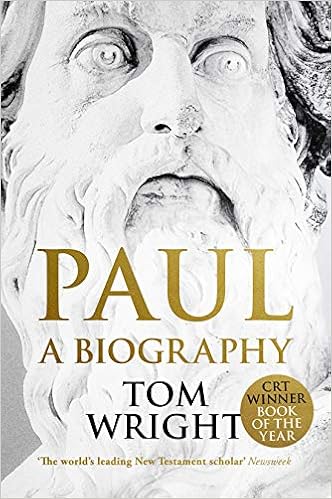
OK. It’s been a while. I’ve had so many ideas but never got round to getting it down. Here’s a few thoughts from Tom Wright, otherwise known as N.T. Wright. He was Bishop of Durham for a while, but is best known as an academic whose whole adult life has been spent studying the life and writings of St Paul.

He wrote a book about the life of St Paul that came out three years ago. I haven’t read it, but heard him talk about it on the Nomad Podacst.

To start with, his name is originally Saul. He comes from a conservative tradition in Judaism, and as the book of Acts describes, will do anything to protect Judaism from what he sees as unhealthy, misguided influences. One of those ‘way out’ movements is of course, what he would see as the cult of Jesus. Saul is basically a fundamentalist, and will track down followers of Jesus, and condone killing them for the cause of religious purity. Hence the stoning of Stephen, one of the prominent members of what we would call the early church. Saul is at this point a violent man, determined to put a stop to this abberation of the faith that he treasures.

But to call it the early church is slightly misleading – at this early point in the evolution of the Jesus movement, we’re talking about a community that is mostly made up of Jews before the word Christian has even been uttered. When we read the word ‘church’ in our English translations, the original Greek word is better translated by ‘gathering,’ ‘assembly, ‘ or ‘company.’

Tom Wright reminds us how important it is to understand the first century context of the words that we read. Another example of where we might have been reading this wrongly is to do with what we might have called the ‘conversion’ of Saul. Growing up, I had the impression that on the road to Damascus, when Saul has his experience of Jesus, it is at that point that he ‘becomes a Christian.’
(You can read the account in Acts chapter 9)

But at that point in time, there was no such thing as a Christian. There was no separate religion called Christianity. Saul was a Jew who had such a profound and mystical experience of the risen Christ, that he suddenly sees that he has been mistaken, and that Jesus is in fact, the Messiah of God. He doesn’t stop being a faithful Jew, and would in all likelihood continue in exactly the same way as he had done before regarding his religious observance, but now seeing that the promised Messiah has in fact come – in the person of Jesus Christ.

After this life changing encounter, at some point early on, Saul disappears off to Arabia for three years. It’s not clear exactly where he went or what he did during these three years, but Tom Wright has a theory … first a bit of background:

Back in the First Testament, * the prophet Elijah is at a turning point in his life. He had just defeated the 400 prophets of Baal, and was on the run from king Ahab and his wife Jezebel. At this time of great stress in his life, where does he go ? To mount Horeb. Mount Horeb is essentially the same as Mount Sinai, where Moses received the Ten Commandments. So Elijah is going back to the place where it all started. The place where God made it clear that the children of Israel were a ‘set apart people.’ They had a call to be God’s people for the nations. At Mount Horeb, God meets with Elijah and he gets the commissioning and strength that he needs for the next phase in his ministry. God tells Elijah that he is to ‘Go back the way you came, to Damascus.’ Once there, he was to anoint Jehu as the new king of Israel.

Tom Wright’s theory is that Arabia was the region that included Mount Sinai. Where would Saul go to think through the experience that he had on the road to Damascus ? Maybe back to where it all started – to Mount Sinai. Saul’s roots are in the ancient story of Israel’s deliverance from slavery; the journeying through the wilderness; the call to live as the people of God. So Saul goes to Sinai, to learn what this new call to follow Jesus will mean. And at the end of those three years, where does he go ? Back the way he came, to Damascus. And once there he will share the news that a new king has been anointed – Jesus. And that this good news of Jesus is for all people, both Jew and Greek, men and women, slave and free. And that this new community will be different from any community previously known, because it will not be according to your ethnic group, or whether you were a man or a woman, or a slave or a free person. This new community will break all the rules and be for all.

I feel like I should read the book !

And, as I was pondering on this alternative, radical new community that we see in the book of Acts, it made me think about my own experience of the church, and to what extent the churches I have been a part of have been ethnically diverse, with men and women both accepted fully, with class, background, education and social status not being an issue. Sadly, it seems that churches by default become fairly monocultural, not at all the vision that Paul had … 2000 years later it’s still a work in progress. Additionally, there are movements within the church that see the growth of the church being most effective when this mono approach is used – because like attracts like. This is in sharp contrast to the kingdom vision of a diverse community, which although it is often a more challenging environment, has within it the possibility of fully enacting the principles of love. Such a Christian community is truly a thing of great beauty.

* Christians have generally called the first part of the Bible ‘The Old Testament.’ But there are dangers in that. It might lead us to think that we can leave all of that behind. Now we have the New, we don’t need the Old. The New Testament gives us everything we need. In a sense that is true, but we are greatly impoverished in our undertanding of Jesus if we do not understand his roots, which lie in the work of God through Israel. If we only know the New Testament, we don’t know the New Testament! There is so much richness in the books of Moses, the history books, the wisdom and the prophets that we need to attend to. There has been a move to call these writings ‘The Hebrew Bible,’ but others are more inclined to use the phrase ‘First Testament,’ which gives those writings a more exalted place than ‘Old Testament,’ and unlike the phrase Hebrew Bible gives them their righful place within the whole revelation of God’s love and purposes.

Grace and Peace

Bible · faith · God · Political · Theology · World Affairs

The Pernicious Influence of Globalisation

The Old Testament story of the Tower of Babel is pretty well known. It’s a curious tale that appears after the flood story. Here’s the text from Genesis 11.

Now the whole earth had one language and the same words.
And as they migrated from the east, they came upon a plain in the land of Shinar and settled there.
And they said to one another, ‘Come, let us make bricks, and burn them thoroughly.’ And they had brick for stone, and bitumen for mortar.
Then they said, ‘Come, let us build ourselves a city, and a tower with its top in the heavens, and let us make a name for ourselves; otherwise we shall be scattered abroad upon the face of the whole earth.’
The Lord came down to see the city and the tower, which mortals had built.
And the Lord said, ‘Look, they are one people, and they have all one language; and this is only the beginning of what they will do; nothing that they propose to do will now be impossible for them.
Come, let us go down, and confuse their language there, so that they will not understand one another’s speech.’
So the Lord scattered them abroad from there over the face of all the earth, and they left off building the city.
Therefore it was called Babel, because there the Lord confused the language of all the earth; and from there the Lord scattered them abroad over the face of all the earth.

The motivation for building the tower seems to be twofold:
a desire to be known as the best, and to do the impossible.
coupled with a fear that without power and fame, the people (whoever they were, we don’t know), would be dispersed, and thus lose their influence.

Walter Brueggemann puts it like this: ‘the story … is an early account of globalisation, a strategy of universal control by powerful people who aim to control all the money and to impose uniformity on all parts of the world population.’

The force behind such attempts for domination is so powerful that it is all consuming, stopping at nothing to be at the top. The consequence of this kind of behaviour, althought not explicitly stated in the Genesis account, is that the poor and the powerless are overlooked.

Walter Brueggemann again … ‘The scattering and confusion wrought by God is to assure that no assertive power can gain ultimate control and emerge as a single superpower.’

Fast forward to the 21st century. Where are the parallels today for empire building to achieve complete control.
The super companies – Microsoft, Google, Apple, Facebook etc (and probably some others that have the same degree of power but work behind the scenes).
The super powers – at this time notably China, while the USA decreases in its influence.

And where would we look to see God’s hand in all of this ? Is there a move of God today that will assure that no assertive power can gain ultimate control ?

Grace and Peace.


A Prayer For This Day · faith · Following Jesus · Prayers

Morning Prayer Through The Week

I have tried all sorts of ways of giving some structure to my prayer, and in lockdown have found something that is working for me. In the past I’ve found that most of the things I’ve tried have either too many words, or not enough to feel that I’ve done anything.
So – I’ve been collecting prayers – some from other sources, and some home grown, and have this to offer. Each day has a theme, and the same structure for each day, as follows

Opening Prayer.


The psalm of the day
(I’m currently using a book by Walter Brueggemann – Gift and Task – that has suggested psalms and Bible readings for each day – you decide how much and what exactly you put in here, but having a part of a psalm as part of it is, I think, a good discipline)


‘Kyrie’ prayer
The Kyrie prayer is is a short prayer that is important in Christian worship. It is a prayer from the heart about human need. God owes us nothing. Everything he gives comes from his mercy. (Kyrie is the Greek word for Lord)

Collect
A Collect prayer – so called because in public worship the prayer gathers together the silent prayer of the assembled company in one prayer.  It has a particular form as follows:
1 God is addressed
2 Something is said about God’s nature, or God’s work
3 A request is made
4 A reason for the request (usually in relation to what was said about God)
5 An ‘Amen’ or other ending. (what Padraig O Tuama calls ‘a bird of praise’

Scripture reading(s) for the day
See above … however much or little you need.

Prayer of thanksgiving or prayers of concern

Blessing

I also use this form of words before Prayer each day

The night has passed and the day lies open before us;
let us pray with one heart and mind. 
As we rejoice in the gift of this new day,
so may the light of your presence, O God,
set our hearts on fire with love for you. Amen.

So to the 7 days and 7 themes.

Sunday – Resurrection and new life
Monday – Creation
Tuesday – Justice and Peace
Wednesday – The Holy Spirit
Thursday – Following Jesus
Friday – Forgiveness
Saturday – The Communion of Saints – believers past and present.

On Sunday at the monent, I’m using the form of morning prayer from the Northumbria community. Since I use this in its entirety, I won’t include it here, for copyright reasons, but you can find it here.
I have included it, because it’s the one thing in the past that I was able to use every day for a couple of years without getting bored with it.

faith · God · Jesus · Song for Today

The Canticle Of The Turning

The message of Advent and Christmas is that God is doing something new.

As this song declares – The world is about to turn.

May you know the new thing that God will bring to birth in you.

Wishing everyone a very Happy Christmas

youtube.com/watch

1 My soul cries out with a joyful shout
that the God of my heart is great,
and my spirit sings of the wondrous things
that you bring to the ones who wait.
You fixed your sight on your servant’s plight,
and my weakness you did not spurn,
so from east to west shall my name be blest.
Could the world be about to turn?

Refrain
My heart shall sing of the day you bring.
Let the fires of your justice burn.
Wipe away all tears, for the dawn draws near,
and the world is about to turn.

2 Though I am small, my God, my all,
you work great things in me,
and your mercy will last from the depths of the past
to the end of the age to be.
Your very name puts the proud to shame,
and to those who would for you yearn,
you will show your might, put the strong to flight,
for the world is about to turn. Refrain

3 From the halls of pow’r to the fortress tow’r,
not a stone will be left on stone.
Let the king beware for your justice tears
ev’ry tyrant from his throne.
The hungry poor shall weep no more,
for the food they can never earn;
there are tables spread, ev’ry mouth be fed,
for the world is about to turn. Refrain

4 Though the nations rage from age to age,
we remember who holds us fast:
God’s mercy must deliver us
from the conqueror’s crushing grasp.
This saving word that our forebears heard
is the promise which holds us bound,
till the spear and rod can be crushed by God,
who is turning the world around. 

Church · faith

Which Jesus Floats Your Boat

Ann Morisy, community theologian and author, talks about imitating Jesus. She is attracted especially by Jesus’ tendency to seek out the unlikely people. Uneducated fishermen; Tax Collectors, most of whom would have collaborated with the Roman authorities; Women, lacking in status and influence. Etc.

She tells of a project to locate a doctor’s surgery in a housing estate where there was no G.P. presence. The unlikely person was the phlebotomist, the one who took blood for testing. He was a reformed drug addict. Who better to find a vein ?!

So I’m asking myself the question … as I look at the life and work of Jesus, is there something that particuarly excites me ? Which Jesus floats my boat ?

Work in progress; I’m still thinking about that.

Grace and peace.

Bible · Church · community · faith · Following Jesus

It Never Struck Me Before

So. I’ve been listening to an interview with Alexander John Shaia. Fascinating. I had not heard of him before. He’s interviewed here on the Nomad podcast, and also in Rob Bell’s Robcast.
There are a load of things to talk about, but just an aside to start with – he talks about the Passover meal, and the central theme being slavery and freedom. It never occurred to me before that they wouldn’t all have gone with Moses!! Some would have followed him, for sure, but there would have been those who thought that they were better off staying in Egypt. They made that choice.

Now why didn’t I realise that ? I just assumed they all went. But of course some would have found the idea of such a radical move to be too difficult.

So on to where this is going to lead – to four questions that map the road of transformation.
I’m just going to try and summarise what Alexander was saying, but I hope you might go and listen to the interview, because I found it mind blowing.

We need to begin with a Jewish Passover:
According to the Ashkenazi tradition, the order of the Four Questions at the Passover meal is as followed:
Question 1: Why on all other nights do we eat either leavened bread or matza, but on this night only matza?
Question 2: Why on all other nights do we eat different types of vegetables, but on this night only bitter herbs?
Question 3: Why on all other nights do we not dip our food once, but on this night we dip it twice?
Question 4: Why on all nights do we eat either sitting upright or reclining, but on this night we recline?

These questions traditionally bring to mind:
Question 1: Eating matza commemorates how the Jews were in such a hurry to leave Egypt they could not wait for their bread to rise.
Question 2: Eating bitter herbs represents the bitter difficulties of life as a slave in Egypt.
Queston 3: Dipping food was a luxury reserved only for the aristocracy and upperclass in ancient times, so the practice of dipping is meant to reflect freedom.
Question 4: Reclining while dining was also a luxurious behavior historically, which stresses the privilege of freedom.

But Alexander Shaia refers to an older practice in Judaism at the time of Jesus that has four similar, but different questions, that might be paraphrased as:
Question 1: Thinking about the Exodus, when God’s people were set free from salvery in Egypt … Where in your life are you lost in a place of emotional paralysis, a state of being unfree, enslaved ?
Question 2: Thinking about the forty years when God’s people wandered in the wilderness … Where are you in a death experience ?
Queston 3: Thinking about the time when God’s people crossed over Jordan into the promised land … Where do you hear God’s new promise for you ?
Question 4: Thinking about life in that land of promise … What new action is God asking of you, for your life, the life of your community ?

So … in summary, the four questions relate to
1. The path of transformation includes times to consider making a change. How are are you going to respond ? Choice
2. The path of transformation will involve tension, and trials. Suffering
3. The path of transformation will include the offer of newness in some way. Gift
4. The path of transformation will challenge you to think about acts of service you are being called to give. Service

Interestingly, these four aspects of the life of faith were a central part of the practice of the early church in preparing candidates for baptism. Not surpisingly really, the church drew on the heritage of Jewish practice in making disciples of Jesus Christ.

Now here’s the thing … the early church also, according to Alexander Shia and others, linked these four aspects of discipleship to the four Gospels.
Matthew – addressed to the Jewish community – Choice.
Who will you choose ? Will you choose this new way in following Jesus ?
Mark – addressed to the Christian community in Rome, suffering persecution under Nero.
Stay strong as you seek to make Jesus the Lord of your life, even in the midst of persecution. Suffering.
John – addressed to the diverse Christian community in Ephesus, which was beginning to revisit old divisions
Even though you come from different backgrounds. Receive the gift of unity. Gift
Luke – addressed to the Christian community in Antioch.
Remember that you are called to serve. Service

So, when you think of the Gospels, think rather of one Gospel. The Gospel that is shown to us in four different ways, to help us understand the fourfold path of transformation.

I found these insights really helpful, and will be praying that I will be aware when I am being asked to make a choice about something –
The challenge of moving on to something new, and leaving other things behind.
The challenge of hanging in there when it gets tough
The challenge of seeing how I am being called to serve.

Grace and peace.

faith

Nuggets From Elizabeth Oldfield (III)

This is her talking about holding faith on the one hand firmly, but also lightly. (That may sound like nonsense, please read on)

“I have a very small number of very strong convictions. And everything else is above my pay grade. I’m very open to changing my opinion on it. This is my hunch (about whatever is under discussion), but I’m very open to changing my mind on it.

And in terms of my faith, I think … one of my favourite prayers is from Morning Prayer from the Northumbria Community, and a part of it says “To whom shall we go ? You have the words of eternal life, and we have believed, and have come to know that you are the Holy One of God. Praise to you, Lord Jesus Christ, King of endless glory.”

One amazing benefit of having interviewed in quite a lot of depth people from very different metaphysical positions is – there’s not something better out there that I could exchange this for. I’ve never met anyone who made me think that their understanding of God, or not God, or whatever it is, is more beautiful or compelling than the Christian gospel, and so, even though my faith is multi-coloured and changes and is a wrestle, (as I think it is for anyone who is being intelectually honest), in some ways it is strengthened … because this is good stuff. It goes deep, it is satisfying – emotionally, intellectually, relationally. It’s like the old worship song – ‘nothing compares to the promise I have in you.’ – and I still fundamentally believe that.

Elizabeth Oldfield is director of the thinktank Theos

and has a podcast – The Sacred