Bible · Church · faith · Following Jesus · Jesus · Theology

New Light On St Paul

OK. It’s been a while. I’ve had so many ideas but never got round to getting it down. Here’s a few thoughts from Tom Wright, otherwise known as N.T. Wright. He was Bishop of Durham for a while, but is best known as an academic whose whole adult life has been spent studying the life and writings of St Paul.

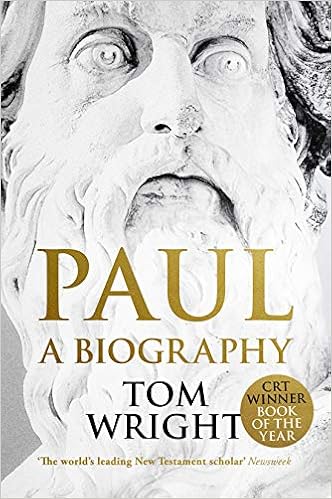
He wrote a book about the life of St Paul that came out three years ago. I haven’t read it, but heard him talk about it on the Nomad Podacst.

To start with, his name is originally Saul. He comes from a conservative tradition in Judaism, and as the book of Acts describes, will do anything to protect Judaism from what he sees as unhealthy, misguided influences. One of those ‘way out’ movements is of course, what he would see as the cult of Jesus. Saul is basically a fundamentalist, and will track down followers of Jesus, and condone killing them for the cause of religious purity. Hence the stoning of Stephen, one of the prominent members of what we would call the early church. Saul is at this point a violent man, determined to put a stop to this abberation of the faith that he treasures.

But to call it the early church is slightly misleading – at this early point in the evolution of the Jesus movement, we’re talking about a community that is mostly made up of Jews before the word Christian has even been uttered. When we read the word ‘church’ in our English translations, the original Greek word is better translated by ‘gathering,’ ‘assembly, ‘ or ‘company.’

Tom Wright reminds us how important it is to understand the first century context of the words that we read. Another example of where we might have been reading this wrongly is to do with what we might have called the ‘conversion’ of Saul. Growing up, I had the impression that on the road to Damascus, when Saul has his experience of Jesus, it is at that point that he ‘becomes a Christian.’
(You can read the account in Acts chapter 9)

But at that point in time, there was no such thing as a Christian. There was no separate religion called Christianity. Saul was a Jew who had such a profound and mystical experience of the risen Christ, that he suddenly sees that he has been mistaken, and that Jesus is in fact, the Messiah of God. He doesn’t stop being a faithful Jew, and would in all likelihood continue in exactly the same way as he had done before regarding his religious observance, but now seeing that the promised Messiah has in fact come – in the person of Jesus Christ.

After this life changing encounter, at some point early on, Saul disappears off to Arabia for three years. It’s not clear exactly where he went or what he did during these three years, but Tom Wright has a theory … first a bit of background:

Back in the First Testament, * the prophet Elijah is at a turning point in his life. He had just defeated the 400 prophets of Baal, and was on the run from king Ahab and his wife Jezebel. At this time of great stress in his life, where does he go ? To mount Horeb. Mount Horeb is essentially the same as Mount Sinai, where Moses received the Ten Commandments. So Elijah is going back to the place where it all started. The place where God made it clear that the children of Israel were a ‘set apart people.’ They had a call to be God’s people for the nations. At Mount Horeb, God meets with Elijah and he gets the commissioning and strength that he needs for the next phase in his ministry. God tells Elijah that he is to ‘Go back the way you came, to Damascus.’ Once there, he was to anoint Jehu as the new king of Israel.

Tom Wright’s theory is that Arabia was the region that included Mount Sinai. Where would Saul go to think through the experience that he had on the road to Damascus ? Maybe back to where it all started – to Mount Sinai. Saul’s roots are in the ancient story of Israel’s deliverance from slavery; the journeying through the wilderness; the call to live as the people of God. So Saul goes to Sinai, to learn what this new call to follow Jesus will mean. And at the end of those three years, where does he go ? Back the way he came, to Damascus. And once there he will share the news that a new king has been anointed – Jesus. And that this good news of Jesus is for all people, both Jew and Greek, men and women, slave and free. And that this new community will be different from any community previously known, because it will not be according to your ethnic group, or whether you were a man or a woman, or a slave or a free person. This new community will break all the rules and be for all.

I feel like I should read the book !

And, as I was pondering on this alternative, radical new community that we see in the book of Acts, it made me think about my own experience of the church, and to what extent the churches I have been a part of have been ethnically diverse, with men and women both accepted fully, with class, background, education and social status not being an issue. Sadly, it seems that churches by default become fairly monocultural, not at all the vision that Paul had … 2000 years later it’s still a work in progress. Additionally, there are movements within the church that see the growth of the church being most effective when this mono approach is used – because like attracts like. This is in sharp contrast to the kingdom vision of a diverse community, which although it is often a more challenging environment, has within it the possibility of fully enacting the principles of love. Such a Christian community is truly a thing of great beauty.

* Christians have generally called the first part of the Bible ‘The Old Testament.’ But there are dangers in that. It might lead us to think that we can leave all of that behind. Now we have the New, we don’t need the Old. The New Testament gives us everything we need. In a sense that is true, but we are greatly impoverished in our undertanding of Jesus if we do not understand his roots, which lie in the work of God through Israel. If we only know the New Testament, we don’t know the New Testament! There is so much richness in the books of Moses, the history books, the wisdom and the prophets that we need to attend to. There has been a move to call these writings ‘The Hebrew Bible,’ but others are more inclined to use the phrase ‘First Testament,’ which gives those writings a more exalted place than ‘Old Testament,’ and unlike the phrase Hebrew Bible gives them their righful place within the whole revelation of God’s love and purposes.

Grace and Peace

faith · God · Jesus · Song for Today

The Canticle Of The Turning

The message of Advent and Christmas is that God is doing something new.

As this song declares – The world is about to turn.

May you know the new thing that God will bring to birth in you.

Wishing everyone a very Happy Christmas

youtube.com/watch

1 My soul cries out with a joyful shout
that the God of my heart is great,
and my spirit sings of the wondrous things
that you bring to the ones who wait.
You fixed your sight on your servant’s plight,
and my weakness you did not spurn,
so from east to west shall my name be blest.
Could the world be about to turn?

Refrain
My heart shall sing of the day you bring.
Let the fires of your justice burn.
Wipe away all tears, for the dawn draws near,
and the world is about to turn.

2 Though I am small, my God, my all,
you work great things in me,
and your mercy will last from the depths of the past
to the end of the age to be.
Your very name puts the proud to shame,
and to those who would for you yearn,
you will show your might, put the strong to flight,
for the world is about to turn. Refrain

3 From the halls of pow’r to the fortress tow’r,
not a stone will be left on stone.
Let the king beware for your justice tears
ev’ry tyrant from his throne.
The hungry poor shall weep no more,
for the food they can never earn;
there are tables spread, ev’ry mouth be fed,
for the world is about to turn. Refrain

4 Though the nations rage from age to age,
we remember who holds us fast:
God’s mercy must deliver us
from the conqueror’s crushing grasp.
This saving word that our forebears heard
is the promise which holds us bound,
till the spear and rod can be crushed by God,
who is turning the world around. 

Bible · faith · Following Jesus · God · Jesus · Worship

All You Who Are Thirsty

Alongside my daily reading of the psalms and the Gospel of John, I have been reading Isaiah. Today I got to chapter 55. More about that shortly.

But first, I must mention the novel that I’ve just finished. ‘In the Beginning’ by Chaim Potok. The story concerns David, who is only a small boy at the start of the novel. His family, orthodox Jews, have arrived in New York in the 1920’s from Poland. Like other novels by Potok, you get an insight into the daily life and religious observance of orthodox Jews, which I found fascinating. It impressed on me how little I know of Judaism, past and present, and prompted me to read some Jewish commentaries on the Bible (Old Testament).

In Synagogue worship, the reading of Torah – The Law of Moses – (The first five books of the Bible) is central, and in the course of a year, the whole of the Torah will be read in the Sabbath morning worship. (In some traditions there is a three year cycle of Torah readings). The reading of Torah is followed by a Havtarah, a reading from another part of the Old Testament that is thematically linked to the Torah reading for the day. The Havtarah reading completes the Bible readings for that day.

So to Isaiah 55. The following verses are part of the Havtarah reading on the Sabbath called Noach, when the story of Noah is read as the Torah reading.

1 “All you who are thirsty, come to the water!
You without money, come, buy, and eat!
Yes, come! Buy wine and milk
without money — it’s free!
Why spend money for what isn’t food,
your wages for what doesn’t satisfy?
Listen carefully to me, and you will eat well,
you will enjoy the fat of the land.
Open your ears, and come to me;
listen well, and you will live —
I will make an everlasting covenant with you,
the grace I assured David.

These verses are an invitation to come to God, the source of all that is good, and lifegiving. The significance of water is clearly to do with the necessity of water for life. This is understood also to tell us of the necessity of God’s law for us to live fully. So water is a symbol of Torah, and like water, we need Torah’s influence in our lives continually.

In the account of the Israelites’ journey after the Exodus, it tells us that they travelled for three days in the desert without finding any water. After three days, they found water, but it was bitter. When the people complained and asked, “Moses, what are we going to drink?” Moses asked the Lord for help and the Lord told him to throw a piece of wood into the water. Moses did so, and the water became fit to drink.

So as the people could not go more than three days without water, and water is a symbol of Torah, we must not go more than three days without a public reading of Torah. It became the custom not to let more than three days pass without a public reading of Torah. So readings from the Torah are read on Monday and Thursday, as well as on the Sabbath.

And for me as a believer in Jesus as the Messiah, I see these verses from Isaiah as an invitation to come to Jesus, God’s promised one. In John’s Gospel chapter 4, Jesus has an encounter with a Samaritan woman at Jacob’s well, and in the course of the conversation, Jesus says these words “Whoever drinks the water I give them will never thirst. Indeed, the water I give them will become in them a spring of water welling up to eternal life.”

For me, the whole of Torah is fulfilled in Jesus, who came to do God’s perfect will, and to lead us to the Father.

Grace and Peace.

Bible · faith · God · Jesus

Make Our Home With Them

I’m still reading part of a psalm and a few verses of John’s Gospel each day.
Today was Psalm 132, with the idea of ‘A resting place, or dwelling for God’

In the psalm, king David makes a vow to ‘find a dwelling for the Lord’
Part of this was to do with the Ark of the Covenant – the chest that contained the Ten Commandments. It signified God’s presence with his people.
The Ark of the Covenant had been stolen by the Philistines in battle, but then returned to Israel. It ended up at a place called Kiriath-Jearim, where it was forgotten for 20 years. Then we read in the First book of Chronicles chapter 13 how David brings the Ark back to Jerusalem. In the psalm this event is recalled in these words:

“Arise, Lord, and come to your resting place,
you and the ark of your might.” Psalm 132 verse 8

In the Old Testament, places are really important. The Ark and the Temple are both material signs of God’s presence with his people. Psalm 132 is part of a collection of psalms that would be sung as people made their way to Jerusalem for festivals. They would sing as they made their journey to meet with God in the holy city. We see the same idea through history in the importance of pilgrimage to holy sites in different religions. Mecca, The River Granges, Rome etc.

Set alongside that is my other reading from John Chapter 14 verse 23
‘Jesus said “Anyone who loves me will obey my teaching. My Father will love them, and we will come to them and make our home with them.”

What Jesus brings to Israel is a new and very challenging insight. God does not reside in buildings and shrines, but in people. Jesus may have taught in the temple, but most of what we read in the Gospels seems to show Jesus meeting people where they are, in their everyday lives. And that is the promise to us today. God is with us. Not through special places, (although they may have their ‘place’) and not through priests as intermediaries, but directly as we open ourselves to God’s presence with us and in us – this promise is not restricted, but is for anyone, at anytime, in any place.

In the end, our destination, our home, is to be with God.
And at the same time, God’s destination, God’s home, is to be with us.

Grace and peace.