music

Seeing In A Straight Line

At age 16, guitarist Robbe Robertson had the opportunity to join Ronnie Hawkins’ Rockabilly band, and made the long journey from the cold of Canada to Arkansas and the steamy south. It was THE turning point in his life, and from this decision would emerge one of the seminal bands of the late 60’s early 70’s – The Band.

Hearing this story reminded me of an encounter I had on Victoria train station in the late summer of 1973.
Just a few weeks before this encounter, I had finished my first year studying engineering at university, and failed two important exams. It could have meant the end of my student life, but there was a possibility of a reprieve. I could retake the two papers at the end of the long summer holiday. My friend Mark had failed the same papers, so he came to stay that summer, and together we went through every single past exam paper we could get our hands on.

By the end of a couple of weeks, we had done as much as we could, and we duly turned up at the university to do our retakes. They put us in a small room, with just enough room for two desks, one behind the other. The retake papers were placed on the desks, and nervously we turned the first page. The first reaction as I read through the questions was one of surprise, closely followed by joy! I had done the questions all before. They had simply lifted questions from past papers! My relief must have been audible, and I could also hear Mark’s reaction – not quite the same as mine. He also recognised the questions, but in his panic he couldn’t remember how to answer them. There was no-one else in the room, and no CCTV, (!) so I whispered to ask if I could help him. He declined the offer, whether through fear of being found out or a degree of self belief, I’m not sure. Anyway, after a while, his state of fear subsided, and we both got on with answering the questions.

We both heard a short while later that we had done well enough to continue with the course in the autumn. As it turned out, I had done very well on the retakes, and my tutor was pleasantly surprised, even shocked!

The encounter outside Smiths newsagents on Victoria station, which is the real point of this post, came between doing the retakes and getting the results. After our stressful couple of hours in that small room, where our memories of electronics and structures were tested, we had a few more weeks of holiday before the new term, so we both went home.

On the way home, I had caught a train into King’s Cross station, and then across London by tube to Victoria. As I was waiting I was browsing the record stand outside W.H.Smiths. I was aware of someone else also looking through the records. After a minute or so, we struck up a conversation, both of us clearly interested in the same sort of music. He introduced himself, and as we were talking, I explained that I had failed my exams, but hope to pass my retakes and go into the second year etc etc.

At some point I started talking about my love of music. In those days, I had a 4 track reel to reel tape recorder, taping from the radio, playing around with using echo and such. It turned out that he worked for Decca records, and as the conversation went on, the possibility of starting in the music industry with a view to being a recording engineer became exciting. He left me with his card, saying that if I changed my mind about continuing at university to give him a call.

On the train journey back home I was already envisioning a future in the music business. The bubble burst when I got back home and relayed the conversation with the Decca man to my parents. I was from a family where education was important, and to leave at this point would be a risk. I would be throwing away a secure future for something that may or may not work.

I was persuaded. Actually I don’t think I put up much of a fight. I’m maybe a safety first person at heart ?

The title of this post is ‘seeing in a straight line.’ That phrase came up in a conversation between T-Bone Burnett and Rick Rubin (see my last post). Seeing in a straight line is what we do most of the time. There maybe some special times when we are able to see around corners, but most of the time we don’t.

Back in 1974, I wasn’t able to see around the corner. I maybe had some stuff in my peripheral vision, but not enough to divert me from the easily visible path ahead.

I think since then, I have been able to see around the corner a couple of times, and allow myself to be taken to a new place in my life.

Thinking back to that conversation on Victoria station, I have no regrets. We probably all have some regrets, but for me, that’s not one of them.

And finally – listening to Robbie Robertson got me asking the question ‘If you could choose to have been present at the recording of one record, which would it be ?’

For me, it would be when Robbie Robertson and the Band recorded their second album, called simply ‘The Band.’ (Or ‘The Brown Album’). Here’s a link to a live recording of one of the songs on that album The Night They Drove Old Dixie Down
(3 million views and counting).

music · Songwriting

The Melody Of The Expression

On my run this morning I was listening to a conversation between T-Bone Burnett and Rick Rubin. T-Bone is a musician and record producer, and Rick Rubin has an impressive CV as a producer.
They were talking about the way that lyrics have their own inherent rhythm – and sometimes for example, a lyric will have a particular feel to it that suggests it should be repeated. A hook line. It might be that the lyric is the heart of the song, and needs to be repeated. Or it might be that it just has a feel about it that is chant-like.

T-Bone then said “it’s the melody of the expression.” There’s something about words that suggest the pace of a song, or whether the melody should be bright or melancholy. Think of Jimmy Webb’s song ‘Up, up and away.’ The melody does exactly that – it goes up … and then seems to float when he gets to the line ‘… in my beautiful balloon.’

So on the way back from my run I thought I would try it. I looked up at the trees on my street and sang :
I see you up in the trees. (the melody going up on the word ‘up’)
So I carried on: I see you up in the clouds
Then, why not have: I see you everywhere I go
So it’s logical to sing: Your face is always on my mind
and then: The traces you have left behind

All in about 20 seconds. I wonder if this will result in a song. In my mind, the last line couldn’t have been anything else, and it’s strange how that line then determines where the song is going.
It’ll have to be about a) Someone who has died (Not again please! I’ve wrtitten too many of those)
or b) A lost love.

I think it will be lost love. I need to write a happy song one day. Oh Well.

Back to T-Bone. He made the observation that (in America, that is), the canned music that you hear in supermarkets and shopping centres tends to be from the 60’s. The 60’s was a time of great change and at the same time great optimism. So many of the songs reflect that mood, and it was a time when the music industry was young.

It seems that there is a tendency for movements and organisations to feel fresh at the beginning, but over time become jaded and bound by the pressures of success.

So – tasks ahead
1) Continue the song from above …
2) Write a happy song.
3) Write a song about songwriting with the line ‘The melody of the expression’

Ron Sexsmith has a song about songwriting. here it is: This Song

I brought a song into this world
Just a melody with words
It trembles here before my eyes
How can this song survive

I brought it to the tower of gold
In my coat of many holes
I came unarmed, they’ve got knives
How can this song survive

Oh now, I can’t help wondering how it is
How someone like you exists
When all around you bullets fly
You don’t seem to notice them go by
How can this song survive

Oh now, I see the game I’m up against
No wonder I feel so afraid
For every song you ever heard
How many more have died at birth
Oh how, how can this song survive

I brought a song into this world
Just a melody with words
It trembles here before my eyes
How can this song survive
I came unarmed
They’ve all got knives
How can this song survive
Until we finally say goodbye
How, how can this song survive
I wonder how, I wonder why

Songwriters: SEXSMITH, RON
Publisher: Lyrics © Sony/ATV Music Publishing LLC

Me · music · Songwriting

In Memory Of A Friend

A few weeks ago, my son-in-law sent me a link to a podcast interviewing songwriters – the one he had recommended was the ‘Broken Record’ podcast episode with Jack White and Brendan Benson of the Raconteurs. It was good to hear songwriters talking about the art of writing songs and not just telling stories about life on the road etc.

So, since then I’ve looked to see who else I might listen to, and just yesterday finished the episode with Joe Henry. You may not have heard of him, but he’s produced a 15 solo albums over the last 30 years, and also been involved in projects with such people as Solomon Burke, Bonny Raitt, Billy Bragg, Elvis Costello and many more. I first heard Joe Henry back in the early 90’s when someone recommended the album ‘Kindness of the World.’

It’s so good to hear someone talking about songwriting and to recognise some of the ways I work in what they are saying.

I’ve been working on a song for a few weeks, and just finished it, I think. It may need some tweaks, but essentially it’s there.
It was triggered off by a line in a book by Will Cohu – The Wolf Pit. The book is a memoir of his growing up in a sheep farming community in North Yorskhire. The line that caught my eye was this ‘The black dog had backed him in a corner.’
The black dog in question was depression, and the person was Will’s uncle Robert. It’s a deperately sad story of how someone tried to fight this disease, and the way his friends and family tried to help him.

I wrote the song, and just as I was beginning to feel that it was finished, it all came back to me.
When I was in the last few years of school, I had a friend called Tim. We didn’t go to the same school – In those days of selective education where I grew up, I was at the High School and Tim was at one of the Secondary Modern Schools. This was back in the late 60’s early 70’s.

The High School for Boys was one of the choices of school if you had passed the 11 plus exam. The education there was more academic, and I remember having to drop subjects like music, art, and woodwork when I was 13 in favour of Latin, History, French and German.

Anyway, I got to know Tim when he turned up at our church youth group, and we started to get to know each other outside the Sunday evening gatherings. He introduced me to his younger sister, Penny, and his parents. His Father was a gifted pianist, and Tim was likewise gifted. He had a similar ability to his father in playing the piano – whtout music and completely untrained. In addition he had an instintive feel for electronics. At the age of around 16, he had built a telephone exchange in the garden shed. In those days it was all mechanical relays, triggered by electrical impulses. He built it such that there was a telephone in every room of the house, all controlled by the complicated arrangement in the shed.

At that time, young people like Tim usually ended up in the Secondary Modern School, because he wasn’t academic in the traditional sense. Yet he was, in many ways, far more gifted than I was. I think someone like Tim would be spotted today as ‘gifted and talented,’ and would have access to a wider range of opportunities.

Back to the telephone exchange in the shed – the thing was, he had designed all of this in his head. At the same time, I was beginning to get some rudimentary grasp of electricity in A level Physics, and was familiar with simple calculations, which I would do on paper. What Tim had done was way more complex and it seemed that he could just think about an electrical circuit and know instinctively what values he should assign the resistors and capacitors in each circuit. I guess he was some sort of savant.

At the same time, Tim was an incurable romantic. He was madly in love with a girl, and she became the subject of our conversations, me as the listener as he poured out his feelings for the girl, and his uncertainties about whether this love was going to be returned.
I suppose this went on for a couple of years. He got to know the object of his love and took her out, and gave her gifts, but there was always this feeling in my mind that he was building this romance up into something that it wasn’t.

The time came when I went away to University to study engineering. It was at the beginning of one of holidays that I found out. I had got home at the end of term and my parents told me that he had died. They hadn’t wanted to tell me until I got home. I missed the funeral. I don’t think I went round to see his parents or his sister. I wasn’t mature enough to think of that. Tim had driven his car up to a nearby beauty spot on the South Downs (a place he had often taken his girlfriend) and taken an overdose.

I can’t remember much about how it affected me, but it must have done. Although it was a bit of a one way friendship, with me being a more or less permanent shoulder to cry on, he was a good friend.

Here’s the song lyrics, and a link to the song

Black Dog

A good friend of mine
was great to have around
but lately we had found
he had another side

The little pills
supposed to make him better
just became a fetter
He couldn’t let ‘em go

He was a lovable man and he tried
We let him know that we were always on his side

The old black dog
had backed him in a corner
buzzing like a hornet
wouldn’t let him go

He tried to fight it
Be normal like his friends
Not having to pretend
But it’s a long way back

He was a desperate man and we tried
but in the end there was nowhere to hide

He locked his car
sat smoking in the shade
he had overstayed
now it’s time to go

The old black dog
that had backed him in a corner
buzzing like a hornet
wouldn’t let him go

Jonathan Evans April 2021.

Church · community · faith · Jesus · Worship

He Is Risen Indeed, Alleluia!

It’s Easter Day. For me the most important day in the Christian Year. It’s a declaration that God is unwilling to take our ‘no’ for an answer. With Jesus, it is always yes. An unconditional ‘yes’ to be with us.

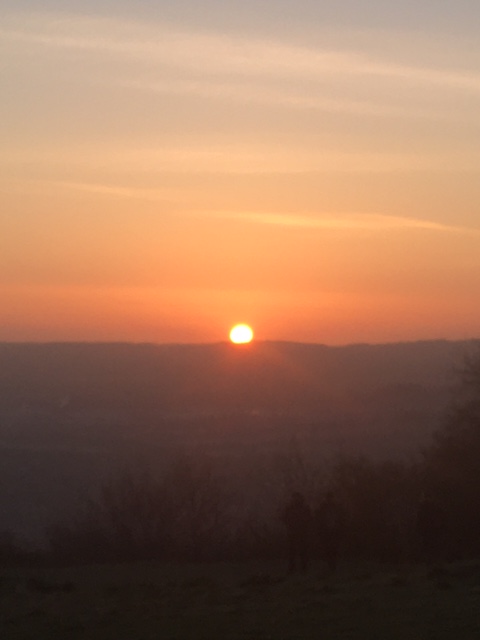
This morning we met with some friends and their two young children to walk up Robinswood Hill. The hill is just a mile or so from where we live, and from the top you gt a 360 degree view taking in the city of Gloucester and the surrounding countryside.

We had decided to get to the top in time for sunrise just after 6.30. We met in the car park, with the darkness already beginning to fade as the pre-dawn light became stronger.

It’s a 200 metre climb – quite a task for Steve with a two year old on his back, and pretty challenging for their five year old. But we made it in time for the sunrise, and got ready for a short act of worship for Easter Day. Another friend joined us at the last minute. He phoned us from the car park, 200 metres below us.
‘Where are you ?’
‘We’re at the top. We’ll see you in about 15 minutes’

So finally, we were all there, and shared a communion of croissants and hot chocolate, with a song and some prayers, and the familar Easter shout:
Alleluia, Christ is risen
He is risen indeed, Alleluia.
Praise the God and Father of our Lord Jesus Christ
He has given us new life and hope by raising Jesus from the dead
Alleluia, Christ is risen
He is risen indeed, Alleluia.

As we started to sing ‘Thine be the Glory’ at the end of our short service, a couple who had just got to the top of the hill came and joined us. I don’t know what the dog walker and the few others who were there for the sunrise thought, but we gave it our best as we sang that great Easter hymn.

Over the last 35 years or so, we’ve nearly always done something similar. From a hill in North Yorkshire, to a nature reserve in Hertfordshire, via Beverley in East Yorkshire, where one year we had snow! There’s something very special about celebrating the resurrection as the sun comes up.


When we got home, I came across this song in one of my prayer books. It seemed to echo our early morning gathering, and sums up for me a lot of what our faith is all about. Here’s a translation below and a link to the song here

“Vamos todos al banquete “

Let us go now to the banquet, to the feast of the universe —
the table’s set and a place is waiting.

I will rise in the early morning; the community’s waiting for me.
With a spring in my step I’m walking with my friends and my family.

God invites all the poor and hungry to the banquet of justice and good —
where the harvest will not be hoarded so that no one will lack for food.

May we build a place among us where all people are equal in love —
For God has called us to work together and to share everything we have.

translated version of “Vamos Todos Al Banquete” written by Guillermo Cuéllar
and commissioned by Msgr. Oscar Romero for the Misa Popular Salvadoreña


Bible · faith · suffering

When The Work Is Done

Holy Saturday and Prayer

Today is Holy Saturday. An important day in the Christian calendar. The day between Good Friday and Easter Day. That holy space between death and resurrection. The space between desolation and life.

My reading in the book of Lamentations, still despairing over the destruction of the Holy City, Jerusalem, has these words, addressed to God:
You have wrapped yourself with a cloud so that no prayer can pass through. Lamentations 3 verse 44

But even in the midst of this despair, we read just a few verses later:
I called on your name, O Lord, from the depths of the pit;
You heard my plea …
You came near when I called on you; you said, ‘Do not fear!
You have taken up my cause, O Lord, you have redeemed my life. (Lamentations 3 verses 55-58)

Somehow in the life of faith of the Old Testament saints is a recognition that even in a time of loss and grief, when God seems to be absent, the only thing to do is to pray. Prayer is all that is left. It’s a paradox. We see no hope, and yet, in spite of that, we hope. These passages are a deep well of resources for the person of faith.

Walter Brueggemann puts it like this:
“Faith is the capacity to hold both honest reality and open possibility”

I wonder if Jesus’ disciples were able to draw on those resources after the crucifixion. I wonder what hope, if any, they were able to find ?

Holy Saturday and Rest

In the Jewish faith Saturday is the seventh day of the week. The Jewish Sabbath. A day of rest. It starts on Friday night and lasts until Saturday night. This recalls God’s work of creation, where each of the acts of creation ends with these words:
And there was evening and there was morning, the first (second etc) day. Genesis Chapter 1

The Sabbath day of rest mirrors God’s own rest at the end of the work of creation:
On the seventh day God finished the work that he had done, and he rested on the seventh day from all the work that he had done. So God blessed the seventh day and hallowed it, because on it God rested from all the work that he had done in creation.
(Genesis 2 verses 2 & 3)

This Sabbath day, Holy Saturday, is also the culmination of God’s work. As God rests at the end of the work of creation, so now another work is finished. Jesus’ dying words on the cross are ‘It is finished’
When Jesus had received the wine, he said, ‘It is finished.’ Then he bowed his head and gave up his spirit.
(John 19 verse 30)
It is at the cross where Jesus finishes his work to be with us in solidarity until the very end.

So this day is a day when we wait. Nothing happens on Holy Saturday. It’s a day for quiet contemplation. Until the celebrations that begin to signal the resurrection, there are no services. Everything stops.

It’s a day when we might recall those aspects of our lives where, like the writer of lamentations, we hold those two ancient prayers together. The prayer of absolute despair and the prayer of hope in the face of no hope.

You have wrapped yourself with a cloud so that no prayer can pass through.
And
I called on your name, O Lord, from the depths of the pit; you heard my plea … you came near when I called on you;

In some mysterious way, the hope doesn’t deny the state that we are in, and yet the reality of that despair cannot stop us from praying.

Grace and Peace.


Bible · faith · God · Theology

We Know Only In Part …

… but we’re getting there.

Rob Bell “I’m going to try and create a space where hope is the most rational response to the world …
I love that thought, and basically I’m with it, but it didn’t seem like that on the first Good Friday.

Today is Good Friday – Friday April 2nd 2021

One of my readings for today was from lamentations:
I am one who has seen affliction
    under the rod of God’s wrath;
he has driven and brought me
    into darkness without any light;
against me alone he turns his hand,
    again and again, all day long.

This is the cry of desolation at the laying waste of Jerusalem and the destruction of the temple. It’s a place of no hope. It is echoed in the cry of Jesus on the cross – ‘My God, why have you forsaken me ?’

No hope.

Also in my readings for today was psalm 95. A strange psalm it seemed to me.
But in the middle of the psalm, these words are addressed to God’s people:

O that today you would listen to his voice!
    Do not harden your hearts, as at Meribah,
    as on the day at Massah in the wilderness,
when your ancestors tested me,
    and put me to the proof, though they had seen my work.

In verse 9, I saw something that resonated with me to do with what happened on that first Good Friday.

The Old Testament is full of God’s faithfulness, in the face of Israel’s unfaithfulness.
It’s as though all the way through, Israel are pushing God to see how far God will go. In spite of the work of God in liberating Israel from slavery, they forget, and abandon the love they have had for God. Is there a point at which God will say – ‘That’s it! I’ve had enough of you people.’

In fact, it does appear at times as though God does say exactly that. But then something happens, and God’s faithfulness reappears, just as the sun reappears from behind clouds.

And today, Good Friday, is a day when it seems like the human race is testing God again. ‘They put me to the proof, though they had seen my work.’
In spite of all that Jesus has said and done, he is now rejected. In Jesus, the world has witnessed the works and character of God revealed in Jesus in a new way, and yet still people put God to the test. Jesus is pushed to see how far his love will go. The soldiers around the cross shout – ‘If you are the King of the Jews, save yourself!’ This is a challenge to see how far God’s love will go.

Sam Wells talks about the cross in this way:
The cross is the moment when Jesus had to choose being with the Father, or with us, and he chooses us.  And at the same time, the Father has to choose between letting the Son be with us, or keeping the Son to himself. Such is God’s commitment to us that chooses to let the Son be with us. 

This is the faithfulness of God in the face of human unfaithfulness.

Sam Wells again (paraphrased) talking about Easter day:
This day. this Easter day, this wondrous, glorious, blessed, fabulous day is the greatest day in the history of the universe. It tells us that however deeply we reject God, whatever we throw at God, God will find a way back to us in resurrection.  And – this resurrected, real flesh and blood body of Jesus, tells us that we too can have that life – and that our eternal destiny is to be with God, as God is, and always has been, with us. 

Now that is hope ! Thanks be to God.

Grace and peace.

Activism · Bible · faith · Following Jesus · Jesus · Political · World Affairs

In My Dream I Saw

I don’t remember my dreams very often, but I still have some snippets from a dream I had last night.
In my dream I saw a statue, standing up with something like a rod in its hand. The statue was a bit more than life size, maybe about 8 feet tall, and the rod was about 18 inches long and maybe 2 inches in diameter.

The next thing I saw was that the statue was lying down on its side, and the rod was held by two cupped hands of the statue. The hands were holding, rather than gripping the rod. Then someone was removing the rod from the cupped hands.

Then I found myself with a group of people in a room, all giving their different accounts of what the rod symbolised. Each one was describing a different angle on power

I can’t quite remember exactly what I said, but it was something to do with what happens when there’s a vacuum. There’s that saying – nature abhors a vacuum. When there’s a vacuum, something will rush in the fill that vacuum.

In the dream, the vacuum was created when the rod was removed from the hands. Suddenly, the person, or organisation that was holding the power is no longer in charge. At that point, other forces are quick to come and seize power.

In my dream, I went on to say that what was needed was an understanding of what the purpose of holding that power should be. The power should be exercised for the benefit of all. That means that everyone needs to have a say, no one should be left out.

At that point, I finished, and everyone applauded. I was surprised, but pleased that what I had said seemed to ring a bell with everyone present.

Here endeth the dream

So – a couple of reflections on the dream. We’re watching a series on Netflix at the moment called Godless. It’s set just after the American Civil war, and I think that may have been on my mind, and that somewhere deep in my unconscious is a memory of Abraham Lincoln’s Gettysburg Address from November 19th 1863, in the middle of the Amercian Civil War. In that speech, he famously said ‘That government of the people, by the people, for the people, shall not perish from the earth.’ The exact wording of the speech is uncertain, and Lincoln wasn’t the first to use that idea …. of the people, by the people, for the people.

My little speech in the dream seemed to be along the same lines …

The second thought is that today – March 28th 2021 – is Palm Sunday in the Christian calendar. The Gospel reading for Palm Sunday recalls how Jesus rode into Jerusalem on a donkey. As he entered the Holy City, the crowds acclaimed him as king shouting – ‘Hosanna to the Son of David.’ Hosanna means ‘save,’ and is probably used here as a special cry of joy for the one who has come to save, to rescue.

Here’s the prophetic passage from the First Testament book of Zechariah that is clearly seen in the events of Jesus’ entry into Jerusalem.

Zechariah chapter 9 verses 9 – 10.
Rejoice greatly, Daughter Zion! Shout, Daughter Jerusalem! See, your king comes to you,righteous and victorious,lowly and riding on a donkey,on a colt, the foal of a donkey. 10 I will take away the chariots from Ephraim and the warhorses from Jerusalem,and the battle bow will be broken. He will proclaim peace to the nations.His rule will extend from sea to seaand from the River to the ends of the earth.

In my dream, someone came and took the rod representing power from the statue. Whatever part of my subconscious that dream came from, the removal of the rod of power is something to do with a non-violent expression of a different quality of power to the oppressive displays of power that dominate our world.

For example, I’m thinking today of the non-violent demonstrations in Myanmar at the brute force and violence shown by the army.

I’m thinking of the non-violent demonstrations in our own city of Bristol, sadly hijacked by violent protesters.

I’m thinking of the peaceful protests against violence done to women after the murder of Sarah Everard, that ironically resulted in a police over reaction and more violence shown to the mostly women protesters.

I’m thinking of the peaceful civil disobedience of the protests of Extinction Rebellion back in 2019.

And I’m thinking of Jesus, riding into Jerusalem on a donkey, not a war horse, to announce God’s kingdom of peace. Jesus comes to demonstrate his power, that is so different to the power of the elite in Jerusalem, and to the imperial might of Rome. He comes to challenge the powers of his day. From the backwater of Galilee, Jesus now enters as it were, the Lion’s Den.

As I imagine the picture of Jesus on a donkey, I see that event as an act of non-violent resistance. The words of the ancient prophets are brought to life, and their words still speak today.

The words of Zechariah conjure up a vision not far from my dream in which I saw the symbol of power taken from the statue – I will take away the chariots from Ephraim and the warhorses from Jerusalem,and the battle bow will be broken.

It is a vision of peace that comes against all kinds of oppression – through the economy, through race, gender and sexuality.
Wherever such protests are made, the forces of power will rise to try and silence the voices of peace.

A prayer for today

God of ancient prophets, we thank you for your timeless utterances of truthfulness. Give us good ears to hear the reverberation of those old words as new voices ring out in our day. In his name. Amen.

Prayer by Walter Brueggemann (slightly altered)

Uncategorized

At The Heart Of God …

In one of the sessions of our church Lent course, we are asked to write something like a creed, a statement of faith …. I believe

My attempt, just written from the heart in a few minutes goes like this-

I believe that at the heart of God is community and that God’s heart is to be with us, and never leave us

I believe that God is behind where everything starts and finishes, and that there is order in everything

I believe that God knows the pain of suffering, and that it helps to know that when we’re going through it

I believe that God is playful and creative, and that we can be as well.

I believe that there’s an awful lot that I don’t know, and even about myself, but I do trust God with everything

I believe that all of the above helps to live a life that can be increasingly full of God, and full of life

faith

I Do Find This Helpful

‘This,’ in the above, being the Enneagram.

Mmmhh, I sense some of you saying
An appreciative mmmhh maybe ?
An mmmhh that means – what on earth is the enneagram ?
An mmmhh that means – you’re on the slippery slope buddy, this is dodgy stuff, so watch out !

Back in 2018, just before we retired, we went on a three day course to discover what the Enneagram was all about. Basically, it’s a tool for self awareness and transformation, and my wife and I thought that as we were starting on a new phase of life, it might be good to take a step back and look at ourselves.

The Enneagram describes 9 personality types, and characteristics that go with each one. The historical roots of the Enneagram are hazy, but one theory is that part of the origin is to be found in the work of the desert fathers and mothers, christian women and men of the fourth century. As the Christian Church became more a part of the Roman Empire, and the purity of the faith was under attack, these women and men lived lives of solitude in the desert, the were essentially the ‘spiritual directors’ of their day, available to christians seeking to grow in their faith.

As they considered the life of faith, they saw nine aspects of human behaviour that they described as passions – anger, pride, deceit, self-doubt, greed, fear, gluttony, lust, sloth. (The Catholic Church later reduced these to seven – the deadly sins).

The other side of the passions, were nine gifts – goodness, love, effectiveness, creativity, wisdom, faithfulness, joy, power, and peace.

The basis of the enneagram is that our basic character is formed when we get to early adulthood, and that one of the above gifts / passions looms larger than the others in our person.

Here’s an example:

People in the One space are gifted with goodness. They do things well, very well. They are conscientious and ethical, striving for excellence. But on the journey of life, they discover that things are not always good, that they themselves are not always good. The false self convinces them that they are responsible for making life not only good but perfect. When things are not as perfect as they think they should be, Ones experience anger, toward themselves, situations, and others. God invites Ones to receive serenity, which is the ability to accept things as they are and to become less reactive when things are not perfect.

The above quote from Alice Fryling – What is the Enneagram

So a type 1 on the enneagram could be described as a perfectionist.

I thought for a time that I was a type 1, but I think I was wrong.

I’ve also had periods when I was convinced I was a 9, and a 3. I really wanted to be a 7 – The adventurer, or the 4, the Romantic !

I found the three day course fascinating, but frustrating. I could see the value of this kind of self awareness, and its potential for transformation, but I could find myself in it. There were aspects of most of the types that I could see clearly in me.
What I think I was missing, was the importance of thinking back to when I was a young adult – that’s where I would find my enneagram type.

It seems that what happens is that as we grow into later adult hood, we find ways to develop other gifts, which is good. It means that we are maturing, and not stuck within one type. For example, over the years, I have worked on my difficulty with dealing with conflict, so have developed (not as much as I would like) my ability in that regard.

The problem is, I don’t have a very good memory, so trying to find what my type was in my 20’s is tricky.

So I asked my wife – In my 20’s, was I particularly a perfectionist. Answer: No.
Was I someone who especially needed my work to be praised by others. Answer: No

So, probably not a 1 or a 3.

But as I thought more about my life then, I have come to the conclusion that I am in fact a 4. A Romantic.

I know some people will think this is all a load of baloney, or pointless navel gazing, but I can see the enneagram not only as a tool to cultivate self awareness, but also for the christian, something that can help us in our dicipleship.

The Enneagram is not about putting us in a box, but helping us see which box we might be in, and enabling us to get out of that box, and discover more fully the gifts that God gives.

This is still a work in progress.

Maybe more another time

Prayer

Stuggling With Ignatius Of Loyola

This links with my last post about being able (or not) to visualise.

Here’s the image from my last post. It’s about the ability to visualise. Some people can see things very clearly. Others, like me, see nothing.

So, as I was thinking about this, I was reminded of the Spiritual Exercises of Ignatius of Loyola. A part of those exercises was to do with entering in your imagination into a biblical scene. The aim is bring the scene to life by applying all five senses, seeing the events, hearing what people are saying, smelling things, and touching things–all within the realm of pure imagination.

By the way, Jesuit priest Anthony De Mello is a fan of this way of praying, and calls this type of prayer ‘fantasy.’ That’s interesting because the name of the condition that I have (not being able to visualise) is called aphantasia !

I have tried this on occasions, but never got very far with it. Now I understand why I have struggled. I just don’t see anything.

I wonder if others have also found this spiritual practice difficult ?

It does make me wonder about the fact that we are all so different, and the value of finding spiritual practices that fit with your personality.

More on that next time, as I look at the Enneagram.

Grace and peace.