Economics · Generative and Distributive · Poverty

Growth, Growth, Growth, Growth, Growth

I’ve been watching the election campaign, especially what the Labour Party are pitching to us.

So, as I’ve been thinking about this, the word growth has been a big aspect of what Keir Starmer has been talking about. I came across this website – taxresearch.co.uk – here’s a snippet

“I don’t believe in growth as an economic panacea. There, I’ve said it, and most economist will be horrified.

Why say so now? Because Rachael Reeves, referred to growth 58 times in her Mais lecture this week.”

Because it’s so good, I’m putting the whole post here: This is Richard Murphy …. He continues

She, admittedly, said it was not the solution to all problems. But, you could be mistaken in thinking that she did not really believe that, given how often she referred to it, and how everything that she offered was premised upon the possibility of its delivery.

So why don’t I believe in growth?

Firstly, that is because the way we record growth does not in any way indicate the value of economic activity . As I used to say to students when I was talking about this subject, one of the easiest ways to deliver growth would be for everyone in a society to get divorced. The expenditure on legal fees and splitting up of households would significantly boost GDP, but the sum of human happiness would undoubtedly reduce.

Then there is the matter of distribution . Most measures of growth are not even related to GDP per head. Worse still, very few provide any indication as to who has enjoyed the benefits of that growth. The best example of the resulting nonsense is found in Ireland. Approximately one quarter of its GDP is made up of the profits of multinational corporations recorded in that country, none of which are attributable to any person living there. In that case, GDP growth in Ireland might bring no benefit whatsoever to its population as a whole, let alone any one Irish person in particular. More commonly, elsewhere, when we know that most GDP growth goes to those already wealthy, it is a particularly poor target for any society.

Then there is the sustainability issue. As a simple matter of fact, we cannot consume ever more physical resources on a finite planet without destroying its capacity to sustain us.

But most of all, I do not believe in growth, because I do not think that it is nearly as important as the goal of meeting needs.

We all know what needs are. We require clean air and water. Good food is essential for a good life. So too is warm shelter. And we need education so that we can integrate in our communities, and help advance their understanding.

Much of healthcare is about community provision, by necessity. And when the events that require a personal healthcare intervention also very largely arise as a result of randomised risk, it is always the case that the community as a whole is the agency best able to carry that risk, and so meet it. The same is true for so many other needs that have to be addressed if we are all to have access to a reasonable quality of life.

Nothing about this denies the existence of wants. Meeting needs does not say that wants should not be fulfilled. But there is an order of priority here. The meeting of wants is not nearly as important as the meeting of needs.

Implicitly, GDP does not recognise that fact. The pursuit of growth does not, therefore, do so either. For that precise reason, I think that both are morally suspect, at best, and profoundly ethically biased at worst.

Nor do, I think that either can be amended to address those deficiencies. Growth is the wrong goal. Meeting need is what we must do, for everyone. Only then can we consider meeting wants, and then only within sustainable limits.

For those who think that this suggests that we will have a miserable existence, think about what it is that have created all the most valuable memories and experiences in your life. I can almost guarantee that none of them related to  material consumption that satisfied a want. Almost all of them will relate to an occasion when you shared an experience with others, whether that was an intimate moment, or a family event, or a concert, or some similar  experience, such as the celebration of an achievement. What all these things have in common is that each also relates to the meeting of the need, whether that be be for emotional, intellectual, or spiritual well-being.

Meeting those higher order needs is harder, however, if our material needs are not met . It is very hard to be joyful when you are hungry, cold, destitute, or are living in fear. Meeting need is, then, the precondition of happiness. Supplying the wants of some, at cost to meeting the needs of others must always, in that case, be a sub-optimal objective. GDP growth is, in that case, always the wrong goal in economics.

That economics has moved far from its roots in moral philosophy is evident from its focus on growth . It needs to go back to its roots and talk about what is right. Meeting everyone’s needs is the right goal for economics. It is what any government should do. And that is why I will criticise any government that fails to achieve that, most especially if it does not even try to do so.


Ecology · LIterature · Songwriting

The World Of Wet Land

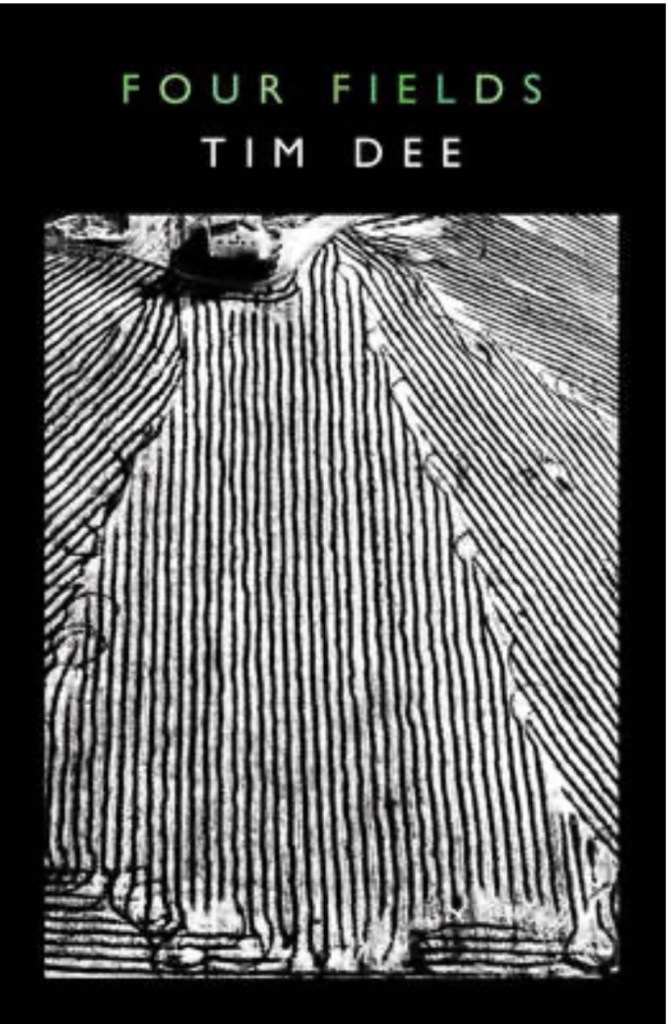
I picked up a book in a second bookshop that had an interesting cover. Then I read a random few sentences and thought … mmhh, this looks interesting.

It’s a book called Four Fields, by Tim Dee.

The writing is beautiful, and I really wanted to write a song after reading the first two chapters.

I’ve tried to stay somewhat within the sense of what he was saying- I hope I haven’t strayed too far.

Here’s what I came up with – and apologies to Tim Dee – I have used a load of the images that he used because they were so captivating. I hope that’s OK ?

I have a tune that I hope evokes something of the feel I’m going for. I’ll try and record that sometime.

I’m calling it ‘Elegy for the Fen.’

Field and fen, stream and river,
this is our life
Sun and seasons, clouds and rain,
water the earth

Generations have walked this land,
mown, mapped and known
Creation – will have our say –
we can’t be owned

Sound of the grass; ground shining green

We will show you how to live
with the grain
Whispers of Eden, guide you now
lead us home

We’ve been worked by other men,
‘til we were dry
But over and over and again,
we’re saved by the leaking sky

Sound of the grass; ground shining green

We have been orphaned from the land,
find the future in the past.

Sound of the grass; ground shining green

P.S. From the Hebrew Scriptures in the book of Job:

Crooks reside safely in high-security houses, insolent blasphemers live in luxury; they’ve bought and paid for a god who’ll protect them.
“But ask the animals what they think — let them teach you; let the birds tell you what’s going on.

Put your ear to the earth — learn the basics. Listen — the fish in the ocean will tell you their stories.

Isn’t it clear that they all know and agree that God is sovereign, that he holds all things in his hand — Every living soul, yes,every breathing creature?

Activism · Political · World Affairs

This Is Something I Regret

So I have been thinking deeply about the forthcoming General Election. I live in a constituency (Gloucester) that has had a Conservative MP for some years- you have to go back to the early 2000’s to see a different colour.

But it is one of the seats that Labour might hope to win this time round (2024).

My question is … if I want to see a more progressive government, who will put the needs of the poorest first, and prioritise our The Climate Catastrophe, The NHS, Schools, Social Care and the Justice System (among others!) … how shall I vote ?

Possible answers … v

1. Vote with my heart and vote Green. Normally that might be seen as a wasted vote in our ‘First Past The Post’ system. But this time the Labour Party are likely to make the new government, so it might not matter what happens to Gloucester … so why not vote Green as the Tories are almost certainly out.

2. Vote Labour on the basis that you never know what will happen in an election, so play it safe.

3. Spoil the ballot paper – the whole system is rigged. So this is one way I can register a protest.

4..Don’t vote – for similar reasons, my Green vote won’t count anyway so why bother

We have a postal vote, and the papers arrived last week. At that point in time, I had decided on option 2, so I filled in the ballot paper and popped it in the post on Friday.

I was too hasty, on reflection. I think I should have gone with my heart. Much as I want to see the Conservative Party out of power, I actually don’t think it will be that different with Labour.

I’ve been reading a book by Ian Dunt – ‘How Westminster Works, And Why It Doesn’t.’ If even a fraction of it is a true reflection of our system of government, then we’re stuffed unless something radical happens.

By that I mean the first step being a reform of the electoral system to some version of PR.

Interestingly, this subject took up a fair bit of time on Radio 4 ‘Any Questions’ and ‘Any Answers’ programme. (But bearing in mind that only about 1 in 7 of people over 15 years of age listen to at least 15 minutes of Radio 4 in a week – (quite a low bar).

Added to that, as a supporter of Palestinian statehood, and incensed by the media coverage of the conflict in Gaza, I am discovering how deep a connection there is between the Labour Party and Israeli interests. That’s seriously worrying. See here

I wish I could take my vote back. No political party is perfect of course, but I believe that the Greens have it more right than the others.

Let me know what you think …

Activism · Persecution · Political · suffering · World Affairs

Every Day Is Nakba Day

Today is May 15th, the day when Palestinians mark the forced removal of Palestinians from their homes in 1948 to make room for the Jews coming from Europe to settle in Palestine. The name Nakba means catastrophe or disaster. Nakba Day is generally commemorated on 15 May, the day after the date in the Gregorian calendar of Israel’s Independence in 1948.

This poem is part of a collection of poems ‘Things you may find hidden in my ear,’ by Mosab Abu Toha, a poet from Gaza.

The poem looks back at the Nakba, which is a daily reality for the Palestinian people. It is being reenacted now in the West Bank as Israeli settlers take over Palestinian land, and in the horrendous war in Gaza, as many people are fleeing to a place of safety, probably never to return to Gaza. Once more a catastrophe is occurring, as history is repeated. May God have mercy on us.

My Grandfather Was A Terrorist

My grandfather was a terrorist—
He tended to his field,
watered the roses in the courtyard,
smoked cigarettes with grandmother
on the yellow beach, lying there
like a prayer rug.

My grandfather was a terrorist—
He picked oranges and lemons,
went fishing with brothers until noon,
sang a comforting song en route
to the farrier’s with his piebald horse.

My grandfather was a terrorist—
He made a cup of tea with milk,
sat on his verdant land,
as soft as silk.

My grandfather was a terrorist—
He departed his house,
leaving it for the coming guests,
left some water on the table, his best,
lest the guests die of thirst after their conquest.

My grandfather was a terrorist—
He walked to the closest safe town,
empty as the sullen sky.
vacant as a deserted tent,
dark as a starless night.

My grandfather was a terrorist—
My grandfather was a man,
a breadwinner for ten,
whose luxury was to have a tent,
with a blue UN flag set on the rusting pole,
on the beach next to a cemetery.

By Mosab Abu Toha

Creativity, · Songwriting

Trying To Write A Song

So … I’m trying to write something – a song.

I had a few instrumental ideas on the guitar that I took to the monthly song writing circle I attend. It was three tunes really, that could have worked together, with a slow section, followed by a fast section, then back to a different slow bit.

They liked it, and suggested a pastoral feel for the lyrics – think summer, sitting by a river, meadows and wild flowers.

It’s still around, unfinished. I tried some lyrics on it earlier this week.

I’d had an idea that was sparked off by listening to Ched Myers talk about the way that where he live – in Northern California, the river is dry because of water being taken off further upstream for communities or industry.

The same happens in the Palestinian Territories in the Jordan Valley, with the culprit being Israel’s industry.

It’s an idea with a more general meaning … that where there is disadvantage, or poverty, it’s probably because someone else has got to all the resources, leaving little for others.

Disadvantage = downstream.

So, the idea was to pick up on the suggestions made by my friends at the songwriting circle, but give it a twist. So use the image of the river, but think about stuff that’s done upstream that makes life hard for the people who live ‘downstream’

Moonlight on the water
Blue lights in the town (On the road / street ?)
Sun’s coming up in an hour or so (or two ?)
…???

It’s about something dark that’s happened that has called about the blue lights of the emergency services.

Anyway … today, I’ve moved on. Forget about trying fit lyrics to the tune that I have for now. Just keep thinking about the upstream / downstream idea, and get some lyrics.

The other thing to add into the mix is something I heard on an interview with the Musician/Producer T Bone Burnett. He made the observation that the word that occurs most in popular music is ‘you.’
’She loves you,’ ‘I wanna hold your hand,’ etc.

The singer is addressing the listener, drawing them in to the song.
Peter Case does this with his song ‘Have you ever been in trouble,’ and adds to it by making it a question.

So, that’s another thing I’d like to get into this song – address the listener, and maybe with a question.

Hopefully I’ll be back later … bye for now.


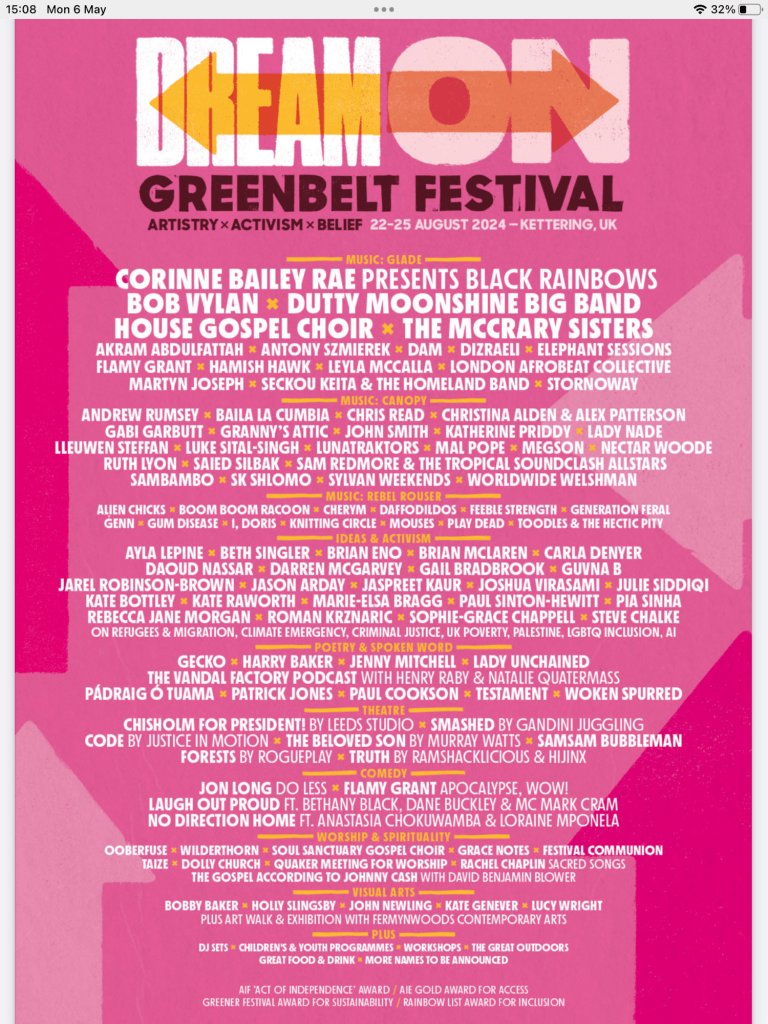
Activism · faith · Greenbelt Festival,

What I Love About Greenbelt

So this was on fb yesterday …on the ‘Unofficial Greenbelt Festival’ group …

Had a lunch at church today, ended up sharing a table with folks discussing the greenbelt line up plus folks who never heard of the festival. “It’s a Christian festival but the sort that would book bob vylan as headliner ” seemed not bad intro , vylan, corrine Bailey rae and flamy grant felt like a fair introduction. Go one you’ve got 2 sentences max and can drop up to 5 names ; how do you describe the festival?

In amongst the other responses I thought this summed up a fair bit of how I feel …

No names to drop –
No shame in that;
And up itself,
Well, just a bit,
And white and middle class
Well yes, but less
I hope, and
Right on left
Well I don’t mind that either.

We’ll go again,
And hope to feel
At home a bit,
and not a bit
Enough to keep us moving
Forward in the
Right direction
With music, faith
And all that social action
Please.

Creativity, · Film · music · Political · Songwriting

Peter Case And A Piano

I was listening to a recent album – Doctor Moan – by one of my musical heroes, Peter Case. It’s great, as always, but unusual in that a lot of the songs are piano based, rather than guitar.

It led me to sit down at the piano, and just mess around with some chord changes, and pretty soon I had a song.

I wrote the song back in January and started this blog post then, but didn’t get it finished. So I’m using some time I have now to finish off some of the things I was working on.

The first line – ‘There are so many stories that should never be told’ – came from something I heard, or read somewhere. I must get into the habit of making a note of where these initial ideas come from …

But that first line got me thinking about the horror of the situation in Gaza, and most of the rest of the words just came in a stream as I was out walking one day in January.

I also had remembered (and noted!) some words from the film ‘The Magnificent Seven.’ The quote that I took from the film comes right at the end of the film, after the seven have helped to rid the village of Calvera and his men.

Only the farmers have won. They remain forever. They are like the land itself. You helped rid them of Calvera the way a strong wind helps rid them of locusts. You are like the wind, blowing across the land and… passing on. Vaya con Dios.”

The Reaper (Working title)

There are so many stories that should never be told
Of lives that were broken, that never got old.
Their choices were cut down
They’re buried or they’re burned

Swarming all over the land
Stripping the fields of grain
And everything you see that grows,
All that grows

For now the Reaper has won
The earth receives her own
Watered by the tears that flow,
The tears that flow

And only the strongest wind
Helps them be rid of the curse
They are like the wind that blows,
The wind that blows

And the graveyards are filled with the people so bold
The women and men and the children now cold (repeat x4)

And I do believe in the milk of human kindness,
But sometimes it seems to run dry
I do believe that there must be hope somewhere
And I will keep looking for the signs

Is it true that one small light
Is all the light we need
To banish all the dark away, the dark away ?

© Jonathan Evans. January 2024

Activism · community · World Affairs

I’m Reading The Argos Catalogue

When our children were little, one of the things they loved to do was to browse through the Argos catalogue. (Argos is a UK store that sells a whole variety of stuff from toys to electronics to household goods.)

Back in the dim and distant past, (The late 60’s), there was another catalogue, called the. Whole Earth Catalog – an actual physical catalogue produced by the counter culture in the USA. It was a mix of essays and product reviews, designed to connect those who wanted to bring about change and work for a more fair and equal society, and give them the tools for that work.

It was referred to by Steve Jobs as a kind of ‘Google in paper form’ that existed before the internet.

In fact it was the direct precursor to the World Wide Web.
The purpose of the internet in the mind of those who built on the aims of The Whole Earth Catalog was that it gave access to information to all, and a forum for the exchange of ideas, for the betterment of humanity.

You can hear more about it in the recent BBC series ‘Gatekeepers

We now know what those originators of the www. did not know. That the internet would give rise to stalking, fake news, exploitation, misinformation, cyber crime, and a host of other unintended consequences, as well as many positive dimensions.

Like every new development, it has the potential for good, and for ill. We’re now facing the same situation with AI, but we are already so far into the age of AI that we probably won’t be able to guard against the negative effects of that technology.

So what ?

I’m not telling you much that you didn’t already know, so what’s my point ?

It’s the age old question of how to respond to culture – withdraw, assimilate, confront or engage ?

I guess the answer is for me to engage, always. I’ve been tempted recently to withdraw – to disengage with social media etc – but I’m still here.

Admittedly some things have gone. The twitter and instagram accounts that I almost never used are no longer. (I hope they do get deleted)
Facebook remains for me a helpful way of accessing information, but not especially as a forum for debate.

This platform is mainly for me to get my thoughts in order, and try to make sense of what’s going on, and I welcome comments.

But the direction I’d like to travel is to do with getting smaller – trying to find ways to engage with people face to face, where there is the possibility of fostering relationship and dialogue.

That’s all for now. Blessings on you.